Category Archives: Yemen

Music in the World of Islam

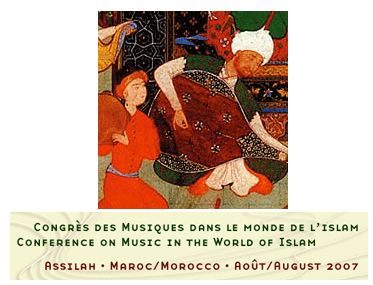
A year ago from August 8-13 an international conference on “Music in the World of Islam” was held in Assilah, Morocco, jointly sponsored by The Assilah Forum Foundation (Assilah, Morocco) and the Maison des Cultures du Monde (Paris, France). The papers from this conference are now available in pdf format online. Music and dance are described for Afghanistan, Algeria, Andalusia, Azerbeijan, Bangladesh, Bosnia, Central Asia, East Africa, Egypt, Ethiopia, India, Indonesia, Iran, Iraq, Kurdistan, Kuwait, Liberia, Malaysia, Morocco, Russia, Syria, Tajikistan, Turkey and Yemen.

A description of the conference is described by its main organizer, Pierre Bois: Continue reading Music in the World of Islam

Flowers and Virtue

[The following commentary discusses a recent attempt in Yemen to create religious police, such as are found in Iran, as an intrusion on Yemeni values and rights in the modern state.]

The paradox of “Mashaqir” and the religious police

Dr. Mohammed Al-Qadhi, Yemen Times

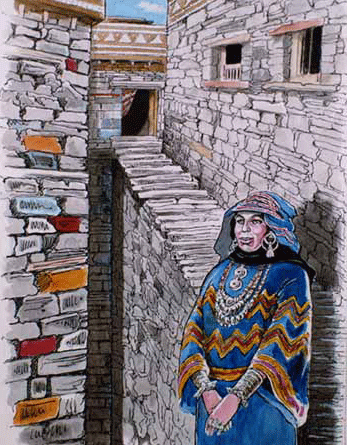
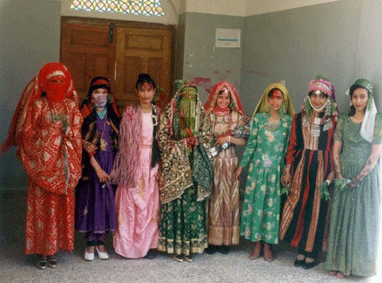
I think the best response to the establishment of a religious police force, under the banner of promoting virtue and curbing vice, is the mashaqir (traditional flowers women put on either side of their head) function run by the House of Folklore. I was extremely thrilled with spiritual joy with the function that revived in everybody nostalgia for a simple and pure life for both men and women free from extremism and fanaticism. The mashqour, a singular form of mashaqir, is a symbol of chastity and freedom women enjoyed in an ordinary rustic life. It also stands for an abused femininity now by a puritanical interpretation of life where everything is devilish and hellish and a male-dominated and masculine culture that considers women inferior to men.

See the paradox between a group of fundamentalist clerics that want to kill life and a function organized by Arwa Othman, director of House of Folklore, that wants to revive and breathe life into the society and women through restoring the culture of the mashaqir. Continue reading Flowers and Virtue

Dinosaurs in Yemen


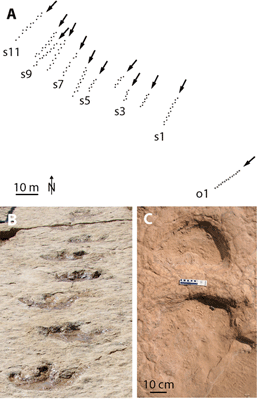
(A)-Map of tracksite with ornithopod (trackway o1) and sauropod (trackways s1–s11) trackways, (B)-Trackway of the ornithopod (trackway o1: steps 3–10), and (C)-Sauropod left manus and pes print (trackway s6: step 12).

Scientists have discovered the first dinosaur tracks on the Arabian Peninsula. In the May 21 issue of the journal PLoS ONE, they report evidence of a large ornithopod dinosaur, as well as a herd of 11 sauropods walking along a Mesozoic coastal mudflat in what is now the Republic of Yemen. “No dinosaur trackways had been found in this area previously. It’s really a blank spot on the map,” said Anne Schulp of the Maastricht Museum of Natural History in The Netherlands. He conducted the study with Ohio University paleontologist Nancy Stevens and Mohammed Al-Wosabi of Sana’a University in Yemen.

The finding also is an excellent example of dinosaur herding behavior, the researchers report. The site preserved footprints of 11 small and large sauropods — long-necked, herbivorous dinosaurs that lived in the Jurassic and Cretaceous periods — traveling together at the same speed. Continue reading Dinosaurs in Yemen

FGM, Early Marriage and Juvenile Delinquents

MPS say: no to genital mutilation, 18 is minimum marriage age, juveniles cannot be punished as adults

By: Kawkab Al-Thaibani For the Yemen Times

SANA’A, June 24 — A two-day workshop in Parliament concluded that the minimum marriage age in Yemen should be 18, and the sponsors of both brides and grooms should be punished if they allow them to marry under this age.

The workshop’s participants also concluded that juvenile delinquents between the ages of 15 and 18 are not equal to adult criminals. They further recommended laws banning female genital mutilation.

The workshop covered three main areas: the criminality of juveniles, female genital mutilation, and the minimum age of marriage. These three subjects were chosen because the existing laws concerning them are not specific enough and are often ignored.

This workshop was arranged by Parliament, the Higher Council for Motherhood and Childhood, and the Yemeni Network Combating Violence Against Women known as SHIMA, under the sponsorship of the UN Children’s Fund (UNICEF), OXFAM International, and Save the Children, a worldwide children’s rights organization. Attendees included members of the Sharia Committee, who matches the constitutional laws with Islamic sharia law, Parliament members (MPs), doctors and human rights activists. Continue reading FGM, Early Marriage and Juvenile Delinquents

Dancing with Snakes

For Yemen’s Leader, a Balancing Act Gets Harder

By ROBERT F. WORTH, The New York Times, Saturday, June 21, 2008.
SANA, Yemen

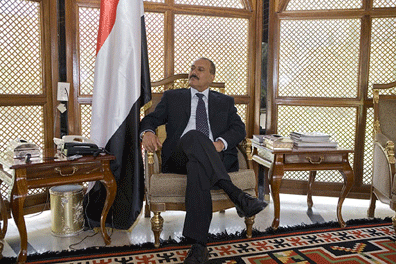
PRESIDENT Ali Abdullah Saleh’s face is everywhere in Yemen. He stares out from billboards, shop windows and living room walls, always with the same proud expression: eyes glinting, chest thrust out as if to confront a challenger. After 30 years in power, Mr. Saleh has become almost synonymous with the state in this arid, desperately poor corner of southern Arabia.

But lately the president, 66, known for his wicked sense of humor, has been uncharacteristically dour. A war with northern Shiite rebels has spread to the outskirts of the capital. Terrorist attacks have led embassies and foreign companies to evacuate their employees. With an insurrection rising in the south as well, the turmoil has renewed fears that this conservative Muslim country of 23 million, a longtime haven for jihadists, could collapse into another Afghanistan.

Mr. Saleh, his gruff voice tinged with anger, dismissed the rebels as “racists” who want to return to Yemen’s ancient system of religious rule. They have won popular support by associating his government with the United States, he said during an hourlong interview inside the sprawling, high-walled presidential palace compound. Continue reading Dancing with Snakes

Hip hop subculture gets spotlight in Sana’a


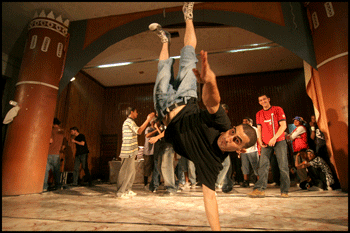
One of the competing breakdancers, Khaled Sinjab, performs complicated dance
moves for his crew “Blast Boyz.”

By Fares Anam, Yemen Observer, Apr 26, 2008

An enthralling show performed by Arab youth was held Wednesday night at the Yemeni Center for Studies and Research. Enlivened by hip hop music, these students studying in Yemen competed to be recognized as the best dancers and singers in Sana’a.

The hip hop festival, titled “Common Ground,” brought this unique American art form together with Arab youth by offering music and dance to the capital. The hip hop party was organized by the French Culture Center in cooperation with the German House, under the control of the Arbitration Commission. The event was supervised by French dancers Romo, Gohen and Fred Burki, in addition to DJ Malik and the Yemeni-American singer, Haggagi. Continue reading Hip hop subculture gets spotlight in Sana’a

All in the name of War on Terror

by Fahad Faruqui, Yemen Times

Detainee number 063, Mohamed Al-Kahtani, was one of the many hundreds housed in the Guantanamo (known as “Gitmo”) Bay detention camps who was subjected to 20 hours of interrogation on only four hours of sleep.

The Haynes memo, which approved controversial and harmful interrogation techniques, was signed by Donald Rumsfeld, the former United States Secretary of Defense, in early December of 2002. Entitled, “Counter-Resistance Techniques,” this was the memo that opened the door for partial drowning (called water boarding), along with humiliation, mental destabilization and other illegal methods of obtaining information from detainees.

Al-Kahtani, a citizen of Saudi Arabia, is the alleged 20th hijacker, but the U.S. Military Commissions dropped key 9/11 suspect charges against him on May 11 this year. Continue reading All in the name of War on Terror

Puzzles and Precious Particularities of Yemen


Hamlet of Mais in central Yemen; entrance is carved through the large rock.
Photograph by Daniel Martin Varisco

By: Khaled Fattah, Yemen Times

Outside observers of Yemen’s social and political life can not avoid noticing many conceptual puzzles and precious particularities. One of the widely known puzzles among researchers with political science background is the surprising fact that although Yemen is the least developed and weakest Arab state that governs a society characterized by fierce tribal traditions and structures, it’s a country with a party pluralism system. Precious particularities of Yemen, on the other hand, are numerous. To begin with, there is a coincidence of almost everything- from geographical and topographical destiny to the patterns of habitation and concentration of sects; and from the shades of experienced ideologies and insecurity of economic resources to the peculiar nature of colonialism and regional power interventions. This sharp multifaceted coincidence is not something of the past. Rather, it is being felt in every bone in the political, economic and socio-cultural skeletons of today’s fragile Yemen. Continue reading Puzzles and Precious Particularities of Yemen