Category Archives: Yemen

Jews of Yemen prefer to stay


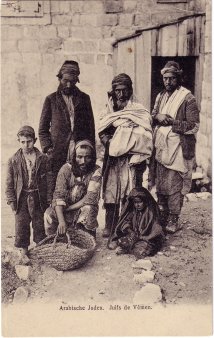
Group of Yemenite Jews, postcard c. 1910

by Salma Ismail, The Yemen Times, June 28

SANA’A, June 28 The death sentence passed on Abdulaziz Al-Abdi, charged with killing Yemeni Jewish and father of nine Masha Al-Nahari last December, heeds mixed reactions among the Jewish community in Yemen.

Despite growing US and Israeli pressure to bring them out of Yemen and settle them in other destinations, the majority of Yemen’s Jews prefer to stay in their ancestral homeland, as long as the government ensures their safety.

Last Sunday’s ruling overturned a previous March sentence that deemed the defendant, a retired pilot in the Yemeni air force, “mentally unstable” and ordered him to pay a “blood fine” of YR 50.5 million, about USD 25,000. Continue reading Jews of Yemen prefer to stay

Unblocking the Blockers

Introducing, “The Circumventer”

By ALEXANDRA SANDELS, Menassat, May 20, 2009

At a Kamal Adham Journalism Institute “Blogging for the Future” conference in Cairo, the Al-Kasir made its first public appearance.

A tool that allows Internet users to access blocked websites, developer Walid Al-Saqaf, a Sweden-based Yemeni, is using the device to respond to government web censorship.

“I realized that the authorities are getting so sophisticated that they need a similarly sophisticated response that could match up to their level that would limit their control over what users can access from within their countries,” he said.

The tool also performs periodic checks on censored sites to track whether they remain constantly blocked or if the filtering is lifted at times. Meanwhile, users of the program can report information about filtering and blocking in their respective countries. The data gets stored in a centralized unit in the software.

Al-Saqaf, who also launched Yemen’s first independent news search engine a few years ago, has been a target of Yemeni government censorship. In the spring of 2008, the five different domains of Yemenportal were shut down, making the site inaccessible in Yemen, except through the use of proxy sites. Continue reading Unblocking the Blockers

Flipping through Yemen a Millennium Ago


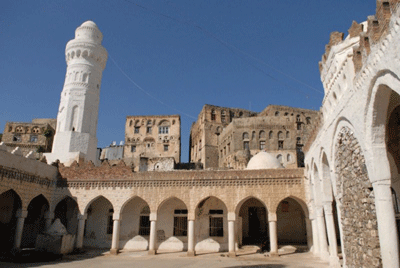
Mosque in Jiblah, Yemen

There was a time when books were hard to come by. Either they cost too much or were inaccessible in a private or exclusive university library. Whatever else the world wide web has done (and that is a mouthful), it now functions as an archive. More and more, the rare and out-of-print books I used to be forced to read in a library reading room are becoming available online. Mr. Gutenberg might roll over in his Grab at the very thought of a pdf file, but print has taken a new and universal turn. I especially enjoy the “flipbook”, which simulates turning the pages of images of the original. For an enjoyable read on the early history of Yemen, there is the flipbook version of Henry Cassels Kay’s translation called YAMAN, ITS EARLY MEDIAEVAL HISTORY, published in London in 1892. This has excerpts (not always trustworthy in their translation) from Umarah ibn Ali al-Hakami (1120/21-1174), Ibn Khaldun (1332-1406); Muhammad ibn Yaqub al-Janadi (d. 1332?).

The sad thing is that well over a century ago, Kay lamented that there was virtually nothing available on the history of Yemen, which had become of strategic interest to the British empire. Continue reading Flipping through Yemen a Millennium Ago

Tarim, Islamic cultural capital for 2010


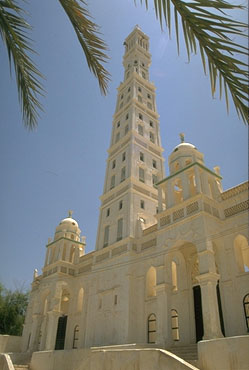
Al-Midhar mosque, Tarim, Hadramawt, Yemen

by Abdulaziz Oudhah, Yemen Observer, May 7, 2009

The Islamic Educational Scientific and Cultural Organization (ISESCO) chose Tarim as an Islamic cultural Capital for 2010, after an agreement was reached during a meeting of Islamic Cultural Ministers in Algiers in 2004. A number of Islamic, Arab, Asian, and African towns were nominated in the process to choose three towns each year to be recognized as Islamic culture capitals.

ISESCO General Manger Abdulaziz al-Tawijri, said that the Islamic capitals program aims to promote the spread of Islamic culture, renew its content, perpetuate its message, and revive the cities’ glorious culture and civilization. The capitals are chosen according to specific standards, which consider the role that they have played in serving Islamic culture, art, science, and knowledge throughout their history. The legacy of these cultural capitals is important to the construction of present and future memory, which is inspired by Islamic civilization. Continue reading Tarim, Islamic cultural capital for 2010

The Walled City of Sanaa

The Walled City of Sanaa
by Ronald Lewcock

[Note: This is an excerpt from Ronald Lewcock;s 1986 UNESCO book. The book is available online in its entirety in pdf format at http://www.worditude.com/ebooks/unescopdf/sana_eng.pdf.]

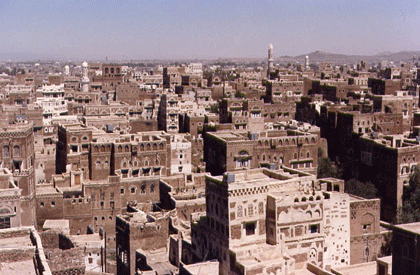
Viewing the old walled city of San‘a for the first time creates an unforgettable impression. And this vision of a childhood dream world of fantasy castles is not dispelled even on closer acquaintance. In the farmlands outside the city, on either side of the roads leading to it, buildings of all shapes – circular, rectangular, square – rise out of the flat highland plain to seemingly impossible heights constructed of apparently weak materials. Not merely does the stonework of the lower levels consist of rough rubble with loose mortar, but for most of their height the buildings are made of mud – layered mud, mud bricks of all sizes – and of mud-straw plaster, infinitely eroded by the monsoon rains until deep indentations mark the channels down which the autumnal torrents find their passage to the earth. Continue reading The Walled City of Sanaa

Yemen’s Alabaster Windows

Moonglow from Underground

Alabaster, one of the rarest and most ancient of lighting materials, has now been reinterpreted in a contemporary idiom.

Used to illuminate Arabian palaces and tower-houses since 2,000 years ago, the subtle glow of alabaster – ‘moonlight stone’ – has been brought to light again by Abdulwahhab al-Sayrafi, master alabaster craftsman. His unique, hand-made range of alabaster windows, lamps and candleholders are perfect for today’s architecture and today’s interiors. Continue reading Yemen’s Alabaster Windows

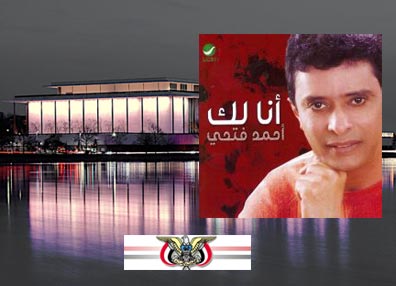
Ahmad Fathi in Washington, DC

The renowned Yemeni singer, composer and oud player, Ahmad Fathi (أحمد فتحي), is coming to Washington and will be performing this Friday at 6 pm at The John F. Kennedy Center for the Performing Arts. The event is free, sponsored by the Yemen Embassy. Fathi is well-known in the Arab world, but less so here in the United States. He has several albums, and his work is readily seen on Youtube (for example http://www.youtube.com/watch?v=mFBdbVnRvbU&feature=related).

Fathi was influenced early on with traditional Yemeni music. He joined the musical institute of Cairo in the late 70’s and earned a diploma in harmonic music with a focus on the lute (oud) instrument. He enriched the Yemeni artistic movement with his distinguished creativity and his brilliance in playing the lute. Fathi obtained an MA with honors from the Cairo higher musical institute December, 1998 for his thesis on the “lute (Oud) and its role in Yemeni songs.”

The Yemeni Culture affairs Ministry decorated Fathi the “Arts Medal” for his role in promoting traditional Yemeni music globally. In 2008, The Arab Creative Association honored composer and singer Ahmed Fathi for his contribution to Arabic Music. Fathi was named an Ambassador of Yemeni Music. Yemeni and Arab fans have enjoyed two decades of modern and classic songs composed by Fathi.

Blood money for Killing Yemeni Jew


Yemeni Jews: source: Yemen Observer

by Nasser Arrabyee, Yemen Observer, March 3, 2009

A Yemeni primary court in Amran, north of the country, ruled on Monday a payment to be made of 5.5 million YR (US$ 27,500) in blood money for the murder of a Jewish man by Yemeni, Abdul Azeez al-Abdi, last December.

The court, chaired by Judge Abdul Bari Aqaba, also ordered that the convict should be placed in a psychotic sanatorium. The father of the Jew refused the sentence and asked for an appeal to be made to demand the death penalty against the convict.

“As long as there is no justice for us, then (they should) deport us to Israel, it’s better for us.” Continue reading Blood money for Killing Yemeni Jew