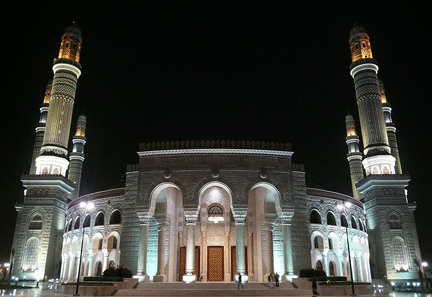
President’s new mosque in Sanaa, Yemen; photo by Arnaud Rat.
There is a short two-minute video taken recently by George Lewis in Sanaa, looking from the old city to the new mosque built by the president. To access this, click here.
President’s new mosque in Sanaa, Yemen; photo by Arnaud Rat.
There is a short two-minute video taken recently by George Lewis in Sanaa, looking from the old city to the new mosque built by the president. To access this, click here.
An Attempt to Unravel Some of the Confusion
Surrounding Yemen Cancels, Post Office
by Bruce Conde, Linn’s Stamp News, 16 July 1956
In 1926, His Majesty the Imam Yahia, king of the usually closed and forbidden mountain land of Yemen in southwestern Arabia, inaugurated a royal postal service for the first time, without benefit of outside postal advice and completely unaware of the fact that there was anything in the world called philately. Only eight years before, Yemen was still partly occupied by Ottoman troops, whose forerunner postal service (Hodeida, Taiz and Sana’a cancels on regular Turkish stamps for indifferent and irregular mail to Turkey, mostly by the military) had not been available to the population at large.
Two basic stamps, a “1/2 of 1/8 imadi” (5c U.S.), and “1/8 imadi” (10c US), corresponding to small pentagonal silver coins of the realm (40 bogash—1 imadi—80c U.S.) were produced locally by locking 20 individual cliches together in a single frame for each master sheet.
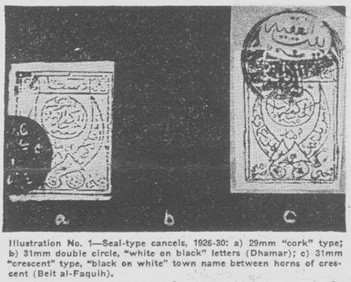
(Seal-type cancels)
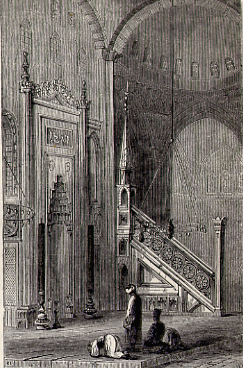
19th century Cairo mosque illustration from Henry Van-Lennep’s Bible Customs.
Those of us who spend hours using Arabic lexicons would be at a loss without the massive Tâj al-‘Arûs min jawâhir al-qâmûs of Muhammad Murtadâ al-Zabîdî. Completed by this consummate Muslim scholar in 1188/1774 after fourteen years of diligent research, the recent Kuwait edition comprises 40 volumes. Ironically, what took al-Zabîdî fourteen years to write and dictate seems a rapid turn-around, given that the Kuwait edition began in 1960 and was not completed until 2002 [There is a copy available for only £2,463 from Abe Books…, but I suggest you go to Lebanon, where the 40 volume set is only $325 from Fadak Books I am not aware of any online version of Tâj, although Lisân al-‘Arab is available online in searchable format.] Those of us who could never afford to house the 40 volume edition have managed to get by with reprints of the 19th century Cairo edition, funky font presence that it sheds. I remember buying my copy of the thick black-cover volumes in 1981, filling a suitcase with the hefty weight, paying the porter a handsome bakshish for his back-breaking effort at Cairo airport, and then having the suitcase implode from the weight as I crossed the threshhold of my home back in New York. I like to think that my own account would have made its way into al-Zabîdî’s inquisitive notes. Continue reading Bringing al-Zabîdî to Light and to Life

by Gregory D Johnsen, The National, November 12, 2009
Last week, the sporadic five-year long war between the Yemeni government and Houthi fighters in the country’s north finally spilled over the border into Saudi Arabia. The conflict has been steadily escalating since the Yemeni government resumed fighting in August after more than a year of fragile calm. Leaving no doubt as to its intentions, the government calls the present campaign “Operation Scorched Earthâ€: the fighting has already produced thousands of internal refugees and spread outward from the northern governorate of Sadaa, where the Houthi rebels are based.
Like much of the conflict, the clashes that began on November 4 are clouded by conflicting and contradictory reports. The Houthis claim that they were responding to repeated strikes by the Yemeni military, which was using Saudi territory as a rear base to launch flanking manoeuvres into Sadaa. Saudi Arabia contends that it was responding to incursions by the Yemeni rebels, and both sides insist that the other fired the first shots.
But whatever the sequence of events, the skirmishes mark a major escalation in the messy and murky guerrilla war that has only become more intense – and drawn in an increasing number of players – since its start in 2004. The Saudis deployed troops to their southern border, where they launched air and ground assaults on pockets of Houthi fighters, purportedly to drive them back into Yemen. The intervention was meant to be a limited one – and the Saudis claim they only attacked positions on their side of the border – but it is doubtful, having joined the fray, that they will be able to extricate themselves easily. Continue reading The Sixth War
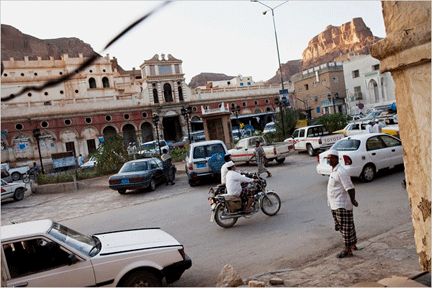
Tarim, a remote desert valley in Yemen with towering bluffs and ancient mud-brick houses, is probably best known to outsiders as the birthplace of Osama bin Laden’s father. Photo: Bryan Denton
Tarim Journal
Crossroads of Islam, Past and Present
By ROBERT F. WORTH, The New York Times, October 15, 2009
TARIM, Yemen — This remote desert valley, with its towering bluffs and ancient mud-brick houses, is probably best known to outsiders as the birthplace of Osama bin Laden’s father. Most accounts about Yemen in the Western news media refer ominously to it as “the ancestral homeland†of the leader of Al Qaeda, as though his murderous ideology had somehow been shaped here.
But in fact, Tarim and its environs are a historic center of Sufism, a mystical strand within Islam. The local religious school, Dar al-Mustafa, is a multicultural place full of students from Indonesia and California who stroll around its tiny campus wearing white skullcaps and colorful shawls.
“The reality is that Osama bin Laden has never been to Yemen,†said Habib Omar, the revered director of Dar al-Mustafa, as he sat on the floor in his home eating dinner with a group of students. “His thinking has nothing to do with this place.â€
Lately, Al Qaeda has found a new sanctuary here and carried out a number of attacks. But the group’s inspiration, Mr. Omar said, did not originate here. Most of the group’s adherents have lived in Saudi Arabia — as has Mr. bin Laden — and it was there, or in Afghanistan or Pakistan, that they adopted a jihadist mind-set. Continue reading Tarim Journal
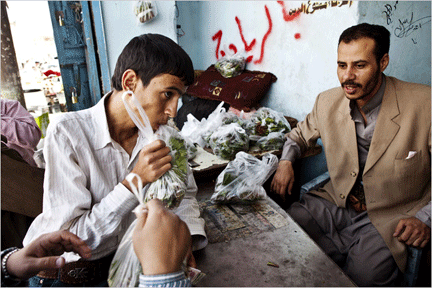
Selling qât in Sanaa, Yemen’s capital. Photo: Bryan Denton
These days if you run across an article on Yemen, it will no doubt feature a scenario of gun-toting tribesmen swearing allegiance to Al-Qaeda, the latest German tourist hijackings or feigned shock at the terrible, terrible addictive drug called qât. At least this was the case in Sunday’s New York Times in another piece of mixed journalistic pablum by roving reporter Robert Worth. Entitling the article “Thirsty Plant Dries Out Yemen,”, the author seems unaware that the site of his posting (Jahiliya) is in fact the Arabic term for the time of “Ignorance” before the rise of Islam. I doubt this reporter stepped out of a Queen-of-Sheba-era time machine and interviewed Abraha about his recent defeat at the “Battle of the Elephant” before Mecca. So where exactly is the fabled posting site of Jahiliya? Ironically, it is part of a World Bank irrigation project. I will leave the irony about IMF money being poured into Jahiliya in the strict sense to the imagination of the reader. And I strongly suspect the posting was made from a fancy hotel in the capital Sanaa and not from a rural internet cafe, while sipping qishr. But for a front page article on a major newspaper, ignorance is no excuse. Continue reading Ignorance is no Excuse

The most important historical port on Yemen’s Red Sea coast is no doubt the old port of Mocha, which gained fame in the West for its association with the Yemen coffee trade. In a new book, The Merchant Houses of Mocha: Trade and Architecture in an Indian Ocean Port, Nancy Um provides a fascinating social history of the trade through this seaport during the Ottoman period. Here is how the book is described on the publisher’s website.
Gaining prominence as a seaport under the Ottomans in the mid-1500s, the city of Mocha on the Red Sea coast of Yemen pulsed with maritime commerce. Its very name became synonymous with Yemen’s most important revenue-producing crop – coffee. After the imams of the Qasimi dynasty ousted the Ottomans in 1635, Mocha’s trade turned eastward toward the Indian Ocean and coastal India. Merchants and shipowners from Asian, African, and European shores flocked to the city to trade in Arabian coffee and aromatics, Indian textiles, Asian spices, and silver from the New World. Continue reading The Merchant Houses of Mocha
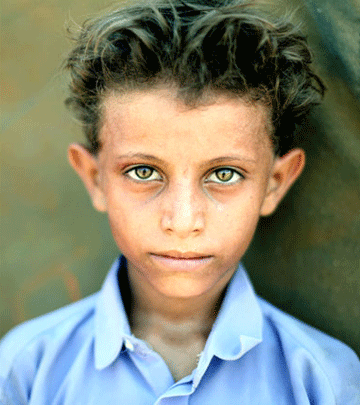
A boy who fled fighting between militants and government forces in a refugee camp near the town of Hadja, north west Yemen. Photo by David Bebber, The Times
Photographer David Bebber has produced a superb slide show in The Times on Yemenis, especially children, displaced by recent fighting in the north of Yemen between government forces and the al-Huthi rebels. To see a slide show of the 19 images, click here.
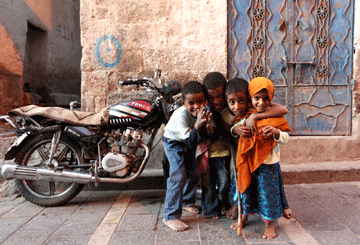
Photo by David Bebber, The Times