Category Archives: Yemen

Reforming the Arab League

Yemen proposal to reform Arab League
SABA, Yemen News Agency, February 6, 2010

CAIRO. Feb. 06 (Saba) – Yemen has put forward a proposal for the establishment of an Arab Union as a replacement for the Arab League that would be discussed by Arab Foreign Ministers in an early March meeting as a prelude to sending it to the Arab Leaders’ Summit in late March.

The proposal was drafted in an initiative form to reform the Arab League.

In the initiative, Yemen suggested a draft constitution for the union that should contain 37 articles based on principles such as respecting sovereignty and regional borders of countries, respecting the unity of a member state’s national soil, the right of a country to choose its ruling system, dis-recognizing taking office through
force, and establishing an Arab security system to protect the member states and contribute to boosting international peace and security, the Egyptian Al-Shorouk newspaper quoted an official at the Arab League as saying. Continue reading Reforming the Arab League

Greg Johnsen on al-Qaeda in Yemen

Welcome to Qaedastan
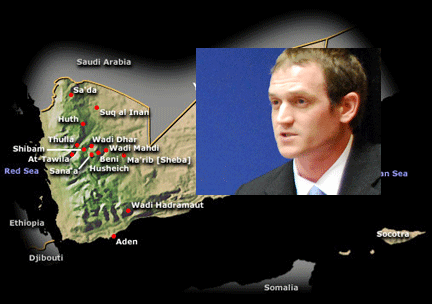
by Gregory D. Johnsen, , Foreign Policy, January/February, 2010

In 2010, Yemen will celebrate the 20th anniversary of national unification. But it won’t be much of a party: This could well be the year Yemen comes apart.

Even the brutal 1994 civil war failed to threaten the structural integrity of this country chronically teetering on the verge of disintegration as much as the current crises, all of which may be coming to a head in 2010.

Yemen has so many dire problems that it’s easy to be overwhelmed. Al Qaeda is growing in prominence, a Shiite rebellion is expanding in the north, and the threat of secession is renewed in the south. There’s a brewing fight over what comes after President Ali Abdullah Saleh, age 67, who has ruled Yemen for 31 years; the country’s elites are locked in a closed-door struggle to take power once he departs. Finally, and perhaps most intractably, Yemen is an environmental and resource catastrophe in the making. The country’s water table is nearly depleted from years of agricultural malpractice, and its oil reserves are rapidly dwindling. This comes just when unemployment is soaring and an explosive birthrate promises only more young, jobless citizens in the coming years. Continue reading Greg Johnsen on al-Qaeda in Yemen

On Yemen (and some a bit off)


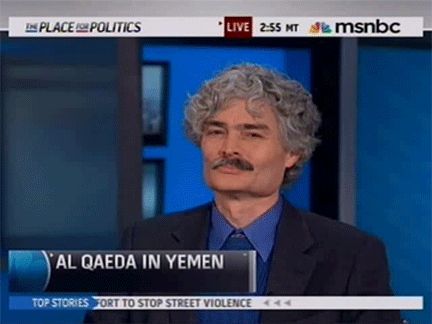
Varisco interviewed about Yemen on MSNBC, January 16

For the past week or so, just before the terrible human tragedy in Haiti, Yemen was once again a front page news story in the Western media. This time it was not about qât, nor about the rhino horn used in Yemeni dagger hilts, but the issue was exotic nevertheless. Yemen is newsworthy because of the recent attempted suicide mission of a Nigerian who met with members of the relatively recently reframed Al-Qaeda in the Arabian Peninsula. At first, the political talking heads were eager to brand Yemen as a lawless tribal haven for the next stop of our continuing war on terror. Joe Lieberman added Yemen to his own version of the axis of evil, which I have previously commented upon. But then late last week Yemeni officials announced that six al-Qaeda figures had been killed in an airstrike, and on Saturday three more had been arrested near the Saudi border.

On Saturday, on my return from delivering two lectures in Toronto, I went straight from the airport to MSNBC, where I was interviewed (if that term works for about two minutes of air time) about the recent strikes on al-Qaeda in Yemen. Earlier in the week, I sat down for an extended interview on the current situation in Yemen with Karla Schuster of Hofstra University, an interview which can be seen on Youtube. Continue reading On Yemen (and some a bit off)

Karim Ben Khelifa in Yemen


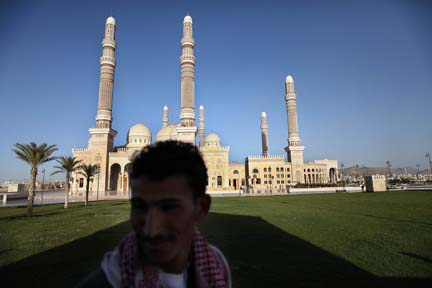
The newly built presidential mosque, which cost an estimated $60 million; photography by Karim Ben Khelifa

Much of the reporting on recent events in Yemen is pathetic. A rare exception is the work of photojournalist Karim Ben Khelifa, who is currently on assignment in Yemen. Thus far he has posted two sets of photographs, one on the Wall Street Journal, and the other for the New York Times. Check out these websites for superb photographs, two of which I reprint here with the permission of the photographer.


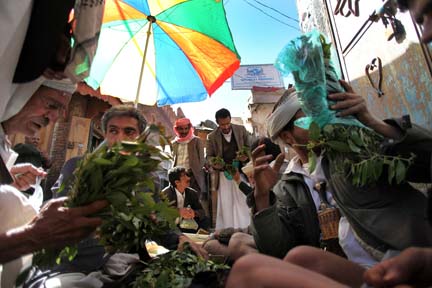
Qât market in Sanaa, Yemen; photography by Karim Ben Khelifa

Following Seward’s Folly: #2 Hopeless Arabia


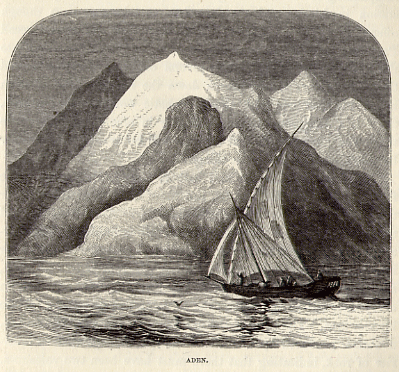
Illustration from Seward’s Travels (1873)

William H. Seward, the American Secretary of State who is forever linked with the “folly” of acquiring Alaska from the Russians, spent a year traveling around the world near the end of his life. In a previous post I recorded his comments on the British rule in India, as reported by his daughter. On April 27, 1871 the Seward party neared the Yemeni port (and British fueling station) of Aden. Here is how the approach is recorded by Ms. Seward:

April 27th. – After eight months travel in the incomprehensible East, with its stagnant civilization, we are now passing into another region still more incomprehensible and hopeless.

On the right hand is Yemen, once ‘Arabia the happy,’ and still known in poetry as a land of light and beauty, but now the dwelling of Arab hordes, who are sinking every day deeper into barbarism. On the left, wee are passing Somali, that part of Africa which stretches from Mozambique to Abyssinia. Continue reading Following Seward’s Folly: #2 Hopeless Arabia

Al-Qaeda in Yemen

[Salon Magazine recently published an interview with Gregory Johnsen on the recent attacks against alleged al-Qaeda sites in Yemen. Here is a brief excerpt from the interview. The whole piece can be found at salon.com.]

Glenn Greenwald: My guest today on Salon Radio is Gregory Johnsen, who is an expert on Yemen; he’s a Ph.D. candidate in Near Eastern Studies at Princeton University and has advised the U.S. and British governments on issues relating to Yemen. Thanks very much for joining me today.

Glen Greenwald: How would you characterize what is being called al-Qaeda in Yemen in that spectrum, and how significant of a threat it is really to the United States, not within Yemen, but outside of Yemen and in the homeland?

Gregory Johnsen: Well, let me talk about it this way, if I can. This is the second incarnation of al-Qaeda in Yemen. Immediately after September 11th, we had what I like to term the first phase of the war against al-Qaeda. This lasted essentially from, say, the USS Cole attack in 2000 and really the September 11th attacks in 2001, up through November 2003. So, in this phase, the US and Yemeni governments partnered very closely. There was the drone strike in November 2002 that I mentioned earlier, and this was largely, at least for al-Qaeda, a reactionary war. Continue reading Al-Qaeda in Yemen

Grinding a Greater Axis of Evil


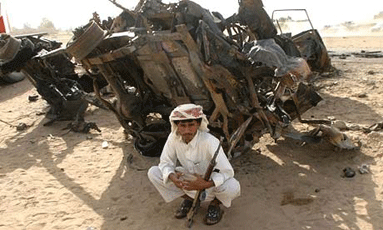
“Yemeni protesters staged a demonstration in the southern part of the country on Thursday after a raid against Qaeda militants”: Photograph from Agence France-Presse for The New York Times

In the midst of two unfinished major wars, the United States has quietly opened a third, largely covert front against Al Qaeda in Yemen. Eric Schmitt and Robert Worth, The New York Times, December 27, 2009

Terrorism takes a toll far beyond the lives lost everyday, even when a plot is thwarted. On Christmas day a 23-year-old Nigerian named Umar Farouk Abdul Mutallab attempted to set himself off as a human bomb on a Northwest Airlines flight from Amsterdam to Detroit. On the surface he hardly fit the profile of a crazed militant fresh out of a training camp in the hills of Pakistan. His father was a recently retired chairman of First Bank of Nigeria and he is an engineering student at University College London. But it now seems that his father was so concerned about his son’s politics that he warned the U.S. embassy about him just a month ago. Initial reports indicate that the explosives were said by Mutallab to be provided by al-Qaeda in Yemen. Based on this claim certain U.S. politicians, most notably Senator Joseph Lieberman of Connecticut, have called for Yemen to be added to the growing terrorist axis of evil. “So I leave you with this thought that somebody in our government said to me in the Sana’a, the capital of Yemen. Iraq was yesterday’s war. Afghanistan is today’s war. If we don’t act preemptively, Yemen will be tomorrow’s war. That’s the danger we face.” Lieberman told Fox News.

Lieberman is actually calling for Yemen to become today’s war, but the key to his thinking is best summed in another line from the same interview: “We’ve got to constantly be thinking like the terrorists here.” Well, Joe, this is the problem. You are thinking like the terrorists when you suggest going into a country you know nothing about and dropping bombs. Unfortunately, it appears we have already started doing that. Continue reading Grinding a Greater Axis of Evil