Category Archives: Yemen

Surfing in Sanaa

Internet cafes offer more to Yemen’s youth
by Teresa Gedi, Yemen Observer, April 3, 2010

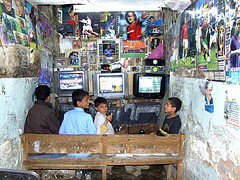
Al-Mortazah internet cafe, located at the foot of the Friendship Bridge near Tahrir square, takes the meaning of internet café to another level. In addition to its 20 computer stations, it has a full service sheesha bar and cafe from which I enjoyed a glass of fresh mango juice courtesy of the soft-spoken poet and journalist Abdul Rahman Ghelan.

Mr. Ghelan, age 30, has frequented the café since his personal computer broke down some months ago. As the place is close to his home and affordable (1 riyal per minute), he takes his time exploring various literary and journalistic websites across the Arab world. Being a poet, Ghelan finds the web to be an effective means of spreading his work and developing it through feedback from the online literary community. Feeling I had stumbled on a budding international artist, I listened intently as he humbly explained his work which focuses largely on politics, women and children. “My poetry has benefited greatly from web exposure in both the Arab world and outside. Literary personalities in Europe for example have contacted me requesting to translate my work into other languages, specifically, French and Italian.” Ghelan is also currently working on a translation of a book into English entitled “Memoirs of the Victim,” the victim being women in Yemen. Another poem “hams al-abir” or “The Whisper of Perfume” has caused quite a stir in the online Arabic poetry community. “I am amazed by the support I receive online,” says Ghelan. “As long as you are appropriate and respectful, it feels like people are right next to you supporting you.” Continue reading Surfing in Sanaa

Human Rights Report on Yemen released

On March 11, 2010 the Bureau of Democracy, Human Rights, and Labor in the U.S. Department of State released its 2009 Country Report on Human Rights Practices for Yemen. The full report can be accessed online here, but I include below the preliminary paragraphs:

Yemen, with a population of approximately 23 million, is a republic whose law provides for presidential election by popular vote from among at least two candidates endorsed by parliament. In 2006 citizens reelected President Ali Abdullah Saleh to another seven-year term in a generally open and competitive election, characterized by multiple problems with the voting process and the use of state resources on behalf of the ruling party. Saleh has led the country since 1978. The president appoints the prime minister, who is the head of government. The prime minister, in consultation with the president, selects the council of ministers. Although there are a number of parties, President Saleh’s General People’s Congress (GPC) party dominated the government. Civilian authorities generally maintained effective control of the security forces, although there were instances in which security forces acted independently of government authority. Continue reading Human Rights Report on Yemen released

Picturing Yemen’s History


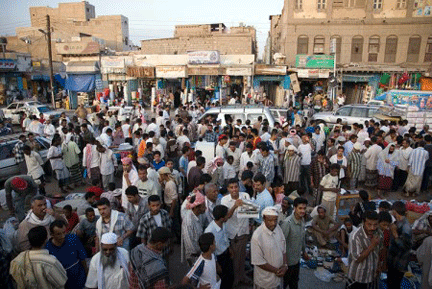
View of a busy marketplace in Aden. Staggering unemployment rate of around 35% hampers serious socio-economic development of the nation. People finishing high school and possessing university degrees are affected the most and according to a government survey published in 2008, 54% of graduates are unemployed/under employed. (Photo: Swiatoslaw Wojtkowiak)

There is an interesting historical study of Yemen through photographs on the Foreign Policy Journal website. Click here to see the full article and pictures. Here is the opening explanation:

Recent events in Yemen have brought the country into limelight again. While Houthi rebels in the north and northeast of the country have an on-off political agreement with the government in Sanaa, al-Qaeda affiliated groups are flexing their muscles by attacking the authorities across the country. Political forces in southern Yemen are also unhappy with the economic development the region has seen since its union with the north two decades ago and talk of secession is ripe.

Though strategically located at the junction of the world’s most important waterways, the Red Sea and Gulf of Aden, the channel that connects world’s western shipping lines to the east, Yemen has failed to capitalise on its potential and emerge as a regional powerhouse. Instead, the country is at the brink of political mayhem and stands at #18 in the Failed States Index 2009 [1].

This photo story sheds light on Yemen’s ancient as well as recent history and discovers the factors that have hampered the country’s economic and socio-political development and brought it to the brink of disintegration.

Islamic Folk Astronomy #4


Modern photograph of the Pleiades

The Pleiades in Arab Folklore

The most famous star in Islamic folklore is undoubtedly the Pleiades. Commentators regard the reference in surah al-Najm (#53) of the Quran as the Pleiades; in fact the Arabs often referred to the Pleiades simply as al-najm (the star par excellence), a usage parallel to that in Sumero-Akkadian (Hartner 1965:8). In a well-known tradition, Muhammad links the early summer heliacal rising of the Pleiades with the beginning of the heat, crop pests and illnesses. In another tradition, more political than weather-related, Muhammad is supposed to have told his uncle Abbas (for whom the Abbasid caliphate was later named) that kings would come from his descendants equal to twice the number of stars in the Pleiades. This would imply that Muhammad thought there were 13 stars in the asterism, since the Abbasid caliphs numbered twenty-six (Ibn Mâjid in Tibbetts 1981:84). Continue reading Islamic Folk Astronomy #4

Exercises in Struggling with Loneliness


Shaqi Shafiq, Adeni poet

Exercises in Struggling with Loneliness

by Shawqi Shafiq, Translated by Sinan Antoon, Banipal

Rub the heart’s ring

rub it well

to erase the dust of depression

Rub it again carefully

so that the wall of forgetfulness shines

or

draw a circle/put a dove, or two, inside it/watch the wings move (that is if there are any)

You will ask: What if the circle crumbles?

What if the dove flies away

or if I am bothered by the wings’ noise

I will say to you: erase the circle

for all the traces to disappear

or put a fresh woman

instead of the dove

to seek revenge

for the aridity of an apartment

devouring your mouth

Yemen – the return of old ghosts


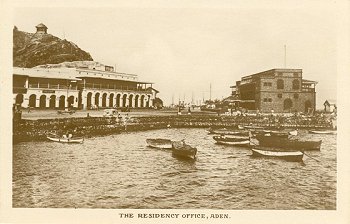
The British Residency Office, Aden

YEMEN – THE RETURN OF OLD GHOSTS

by Adam Curtis, BBC blog, January 8, 2010

What I find so fascinating about the reporting of the War on Terror is the way almost all of it ignores history – as if it is a conflict happening outside time. The Yemen is a case in point. In the wake of the underpants bomber we have been deluged by a wave of terror journalism about this dark mediaeval country that harbours incomprehensible fanatics who want to destroy the west. None of it has explained that only forty years ago the British government fought a vicious secret war in the Yemen against republican revolutionaries who used terror, including bombing airliners.

But the moment you start looking into that war you find out all sorts of extraordinary things.

First that the chaos that has engulfed the Yemen today and is breeding new terrorist threats against the west is a direct result of that conflict of forty years ago.

Secondly it also had a powerful and corrupting effect on Britain itself. To fight the war both Conservative and Labour governments in the 1960s set up international arms deals with the Saudis. These involved bribery on a huge scale which led to the Al Yamamah scandal that still festers today. Continue reading Yemen – the return of old ghosts

Madrasa in Sufi Hands


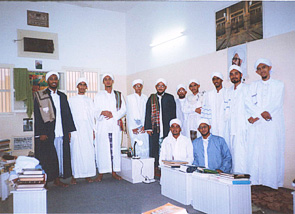
Students at Dar al-Mustafa in Tarim, Hadramawt

The image of the Islamic madrasa is severely tainted in the West. One of the oldest educational institutions in the world, and a pedagogical system that had influence on the evolution of colleges in medieval Europe, is generally portrayed in the media as a reactionary base for hateful anti-Western propaganda. Now that Yemen has surfaced as yet another “terrorist haven,” the idea of Islamic education in Yemen is likewise viewed negatively. One of the most important historical centers of Islamic education in Yemen remains Tarim in the Hadramawt valley. Yes, indeed the very Hadramawt from which the ancestors of Osama Bin Laden migrated. But Tarim has an international focus that many people are not aware of. For centuries Hadramis, including Sufi missionaries, have established strong ties with the people of India and Indonesia. The largess of Hadramis abroad has led to substantial support for schools back in Tarim. These are not backward enclaves with firebrands but devout Sufi masters who have long preached tolerance and the quest for spiritual truth. There is a video report posted on Al-Jazeera by Hashem Ahelbarra on “Students in Yemen fight Stereotypes” that is worth watching. For more information on Dar al-Mustafa, which is featured in the video, click here.