Category Archives: Yemen

Nutrition in Colonial Aden, #2

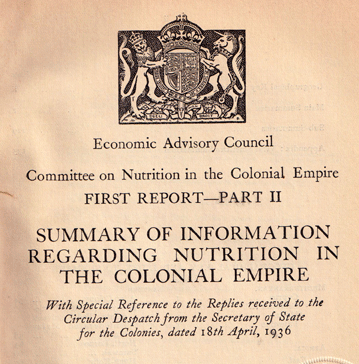
Say what you will about colonial empires, but at least they generate reports. I recently came across a British report to Parliament in 1939 entitled “Summary of Information Regarding Nutrition in the Colonial Empire.” Four pages are devoted to Aden Colony, which is said to have an area of 75 square miles, a population in 1931 of 45,992, a birthrate in 1937 of 32.07 per 1,000, an infant mortality rate in 1937 of 196.61 per 1,000, and a death rate in 1937 of 31.72 per 1,000. For part 1, click here. I attach more excerpts below:

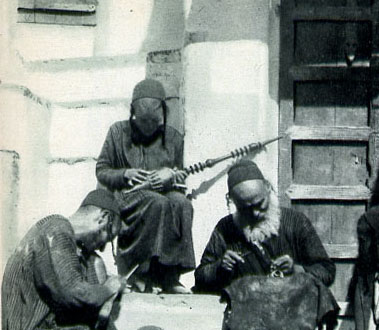
3. Diet and Health (deficiency diseases and other relevant considerations). – On the whole, Aden can boast a high standard of public health. The greatest drawback is overcrowding. Large families occupy inadequate and ill-ventilated accommodations in which, as often as not, the domestic goat also claims a quota of space. In consequence of these conditions, respiratory and alimentary diseases are all too common. Diseases directly attributable to qualitative dietary deficiency are not a prominent feature of hospital returns in Aden and the more classical of the tropical diseases – beriberi, scurvy and pellagra – do not occur. Evidence of qualitative deficiency is found, however, in the incidence of rickets among children and of certain eye infections. An examination of 527 unselected children (consecutive cases treated in the Civil Hospital) showed that 33, 0r 6.2 per cent, were suffering from rickets. Continue reading Nutrition in Colonial Aden, #2

Food Crisis in Yemen: A Rocky Road


Shahara bridge in northern Yemen

Poverty and famine are old comrades in much of the world. Add to this drastically declining water tables and economic stagnation and you have a sense of Yemen today. But a recent World Bank project makes a virtue out of the rocky road by literally providing jobs for skilled Yemeni stone cutters to build roads. Check out the video on the website by clicking here.

Suicide bomber attacks UK ambassador’s convoy in Yemen


Ambassador Torlot

Suicide bomber attacks UK ambassador’s convoy in Yemen

Hugh Macleod in Sana’a and Adam Gabbatt, The Guardian, April 26, 2010

The British ambassador to Yemen escaped assassination this morning when a suicide bomber attacked his security convoy as it drove through a crowded street near the embassy.

The ambassador, Tim Torlot, was unharmed, but one person – believed to be the bomber – was killed in the blast. Two local men and a woman were injured.

Torlot’s armoured car was passing through a poor neighbourhood in the eastern part of the capital, Sana’a, when the explosion occurred.

Witnesses described the suspected bomber as a young men dressed in a tracksuit and trainers who was waiting by the side of a busy road for the convoy to pass. Continue reading Suicide bomber attacks UK ambassador’s convoy in Yemen

Yosef Tobi at Hofstra

Professor Yosef Tobi of Haifa University will be presenting a talk entitled “The Legal Status of the Jews in Muslim Yemen, 897-1948” at Hofstra University on Tuesday, April 27 at 9:35 am in 201 Barnard Hall. This lecture is sponsored by the Middle Eastern and Central Asian Studies Program and the program in Jewish Studies at Hofstra. Dr. Tobi is one of the leading experts on the history of Yemenite Jews and has written several important books on the topic, including The Jews of Yemen: Studies in their History and Culture (1999).

For a review of Dr. Tobi’s The Jews of Yemen, click here.

For an article by Dr. Tobi entitled “THE CONTRIBUTION OF YEMENITE
JEWISH WRITINGS TO YEMENITE HISTORY” click here.

ON MILITANCY AND THE ART OF THE EGG

The Colloquium for Unpopular Culture and NYU’s Program for Asian/ Pacific/ American Studies present a new series: AUSCULTATIONS: sound, noise, (nervous heart)beats

FLAGG MILLER (University of California at Davis)
ON MILITANCY AND THE ART OF THE EGG: THEOLOGICAL LESSONS FROM THE OSAMA BIN LADEN AUDIOCASSETTE COLLECTION

Cosponsored by NYU’s Hagop Kevorkian Center for Near Eastern Studies

When: Monday 19 April 2010, 12:30pm
Where: Room 471, 20 Cooper Square (East 5th and Bowery)
Free and open to the public

The alleged fantasies of Islamic militants provide Western audiences with an ample repertoire not only for stereotyping Muslims but also for severing acts of terror from realms of human experience. With the aim of bringing Muslim militants’ narratives of violence back to the complexities of situated cultural interaction, Flagg Miller will investigate the ways in which militancy is conceptualized through audiocassette-mediated sound production. In the winter of 2002, over 1500 audiocassettes from Osama Bin Laden’s former compound in Qandahar, Afghanistan were acquired by Cable News Networks. Miller will focus on one cassette entitled “With the mujahidin” (ma` al-mujahidin) that features participants cooking breakfast in a makeshift Afghan Arab kitchen. Continue reading ON MILITANCY AND THE ART OF THE EGG

Islamic Folk Astronomy #5

The Pleiades Conjunction Calendar

One of the indigenous calendars from the Arabian Peninsula is based on the monthly conjunction of the Pleiades with the moon. The moon conjuncts with the Pleiades about once every 27 1/3 days. This conjunction was visible monthly from autumn through spring and occurred about the same time each year; thus it coincided with the main parts of the pastoral cycle on much of the Arabian Peninsula. According to Abû Laylî (in al-Marzûqî 1914:2:199), these conjunctions began at the time of the autumn wasmı rain. This observation is still found among contemporary Sinai Bedouins (Bailey 1974:588). Ibn Qutayba (1956:87) noted that when the moon conjuncts with the Pleiades on the fifth day of the lunar month, winter goes away. The new moon coincides with the Pleiades during the month of Nîsân or April during the naw’ of simâk. This was considered to be one of the most fortunate star movements in the sky, perhaps because of its unique annual character. Shortly thereafter the Pleiades disappears from view at the start of the heat. Continue reading Islamic Folk Astronomy #5

Nutrition in Colonial Aden, #1

Say what you will about colonial empires, but at least they generate reports. I recently came across a British report to Parliament in 1939 entitled “Summary of Information Regarding Nutrition in the Colonial Empire.” Four pages are devoted to Aden Colony, which is said to have an area of 75 square miles, a population in 1931 of 45,992, a birthrate in 1937 of 32.07 per 1,000, an infant mortality rate in 1937 of 196.61 per 1,000, and a death rate in 1937 of 31.72 per 1,000. I attach excerpts below:

“1. General. – …This survey deals primarily with the 75 square miles of volcanic rock and sand which constitute the Colony of Aden; a detailed review of the nutritional affairs of the Protectorate has been postponed until a later date. The Colony is almost entirely urban and so cosmopolitan in make-up as to complicate the task of reviewing the nutritional conditions as a whole. Arabs, Jews, Somalis and Indians of various races predominate, and a preponderance of males is occasioned by the fact that those who come to Aden for varying periods of time to seek livelihood as coolies or tradesmen leave their womenfolk behind in the interior or in India. The natural division is to classify Arabs, Jews and the poorer classes of Indian Mohammedans as the indigenous population and it is to these, particularly the middle and lower classes, that the present nutritional considerations apply.

2. Composition and Nutritive Value of Dietary. – All the chief articles of diet are, with the exception of fish, imported from overseas or from Arabia. They are: rice, flour, sugar,; fish, mutton, beef, goat’s milk, eggs, ghee; fruits, vegetables, dates, lentils, simsim oil, tea, coffee and spices. Continue reading Nutrition in Colonial Aden, #1