Category Archives: Yemen

Rebuff the Radicals


The Egyptian televangelist Amr Khaled with a group of young Yemeni performers at the opening ceremony of a new campaign to combat religious extremism in Yemen. Yemen Times photo

by Tom Finn. Yemen Times, November 25, 2010

ADEN, Nov. 23 — A campaign has been launched by the Yemeni government to win over Yemeni hearts and minds, in a battle to confront extremist ideology and favour Islam’s moderation.

The project was launched on Wednesday at an opening ceremony in Aden attended by the Deputy Prime Minister and representatives from the Ministries of Tourism, Culture and Justice.

As well as an array of performances by Yemeni children, the ceremony included a speech by Amr Khaled, the world renowned Egyptian televangelist, whose organization, the Right Start Foundation, will be leading the two week project to confront religious extremism in Yemen. Continue reading Rebuff the Radicals

Worse than Vietnam


by Robert Wright, The New York Times, Opinionator, November 23, 2010

“We did the Cole and we wanted the United States to react. And if they reacted, they are going to invade Afghanistan and that’s what we want … . Then we will start holy war against the Americans, exactly like the Soviets.”
— Mohammed Atef, military commander of Al Qaeda, in November of 2000

You have to give the people at Al Qaeda this much: They plan ahead. And they stick with their goals. If bombing the U.S.S. Cole failed to get American troops mired in Afghanistan, maybe 9/11 would do the trick?

You might say. Last week at the NATO summit President Obama pushed the light at the end of the tunnel further down the tracks. By the end of 2014, he now tells us, American combat operations in Afghanistan will cease.

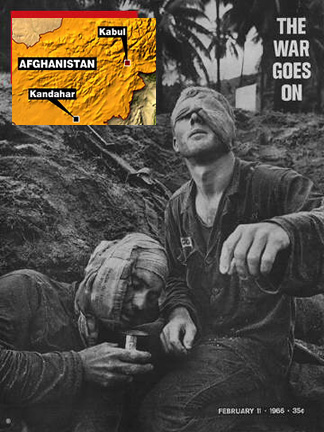
It’s not as if we need those four years to set any records. At just over nine years of age, this war is already the longest in American history. And this Saturday we’ll eclipse the Soviet Union’s misadventure in Afghanistan; the Soviets brought their own personal Vietnam to an end after nine years and seven weeks.

Is Afghanistan, as some people say, America’s second Vietnam? Actually, a point-by-point comparison of the two wars suggests that it’s worse than that. Continue reading Worse than Vietnam

What’s Cooking in Yemen 1

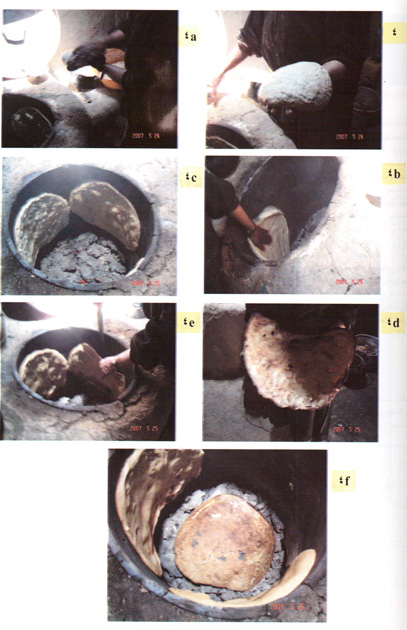
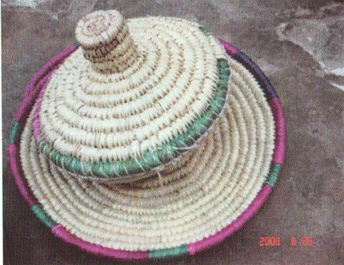
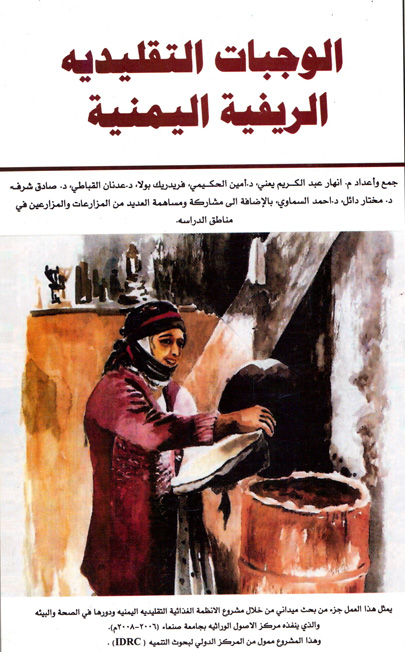
In yesterday’s post the cover of a recent book published in Yemen was featured. This book is a pictorial introduction to the art of traditional cooking in rural Yemen. It was published in 2008 by the Center for Heritage of Sanaa University. The picture on yesterday’s cover was of a Yemeni woman preparing to bake bread. The steps above illustrate the preparation and baking of round barley bread, known as malûj in Yemen’s central highlands. The bread dough is formed into a ball and then stretched out with a makhbaza (see below) to a flat found shape that can be patted to the sides of the tannûr oven. The taste is hard to describe, since it is almost impossible to find pure barley bread in America. It is a hard, crisp bread and tough to break apart, but goes well with a variety of traditional stews.

to be continued

Arabian Nights and Daze


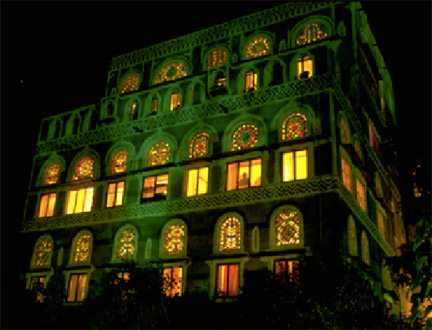
Bayt al-Hilali. Lighted middle floor was Wyatt’s home in Sanaa,Yemen (1970-72); Photo by Peggy Crawford (1988)


Announcing Susan C. Wyatt’s new book: Arabian Nights and Daze: Living in Yemen with the Foreign Service

Is Yemen Really a Hotbed of Terrorism? “No,” says Author.

Arabian Nights and Daze Evokes a Friendlier Yemen than the Media Presents

Americans today have a negative image of Yemen and its people in the aftermath of media focus on radical Islam and terrorist activities in that country. Susan Clough Wyatt’s Arabian Nights and Daze: Living in Yemen with the Foreign Service provides timely insights into this vulnerable country, its history and culture, and the enormous challenges Yemen faces today. Arabian Nights and Daze has been selected as part of the Memoirs and Occasional Papers Series of the Association for Diplomatic Studies and Training (ADST) in Arlington, Virginia.

Journey back to 1970 when Wyatt and her Foreign Service officer husband reopened the U.S. diplomatic mission to the Yemen Arab Republic (YAR) after its closure at the time of the 1967 Arab-Israeli War. Arriving only eight years after progressive revolutionaries ousted a thousand-year-old dynasty of conservative Shiite Muslim imams, they found the mission in a shambles. Under the protection of the Italian embassy, they built it back in stages prior to full resumption of diplomatic relations with the YAR in 1972. Continue reading Arabian Nights and Daze

Yemen is Not a Terrorist Factory


Yemen is not a terrorist factory
By Daniel Martin Varisco, Special to CNN, November 8, 2010

Editor’s note: Daniel Martin Varisco is a professor of anthropology at Hofstra University and has visited Yemen over a dozen times for development consulting and research since 1978. He moderates Tabsir, an academic blog on Islam and the Middle East.

(CNN) — Domino theorists love the Middle East. Because of this, a number of media pundits have recently added the little-known country of Yemen as a front in the unsettled aftermath of George W. Bush’s War on Terror.

First came the overthrow of the Taliban in Afghanistan, then a protracted war there and in Iraq. Iran is still in the hawkish gun-sights of conservative pundits, but the focus has now shifted to Yemen, a country most Americans could not find on a map. Is Yemen really the terrorist haven we should fear the most?

For the rest of my post on the CNN blog, click here.

Those Yemeni parcels


Armed Yemeni police stand guard next to the closed UPS office Thursday, Nov. 4, 2010, in Sanaa, Yemen

[Webshaykh’s Note: The latest from Greg Johnsen, one of the most informed commentators on AQAP and one who needs to be much more widely read.]

Initial Notes on AQAP’s statements
by Gregory Johnsen, Waq al-Waq, Friday, November 5, 2010

I have just finished a first reading of the three statements AQAP posted to jihadi forums earlier today. The one that is getting the most attention – not surprisingly – is the one that takes credit for two parcel bombs and the downing of a UPS plane in Dubai in September.

But for me, by far the most interesting statement is #27, which denies that AQAP had anything to do with two bombs outside a sports club in Aden on October 11. I will return to this below, and talk about why I think this statement is so significant. but first a couple of notes.

Note 1: Statement #28 talks about the fighting in Mudiya on October 14, 2010. I wrote about this fight here, in which the brother of the governor of Abyan was killed. Now we have AQAP’s version of the fighting, interesting details, but probably only to me. So I’ll save you the full discussion.

Note 2 : Another thing that I have noticed is the change in references to President Ali AbdullahSalih now and in the pages of Sada al-Malahim back when it was under the editorial guidance of al-Qahtani, who was killed in an airstrike. Continue reading Those Yemeni parcels

Selma and the Madrasa


Selma Al-Radi at work at the Amiriya Madrasa; photo by Qais al-Awqati

In addition to the obituary previously posted, the New York Times has recently published this account of Dr. Selma Al-Radi.

Selma Al-Radi, Restored Historic Madrasa, Dies at 71

By MARGALIT FOX, The New York Times, October 14, 2010

On certain dark nights, as a Yemeni legend tells it, Sultan Amir ibn Abd Al-Wahhab would command his servants to set lanterns in the windows of the Amiriya Madrasa, the ornate palace complex he had commissioned at Rada, in southern Yemen. Then, with his daughter by his side, he would ride into the hills above town, to behold his vast edifice ablaze with light.

The sultan was a historical figure, the last ruler of the Tahirid Dynasty, which flourished in Yemen from the mid-15th to early 16th centuries. The Amiriya Madrasa, erected in 1504 and named for him, was then and is now again one of the great treasures of Islamic art and architecture.

Solidly built of limestone and brick, the Amiriya seemed destined to endure as the sultan’s monumental legacy. But after he was killed in battle in 1517, the complex was left to decay. The more puritanical rulers who followed him deemed its lavishness a distraction from the sober business of prayer.

That the Amiriya today stands resplendent after five centuries of neglect is due almost entirely to the efforts of one woman, the Iraqi-born archaeologist Selma Al-Radi, who was for many years a research associate at New York University’s Institute of Fine Arts. Continue reading Selma and the Madrasa