Category Archives: Yemen

Is this the last dance for Ali?


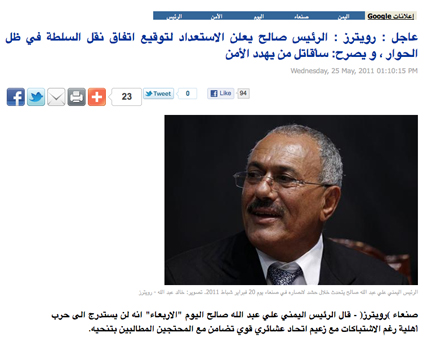
Reports coming out of Yemen today suggest that Ali Abdullah Salih may finally have no choice but to sign his abdication. Yesterday’s altercation with supporters of Hashid shaykh Sadiq al-Ahmar near his fortified house in Sanaa expanded to the Ministry of Interior. Today it is reported that Sanaa International Airport is closed and the Central Bank of Yemen has been shut down as well. Yemen is currently in the dark, both literally and politically.

Having run his country into a ditch, indeed quite a large wadi, President Salih is desperately trying to go out with some kind of moral victory. He will not let the country succumb to Civil War, like Somalia. He will not let Yemen become a failed state and fall to Al Qaeda. He will stay in the country and join the opposition. The words sound conciliatory enough, but his political kalam machine has been spewing forth similar justifications ever since he took power lo those many years ago. Even the little boy who cried “wolf” in the fabled children’s story only did so three or four times. Continue reading Is this the last dance for Ali?

The Crucible of Yemen


The crucible of Yemen

The two opposing forces of unity and disunity are helping to shape the future of the struggle against Saleh in Yemen.
by Larbi Sadiki, Al Jazeera, May 22, 2011

There has never been a single Yemen, and maybe there will never be one. What is nonetheless exceptional about the revolt engulfing Yemen is that it represents a united stand, a cry for freedom and dignity. Thus it echoes the cry for freedom in Tunis’ Habib Bourguiba Avenue and Cairo’s Tahrir Square.

However, Yemen presents a prominent specificity; it’s a unity-disunity pairing that shapes and re-shapes the current moment of popular empowerment, constantly stirring the politics concocted within the Yemeni crucible.

Note that Yemenis feel insulted by the brand of nepotism and dynasticism engineered by Saleh and his ilk. The fissiparous forces which Saleh controlled, kept in check or used to his own ends through cunning, money, and even violence, are today largely rallied against him.

He dropped them like hot potatoes when political expediency demanded it. Now they are returning the favour. In this, Saleh’s foes seem to be united.

The interplay of unity and disunity are responsible for both Yemen’s moment of popular empowerment and weakness, as far as democratic protest and change are concerned.

One Yemen, many Yemens

In every sense, Yemen is breathtaking. It is a quilt of colours, climes, landscapes, regions, sects, tribes, customs, ideologies, histories and identities. Anthropologists would have a field day exploring it. But not so if one approaches Yemen with a narrow political science set of lenses. The risk to miss the “Archimedean point” – wherever that might be – is greatest here. Continue reading The Crucible of Yemen

dilly dally, ya Ali


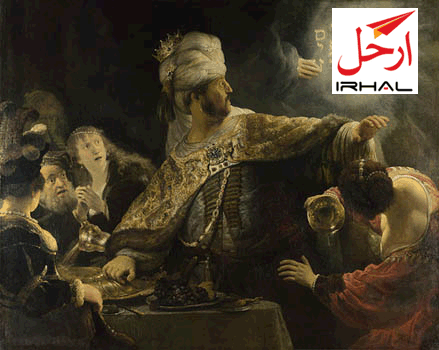
Rembrandt’s ‘Belshazzar’s Feast’ (1635)

Mene mene tekal upharsin. Some two and a half millennia ago it did not take King Belshazzar of Babylon too long to get this Aramaic message. Here is the gist, as recorded in the biblical book of Daniel (5:25-28):

And this is the writing that was written, MENE, MENE, TEKEL, UPHARSIN. This is the interpretation of the thing: MENE; God hath numbered thy kingdom, and finished it. TEKEL; Thou art weighed in the balances, and art found wanting. PERES; Thy kingdom is divided, and given to the Medes and Persians.

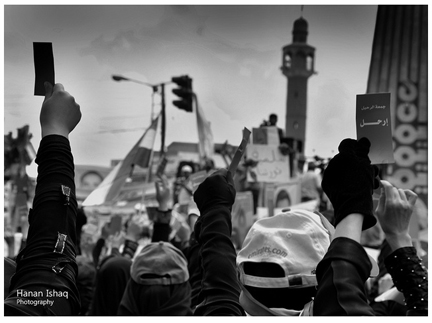
The ink on this populist uprising, with over 100 days of signs held aloft in Yemeni protests saying “irhal ya Ali”, has long since dried and Ali Abdullah Salih has been dilly dallying all along. The latest deal, brokered by the GCC with the U.S. and E.U. seals of approval, was signed yesterday by the opposition parties and Salih was supposed to sign today. Continue reading dilly dally, ya Ali

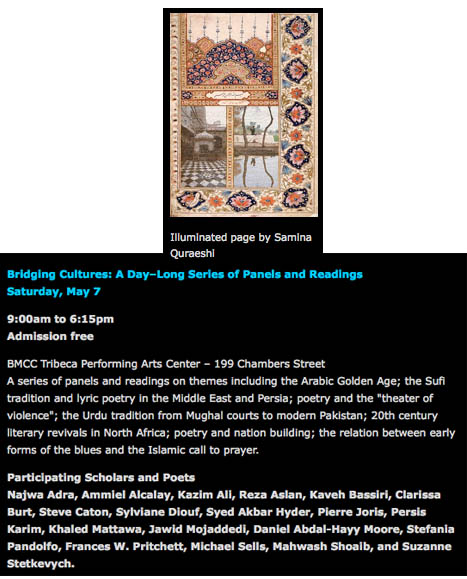
Illuminated Verses: The Poetries of the Islamic World


Illuminated Verses explores some of the rich and varied poetic traditions of the Islamic world. For a schedule of panels, click here (and scroll to bottom to download pdf of program).

Here is the program for Saturday, May 17, 2011:

Detailed Schedule

•9:00-9:15am
Welcome by Poets House Executive Director Lee Briccetti and City Lore Executive Director Steve Zeitlin

•9:20-9:55am
Illuminated Verses: the Poetries of the Islamic World
An opening panel setting up large questions and contexts with Reza Aslan and Michael Sells.

•10: 00-11:00am
Origins and Orality: the Poetry of the Arabian Peninsula
An examination of the poetries of the Arabian Peninsula from the Golden Age to contemporary oral tribal poetry. With anthropologists Najwa Adra and Steve Caton and literary scholar Suzanne Stetkevych. Continue reading Illuminated Verses: The Poetries of the Islamic World

Yemen after Ali Abdullah Salih


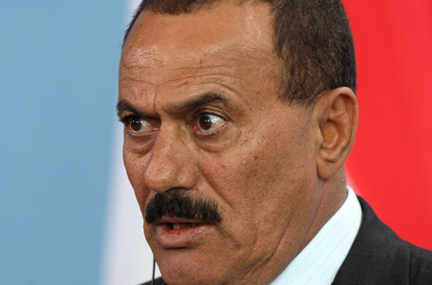
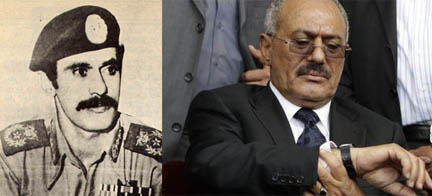
Ali Abdullah Salih, from 1978 to 2011

From the latest news reports in the region it appears that President Ali Abdullah Salih has agreed to step down within a month in an agreement brokered by the GCC. The plan calls for Salih to hand over power to his Vice President one month after the opposition signs on to the agreement, which they have reportedly done. Although, as I write this Salih’s decision to step down has not been broadcast in the state-run Yemeni newspaper al-Thawra or on his personal website. Two months later a national election is to be held. A possible sticking point is the immunity that this agreement provides President Salih and his family. The U.S. administration has already blessed the plan and it seems likely that it will be finally resolve Salih’s departure.

The protests against Salih have left the country divided and the economy, weak as it was to begin with, has basically ground to a halt. The poorest country in the Middle East is even poorer after three months of protests across the country. So what happens now?

The removal of President Salih will not solve the range of economic, ecological and social problems facing Yemen. Unemployment will continue, as the oil production nears an end; water tables will draw down even more drastically; imported Salafi conservatism will divide the population even more. In a sense Salih has been out of power for the past three months, simply hanging on as the protests gained more and more momentum. Unable, and apparently unwilling, to stop the street protests militarily (as Qaddafi is desperately trying), Salih deftly tried to garner his own supporters as a counter to those who wanted him to leave. But the hand writing was on the wall all along, given the wide coalition of groups who had grievances against his regime. The opposition seemingly united in its primary goal of removing Salih, but there is no single leading opposition party or leader waiting in the wings. Continue reading Yemen after Ali Abdullah Salih

Yemen beyond the protests


The recent protests that have shaken the Middle East from North Africa to Yemen so dominate the news these past couple of months that it is almost as though we see nothing else. Whether pictures are worth a thousand and one words, or even more, here are some superb photographs of Yemen by Raiman al-Hamdani, taken with his permission from his Flickr account.


One of the important mosques in the coastal town of Zabid