Category Archives: Yemen

يا قاتل الأطفال يا مهدم الحياة والديار


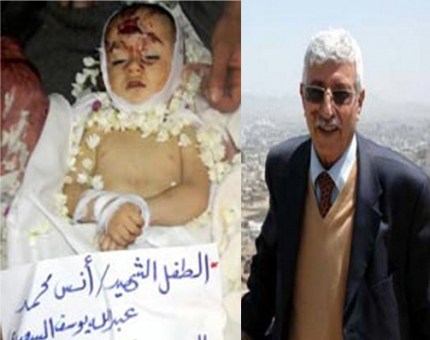
عبدالعزيز المقالح: ذهبت مثلما أتيت ملعون المساء والنهار .. يا قاتل الأطفال يا مهدم الحياة والديار

Yemen Press, Saturday, 24 September, 2011

ذهبت مثلما أتيت ملعون المساء والنهار…
أيامك الطوال عار..
وعهدك القصير عار..
أكبر منك نملة..
أشهر منك ريشة على جدار..
يا أمسنا الذبيح..
يا فأرنا القبيح..
يا قاتل الأطفال يا مهدم الحياة والديار..
ظننت أنك الإله .. أننا العبيد..
تفعل ما تريد..
تعبث في مصائر العباد..
فخانك الظن وخانك الرشاد..
أصبحت كومة من الرماد..
تنام في انفراد..
تصحو على انفراد..
تسألك الريح ، يسألك الجماد..
ماذا صنعت قل ..
ماذا صنعت للبلاد؟,,
ماذا تركت من ذكرى على ضميرها ومن أمجاد؟..
لا شيء يا صغير..
لا شيء غير لعبة المزاد..
رفاقك القرًاد والقوًاد..
وعاصف الفساد..
ماذا تركت للذين يقرأون؟..
ماذا سيكتب الأطفال عنك حين يكبرون؟..
سيكتبون .. مر من هنا منتفخا..
فأر صغير يرتدي ثوب مغامر جلاد..

Is 4 million enough to get the point?


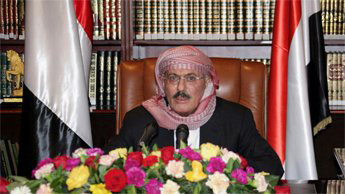
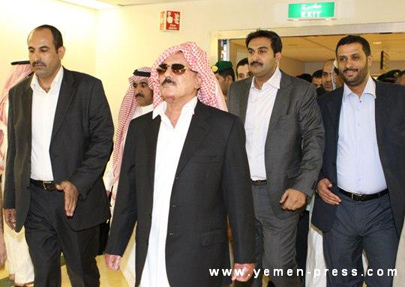
Salih returns to Yemen, but probably not the best public relations to photograph him in front of an exit sign

In a move that took almost everyone by surprise, Ali Abdullah Salih returned to Yemen Friday from his recuperation stay in neighboring Saudi Arabia. It is not clear which Ali Abdullah Salih returned. Is it the one who has promised at least four times to abide by a GCC-brokered sweetheart deal that would give him immunity if he agrees to step down? Is it the Ali Abdullah Salih who was badly burned and almost killed in a bomb explosion last June and was considered unlikely to ever return to Yemen? Is it the father who cannot control his succession-mongering son and relatives from trying to kill off any possible opponents to their eventual takeover? Is it the Ali Abdullah Salih who has survived dancing on the heads of snakes for over three decades? Could it even be Ali Abdullah Salih the peacemaker, calling for negotiations?

In a way it does not really matter. Yesterday it is estimated that some 4 million Yemenis took to the streets all over Yemen protesting his regime and any attempt to perpetuate it. To be sure there are still some supporters, but the overwhelming majority of Yemenis have demonstrated, quite literally, that it is time the Arab Spring blossom into a new political system in Yemen. Meanwhile, it seems all the sides jostling for power are more interested in self promotion than love of their country. The cowardly attacks of the Republican Guard on the protesters will only make these regimists all the more hated. The battle for Sanaa is bringing life to a grinding halt in the capital city and taking the life of far too many innocent civilians caught in the crossfire. All of Yemen is suffering. Continue reading Is 4 million enough to get the point?

A plot against all the Yemen people


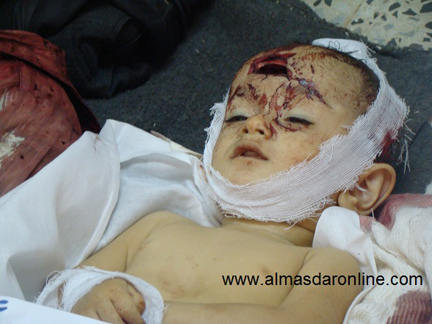
One of the victims in Sanaa

The protests against the regime of Ali Abdullah Salih have persevered in Yemen for some nine months with no end in sight that does not result in the past tense of “Irhal” for Salih. Hundreds of thousands of ordinary Yemeni citizens have joined the protest, some living in tents in a makeshift Freedom Triangle. For the most part, given the length and extent of the protests, there has been no violence from the protesters and limited attacks on them. The times that troops loyal to Salih have fired on protesters have only encouraged more protests. But the past couple of days have become ugly. As reported today, at least 21 have been killed a day after 26 were shot dead in Sanaa. Here is the report in Al Jazeera:

According to reports, Monday’s deaths occurred as snipers fired upon passers-by and peaceful protesters demonstrating at Change Square.

“Help me, oh my God look at his slaughter!” said the father of a boy who died from a gunshot wound to the head.

“We were just in the car on Hayel Street (near the fighting). I stepped out to get some food and left my two boys in the car and I heard the older one scream. The little one was shot straight through the head.”

The clashes came as protesters tried to push further into territory held by government forces after extending their camp overnight.

The opposition had earlier vowed to press ahead with demonstrations despite Sunday’s crackdown.

A freelance journalist stationed in Yemen, told Al Jazeera, “Everything points to more protest”.

Meanwhile, Abdu al-Janadi, Yemen’s deputy information minister, rejected accusations that the regime had planned attacks on the protesters and accused what he described as “unknown assailants” of carrying out the acts.

“This attack was prepared so as to kill as many people as they could. … This is a plot against all the Yemeni people,” al-Janadi told a British television station.

A boy sitting in his car as his father is getting food. All deaths in this situation are to be condemned, because all could be avoided if the greed of political foes did not rule out the honorable virtue of compassion. But there is something about the killing of innocent bystanders, whether intentional or not, that galvanizes the moment. The perpetrators are not “unknown assailants,” but clearly individuals told to do all in their power to sabotage the transition to a new government. Their names do not matter because their motives are so clear. Continue reading A plot against all the Yemen people

If a young [Arab] man wants sex

Now that we are about to officially head into the Autumnal paradox of the Arab Spring, there is no limit to the excess of punditry about why it happened, is happening and will continue to happen. Back in February, the historian Bernard Lewis weighed in on the current uprisings for an interview in The Jerusalem Post (which, for those with any historical memory, is not your parent’s Jerusalem Post). The article begins with Lewis’s summation in a nutshell: “The sort of authoritarian, even dictatorial regimes, that rule most of the countries in the modern Islamic Middle East, are a modern creation,” he notes. “The pre-modern regimes were much more open, much more tolerant.” Ah, yes, that Golden Age of Islam when the caliphs of the Arabian Nights were the community organizers of their eras. Surely Al-Hakim bi-Amr Allah did not really mean to destroy the church of the Holy Sepulcher in Jerusalem a millennium ago. That “more open, much more tolerant” pre-modern political paradise is as absurd as the more common Islamophobic trope that Muslims have always ruled by the sword. Indeed, as Lewis notes, the modern dictators in the region are a modern creation, but (as Lewis does not mention) largely the result of Western carving up and interference after World War I.

But the part of the interview that is most telling is the Freudian framing of the Arab twitter generation. I note here the question from the interviewer and the response by Lewis:

As we look at this region in ferment, how would you characterize what is unfolding now? Can we generalize about the uprisings that are erupting in the various countries? Is there a common theme?

There’s a common theme of anger and resentment. And the anger and resentment are universal and well-grounded. They come from a number of things. First of all, there’s the obvious one – the greater awareness that they have, thanks to modern media and modern communications, of the difference between their situation and the situation in other parts of the world. I mean, being abjectly poor is bad enough. But when everybody else around you is pretty far from abjectly poor, then it becomes pretty intolerable.

Another thing is the sexual aspect of it. One has to remember that in the Muslim world, casual sex, Western-style, doesn’t exist. If a young man wants sex, there are only two possibilities – marriage and the brothel. You have these vast numbers of young men growing up without the money, either for the brothel or the brideprice, with raging sexual desire. On the one hand, it can lead to the suicide bomber, who is attracted by the virgins of paradise – the only ones available to him. On the other hand, sheer frustration.

The fact that a young man (or woman) in Tunisia, Egypt, Libya or Yemen cannot get a job and make a living at home is not the tipping point for Lewis; no, it is pure jealousy — give me hamburgers and blue jeans or give me death — don’t tread on my cell phone. Then there is that particular “another thing.” If as a young Arab man you can’t get laid, then you might as well go out in the streets and brave the dictator’s thugs and tanks. After all, unlike the casual West, you can only get sex in marriage and in the whore house. Continue reading If a young [Arab] man wants sex

The State of Agriculture in Late 13th Century Rasulid Yemen, 5


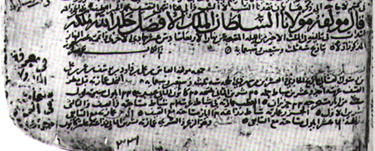
Tax document of al-Malik al-Afḍal, mid 14th century CE

By Daniel Martin Varisco

[In 2003 I attended a conference in Rome and gave a paper which was eventually published in Convegno Storia e Cultura dello Yemen in età Islamica, con particolare riferimento al periodo Rasûlide (Roma 30-31 ottobre 2003 (Accademia Nazionale dei Lincei, Fondazione Leone Caetani, 27, pp. 161-174, 2006). As this publication is virtually inaccessible, I am reprinting the paper here (with page numbers to the original indicted in brackets). For the previous part of this article, click here. The references are provided at the end of the first entry.]

ARCHIVING AGRICULTURAL ECONOMICS

Al-Ashraf’s Milh al-malāḥa provides a textbook survey of the mechanics of the agricultural system, but there is nothing on production costs, yields or the marketing system. Fortunately, some microeconomic details can now be filled in with information from the Muẓaffar archive, compiled from field reports sent to the Rasulid court between 691-95/1292-96 at the very end of al-Muẓaffar’s reign. Particularly valuable is a survey made in Ramadan 692/1293 from the lands of a shaykh Muḥammad ibn IbrāhÄ«m al-Ḥawm (?) of Ta‘izz and shaykh RashÄ«d al-DÄ«n Manṣūr ibn Ḥasan in Mikhlāf Ja‘far, as well as some data from ‘Abadān. (26) Details are provided on fees and shares for ploughing and virtually every agricultural activity with special emphasis on the obligations in sharecropping agreements and regional differences.

For the Ta‘izz case, the grain yields of sown sorghum are said to be up to 400 fold (i.e. one zabadī of seed will yield a crop of 400 zabadī) on good land, 150 fold on middle-range land and only 90-100 fold on poor land. Sorghum is also important in Yemen for its stalk (‘ajūr), used as fodder and fuel. The stalk yield for the sowing on good or medium land will be three camel (?) loads, but reaches five loads on land of poor quality; the reason given for this is that such sorghum is grown mainly for its stalk value. [p. 171]

For wheat in Ta‘izz, the increase is 15 fold on good land, 10 fold on medium land and only 3 fold on poor land. Emmer wheat (‘alas), on the other hand, yields 10 fold on good land, 4 fold on medium land and 2 fold on poor soil. Barley is said to yield 10 to 1; this is sown only in the mountain areas and not usually on the best land. Information is also provided on the straw (tibn) yields. Continue reading The State of Agriculture in Late 13th Century Rasulid Yemen, 5