Category Archives: Yemen

The Zaydi manuscripts of Northern Yemen


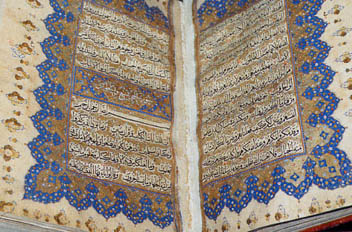
Qu’ran manuscript in Western Library of the Great Mosque, Sanaa

by Arie Amaya-Akkermans, bikyamasr, 13 December 13, 2011

In recent articles on Bikyamasr.com, it was reported at length on the diversity of cultural sites, part of Yemen’s vast cultural heritage, that were threatened with neglect and destruction, partly because of the inability of the Yemeni authorities to preserve them and partly because of the state of unrest caused by the Yemeni uprising – namely the ancient cities of Sana’a, Shibam and Zabid, in which thousands of years of rich history are likely to become yet another casualty in Yemen’s struggle for freedom from the 33-years old dictatorial rule of Ali Abdullah Saleh.

It is fortunate however that these three ancient cities are considered UNESCO world heritage sites, due to the fact that they have received attention from international organizations – most prominently the government of Germany – and some degree of action has been taken in order to minimize the damage, or at least, that was the case until the beginning of the Yemeni uprising. The extent of the real damage done to the sites in the course of 2011 remains yet to be properly assessed in a post-revolutionary scenario.

More unfortunate is the fate not only of other sites but of something much more intangible but equally valuable: The rich intellectual Islamic heritage of the country embodied in over 50000 manuscripts held in many libraries and private holdings. The astounding numbers and the nature of the manuscripts make Yemen one of the most important archival collections in the world, easily rivaling similar holdings of Islamic manuscripts in the national libraries of Cairo, Istanbul and Teheran. Continue reading The Zaydi manuscripts of Northern Yemen →
Welcome to America?


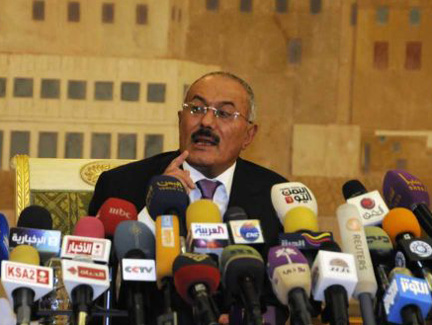
Photo credit: AP | Yemen’s President Ali Abdullah Saleh speaks to reporters during a press conference at the Presidential Palace in Sanaa, Yemen. (Dec. 24, 2011)

Yemen rarely makes the front page of The New York Times, but today it did. The seesaw political succession game underway in Yemen has seen President Ali Abdullah Salih’s head bobbing up and down in the power vacuum like a bobblehead doll in the hands of a Little Leaguer on opening day in Yankee Stadium. According to the article, Salih requested a visa to receive medical attention at New York’s Columbia Presbyterian hospital. Why it is not sufficient to return to Saudi Arabia, where he first underwent surgery and medical attention for major burns and other complications, is not clear. To complicate matters, and Salih has a knack for complicating matters, Salih told the Yemeni public in a recent televised address that he was not seeking medical treatment in the United States but simply wanted to allow the political process to evolve with him on the sidelines.

The Statue of Liberty still holds the beacon of hope aloft. So what does Salih hope to get from this visit. The Obama administration is keen to insist that Salih is welcome only for medical assistance, not for refuge. There is a glaring precedent that urges such caution: when Jimmy Carter allowed the former Shah of Iran entry to the United States for treatment, the pre-nuclear revolutionaries back in Iran went ballistic and stormed the U.S. Embassy. The rest, as they say, is history, but not the kind one likes to repeat. Continue reading Welcome to America? →

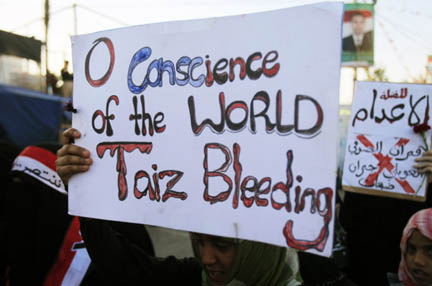
Is Taiz going to be the next Benghazi of Yemen?


by By Tom Finn, Time, Tuesday, Dec. 13, 2011

Read more: http://www.time.com/time/world/article/0,8599,2102183,00.html#ixzz1gXKFNc14
During the day, Taiz, a mountainous municipality nestled in the basin of Yemen’s rugged central highlands, has the feel of any other Yemeni city. Scrawny teenagers with wheelbarrows filled with oranges weave in and out of the traffic dodging debabs — local six-seater microbuses — and motorbikes as they splutter up and down the city’s steep, dusty alleyways. But once the sun begins to set and the mountains surrounding the bowl of the city darken into jagged silhouettes, the wail of the muezzins soon competes with the ominous thud of explosions.

Taiz is famed for its doctors, lawyers and relative cosmopolitanism, but it was its youth who in February jump-started the movement in Yemen to oust the wily, decades-long ruler, Ali Abdullah Saleh, from power. Inspired by their counterparts in Tunis and Cairo, a group of men and women — most of them students — erected a circle of tents on a dusty boulevard in downtown Taiz and named it Freedom Square. Since then they have spent months braving a barrage of bullets, batons and tear-gas canisters from the security forces, marching through the city’s grubby streets and calling for change. (See photos of Yemen on the brink.)

But in recent weeks the conflict in Taiz has taken on a more deadly twist. Continue reading Is Taiz going to be the next Benghazi of Yemen? →

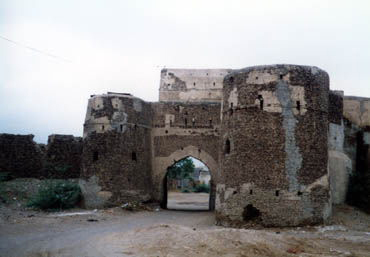
Fire on Historic Gate of Zabid


ذكرت مصادر محلية بمديرية زبيد بمحافظة الحديدة مساء يوم أمس الجمعة بأن حريقا” هائلا” تسبب في تشويه المنظر التاريخي لسقف المبنى الأثري الواقع في بوابة سهام بالجهة الشمالية لمدينة زبيد القديمة بمحافظة الحديدة ØŒ بالإضافة إلى إتلاف كمية كبيرة من الأخشاب المزينة بالنقوش الإسلامية الأثرية جراء الحريق الذي لم تعرف أسبابه حتى اللحظة .

وأشارت مصادر أمنية بالمديرية بأن ألسنة اللهب اشتعلت في المبنى الأثري التاريخي لبوابة مدينة زبيد الأثرية المعروفة ببوابة سهام ما أدى إلى احتراق سقف البوابة بالكامل إلى جانب كمية كبيرة من الأخشاب القديمة المزينة بالزخارف والنقوش التي لا تقدر بثمن.

وأضافت المصادر بأن أبناء زبيد لم يتمكنوا من أخماد الحريق الذي تصاعد بشكل مخيف في المبنى الاثري ولا تزال التحقيقات جارية لمعرفة أسباب ودوافع الحريق.

هذا وكانت زبيد قد أدرجت في قائمة التراث الإنساني العالمي في العام 1993Ù… , واعطت منظمة اليونسكو التابعة للأمم المتحدة اليمن مهلة للبدء في تنفيذ برنامج إنقاذي شامل لحماية ما تبقى من المعالم الأثرية في المدينة التاريخية والتي باتت مهددة بالاندثار قبل أن تباشر “اليونسكو” في إجراءات شطبها من قائمة التراث الإنساني بصورة نهائية.

Turning a new page in an old Yemeni book


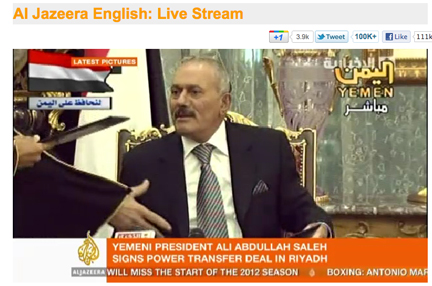
Over a week ago Yemen’s beleaguered President Ali Abdullah Salih finally stepped down after taking power in North Yemen 33 years ago during a military coup. Having promised three times to sign a deal worked out by the Gulf Cooperation Council, the fourth time was finally the charm. Saudi television carried the signing ceremony live from Riyadh, with the Saudi King Abdullah calling this a “turning of a new page” for its neighbor to the south.

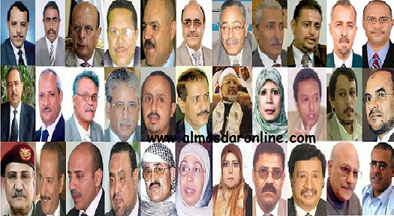
The final details were negotiated by UN envoy Jamal Benomar. The transition is being directed by the current Vice-President Abd al-Rab Mansur al-Hadi. The first stage is forming a government of national reconciliation within two weeks. The new ministers will include half from the President’s ruling party and half from the opposition Joint Meeting Parties, with 20% of the positions reserved for women. In each case a minister of one party will have a deputy minister from another party. The cabinet has now been formed (click here to read the brief resumes of the cabinet officers in Arabic). Continue reading Turning a new page in an old Yemeni book →

The Beast of the East


The rallying cry of those who admire the enlightened wit of David Hume might as well be “a pox on your apocalypse.” I suspect that there has hardly been any era since prophecies filled the imagination that prophetic fulfillment did not seem immanent. The biblical prophets clearly had real blood and flesh enemies in mind, and they are mentioned literally. Yet one can lionize a prophet like Daniel to such an extent that his multi-purpose end-time scenario is always in play. In the past year alone there have been the usual predictions of a fundamentalist “Rapture” when all the “true” believers get transported upwards in an eye-twinkling nanosecond and the rest of us are “left behind” for the worst hell-on-earth yet experienced. Those perpetual latter-day preachers who revel in the vials of Revelations are having a heyday with the current wave of political protests in the Middle East. New anti-christs can be christened; conniving Beasts are waiting in the wings for that one-world-government to finally take form. And, of course, the enemy these days is “radical izlam.”

As a Yemen watcher, a friend sent me a youtube video by Paul Begley, co-paster of the Community Gospel Baptist Church in Knox, Indiana. Begley has a string of youtube talks in which all the Satanic evil in the world is condensed into the religion of Islam. His latest video, produced on Friday, begins by reading the news about the reaction in Yemen to President Ali Abdullah Salih’s signing of the GCC agreement to step down. Begley’s disdain for Muslims and Arabs spills over into his linguistic mumblings, as he takes obvious delight in pronouncing Abdallah as abdalalalalalala. I beg your pardon, Pastor Begbegbegbegbegally, but r u serious? Continue reading The Beast of the East →

Signing off?


The fat lady has sung…

Yemen’s beleaguered president Ali Abdullah Salih has finally signed off on his role after several aborted efforts earlier this year. He has arrived in Saudi Arabia and even the official Saba news agency is reporting that he has agreed to finally sign the GCC-brokered resolution. One can still find a November 15 item in which Salih denies not agreeing to sign the deal. It is hard to imagine that he can back out of this after signing it, especially on Saudi soil. If the fat lady is not singing, she is at least clearing her throat and it sounds like music to those opposing him … But signing does not make it a “done deal” given the stalemate within the army and the dissension between the groups opposing Salih. The next few days will be vital, as the various groups jostle for power and influence, no matter what the GCC deal entails in principle. One result is that Salih receives immunity, a rather sore point that will not go away. The historic deal was covered live on al Jazeera. Stay tuned…

Hostages and the Yemeni Crisis


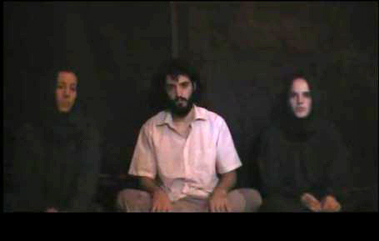
Taking hostages is hardly a new phenomenon. In far too many cases a hostage is nothing more than a political pawn, perhaps for a showcase video or as an “eye-for-an-eye” beheading. In Yemen the majority of hostages in tribal areas are negotiation acts. When Hunt Oil worked the Marib fields, local tribes would periodically “detain” American workers in order to get the government to do what they wanted or needed. The workers were treated as guests, for the most part, and it was a recognized game which generally led to the government doing what it should have done all along. This changed in the mid 2000’s with several high-profile al-Qaida killings of tourists. But generally when someone is taken hostage, the point is to get something out of it and not just to get publicity for a cause. This is especially the case when the context is tribal, since there are mechanisms within customary law for mediating such disputes.

Three French hostages kidnapped by al-Qaida fighters in Yemen more than five months ago have arrived in the Omani capital Muscat after being freed. Al Jazeera is reporting a recent release of three French aid workers who had been kidnapped last July in Hadramawt, one of the safer areas in Yemen at the moment, by suspected Al-Qaida operatives. They were released to Oman after a round of negotiations, as discussed in the news report: Continue reading Hostages and the Yemeni Crisis →