Category Archives: Yemen

A Tale of Two Brothers


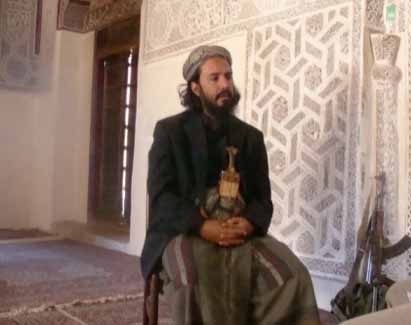
The late Tariq al-Dhahab

Yet another tale of two brothers, this time in Yemen and it is not about brotherly love. What drives a man to kill his brother? For Cain in the Garden of Eden it was jealousy that God preferred his brother Abel’s sacrifice to his own; in effect the God of Genesis wanted blood. Several Abbasid caliphs were adept at taking their brother’s lives, a royal custom that knew no geographic or cultural boundaries. The American Civil War is remembered as a family conflict in which brother at times fought brother. When fratricide does occur, it is always a sad affair, whether the passions are aroused by politics, religion or a more mundane jealousy.

The two Yemeni brothers are Tariq and Hizam al-Dhahab. Tariq gained international attention on January 16 when he seized control of the Yemeni town of Rida’ and declared himself Amir of a new Islamic regime. A self-important proponent of Al-Qaida in the Arabian Peninsula (as useful a banner as any these days in this region), Tariq was related to Anwar al-Awlaqi by marriage and this made the event all the more newsworthy outside of Yemen. But the purpose of the raid, which was symbolic more than bloody, was to negotiate release of prisoners and not jumpstart a new caliphate. After nine days they pulled out when Hizam’s brother Nabil was released, but the main impetus was opposition within his own tribe against such actions. Continue reading A Tale of Two Brothers

Can AQAP mount an insurgency?


by Issandr El Amrani, The Arabist, February 14, 2012

[This post was co-authored by the editor of the recently released report “A False Foundation? AQAP, Tribes, and Ungoverned Spaces in Yemen”, Gabriel Koehler-Derrick, and the author of the same report. For reasons of security and to facilitate future research in the region the author’s name has been withheld from the report. Gabriel is an associate at West Point’s Combating Terrorism Center and an instructor in the Department of Social Sciences.]

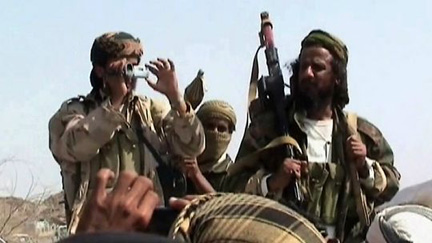
On 15 January a member of a United Nations team was kidnapped from an upscale neighborhood in Yemen’s capital. He was reportedly taken to the eastern governorate of Marib and held for more than a week by heavily-armed tribesmen who demanded the release of their relatives held on suspicion of supporting al-Qa`ida. The day of the abduction, word spread of militants from an alleged al-Qa`ida affiliate, Ansar al-Sharia`a, overrunning a city just 80 miles south of Sana’a. A week later, footage of an alleged commander of the group, a tribal sheikh and brother in law of Anwar al-`Awlaqi named Tariq al-Dhahab, was posted on YouTube. The clips seem to show Ansar al-Sharia`a fighters in control of the city’s mosque, enjoying support from some local residents, and for the first time on video, soliciting oaths of allegiance from young men on behalf of al-Qa`ida’s leaders in Yemen and Pakistan. (Click here for videos)

Both events have been interpreted as the latest evidence of Yemen’s imminent collapse, an outcome especially troubling for the United States. Whereas the Arab Spring has spurred varying degrees of optimism regarding political developments in Tunisia, Egypt, and even Libya, Yemen appears headed in the opposite direction. The prospect of al-Qa`ida inspired militants moving to fill the void left by a faltering central government makes a bad situation that much worse. AQAP is not alone in taking advantage of the chaos. Across the country the Yemeni government is ceding ground to a variety of sub state actors. These include Southern Secessionists in the former PDRY (People’s Democratic Republic of Yemen), Houthi insurgents in the North, and since May of 2011 in Abyan and perhaps Baydah governorates, al-Qa`ida’s local offshoot, al-Qa`ida in the Arabian Peninsula (AQAP) and Ansar al-Shar`ia. Continue reading Can AQAP mount an insurgency?

Voting in Yemen


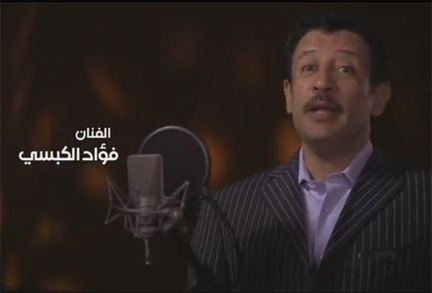
Fouad al-Kibsi and a new video on the Yemeni election

IRIN Middle East, SANA’A, 10 February 2012 – A presidential election to be held on 21 February in Yemen will open the door for a new chapter in the poorest and arguably most fragile country in the Arab world, says new Prime Minister Mohammed Salim Ba-Sindwa.

A successful election will pave the way for comprehensive reforms, said Ba-Sindwa, who was chosen to lead a national reconciliation government – part of a deal signed in November ending months of political turmoil.

Once elected directly by people, the new president will be constitutionally empowered to re-unite the divided army and replace corrupt officials in the various government institutions, Ba-Sindwa told IRIN in an interview.

“Our plan for the post-election period is to make the rule of law prevail nationwide. This is key to purifying the country from corruption and corrupt officials,” he said. “We will apply the law on the senior [official] before the junior; on the strong before the weak and on the rich before the poor.”

The prime minister’s words echo the optimism among some in the country, who see the election as the cornerstone of political transition. It is one of a string of steps stipulated in a power-transfer deal brokered by the Gulf Cooperation Council (GCC), after year-long nationwide protests against President Ali Abdullah Saleh’s 33-year rule dragged the country to the brink of civil war.

“The upcoming presidential election is the first step in this challenging journey,” Gustavo Gonzalez, senior country director for the UN Development Programme (UNDP) in Yemen, told IRIN. “Any positive transformation of Yemen in terms of stability, security and development will have a strong geopolitical impact on the region,” he said.

But the election faces massive challenges in feasibility and credibility, with the only candidate starting his campaign just two weeks before the election, various groups boycotting the election and violence continuing to affect parts of the country.

The sole candidate, current Vice-President Abdu Rabu Mansour Hadi, has the backing of the main opposition grouping and former Saleh supporters, but the electorate had no input in his selection and will not have a choice on election day beyond whether or not to vote. As Jane Novak, a US-based analyst and expert on Yemeni affairs, put it, “there isn’t a `no’ vote option on the ballot”.

Hadi was nominated by a parliament that deemed the country too fragile for possibly divisive competitive elections. But Hafez al-Bukari, president of Yemeni Polling Center (YPC), a local think-tank, worries the lack of competition will lead Yemenis to believe that democratic and competitive elections are not the ideal tool for change. Continue reading Voting in Yemen

World Press Photo of the Year 2011


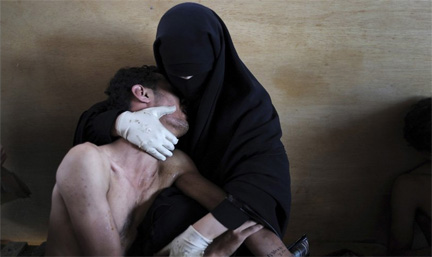
The international jury of the 55th annual World Press Photo Contest has selected a picture by Samuel Aranda from Spain as the World Press Photo of the Year 2011. The picture shows a woman holding a wounded relative in her arms, inside a mosque used as a field hospital by demonstrators against the rule of President Ali Abdullah Saleh, during clashes in Sanaa, Yemen on 15 October 2011. Samuel Aranda was working in Yemen on assignment for The New York Times. He is represented by Corbis Images.

Comments on the winning photo by the jury
Koyo Kouoh: “It is a photo that speaks for the entire region. It stands for Yemen, Egypt, Tunisia, Libya, Syria, for all that happened in the Arab Spring. But it shows a private, intimate side of what went on. And it shows the role that women played, not only as care-givers, but as active people in the movement.”

Nina Berman: “In the Western media, we seldom see veiled women in this way, at such an intimate moment. It is as if all of the events of the Arab Spring resulted in this single moment – in moments like this.”

Aidan Sullivan: “The winning photo shows a poignant, compassionate moment, the human consequence of an enormous event, an event that is still going on. We might never know who this woman is, cradling an injured relative, but together they become a living image of the courage of ordinary people that helped create an important chapter in the history of the Middle East.”

Manoocher Deghati: “The photo is the result of a very human moment, but it also reminds us of something important, that women played a crucial part in this revolution. It is easy to portray the aggressiveness of situations like these. This image shows the tenderness that can exist within all the aggression. The violence is still there, but it shows another side.” Continue reading World Press Photo of the Year 2011

Behold the Huthis


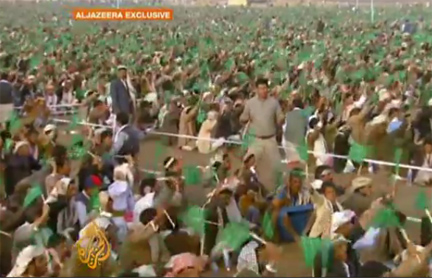
Huthi political rally near Sa’da this week

The ongoing political turmoil in Yemen has been overshadowed, and understandably so, by the increasing bloodshed in Syria, soccer riots in Egypt and lingering resistance by a few Qaddafi supporters in Libya. The past year of protests and revolution, unprophecied by political pundits, reminds me of a giant tire with so many holes that it is impossible to stop the air from escaping, even when one hole seems to be plugged. Meanwhile the road gets bumpier and bumpier in Yemen. Now for the latest recap… about-to-be-former President Ali Abdullah Salih is still in New York receiving medical treatment. He is in principle immune from prosecution, but certainly not immune from the continuing opposition to the excesses of his long rule in Yemen. A recently infused political form of Islam, known as Ansar al-Shari’a (with its own Facebook page) has all but replaced the infamous name Al-Qaida, in the south. The upcoming election, with one emerging compromise candidate for President, hardly seems headed for a democratic exercise apart from name only. Several aid workers were captured earlier this week and then released. And, behold the Huthis…

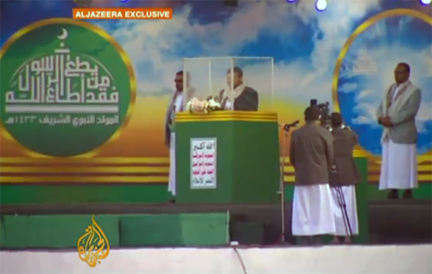
Al-Jazeera posts a video of a celebration of the Prophet Muhammad’s birthday in a remote area outside of the northern city of Sa’da. There on a platform etched against a barren landscape, a region less vibrant after almost eight years of conflict with the government that has left the ancient town of Sa’da in tatters, stood Abd al-Malik al-Huthi, the leader of the rebellion. Reports of his death at the hands of a government raid in 2009 are, as Mark Twain once noted about a premature obituary for himself, greatly exaggerated. While I do not doubt the sincerity of those present who celebrated the birth of the Prophet, the political flavor of the event certainly dominated the scenes shown on al-Jazeera.


Abd al-Malik al-Huthi speaking near Sa’da this week

Continue reading Behold the Huthis

Picturing Yemen #1


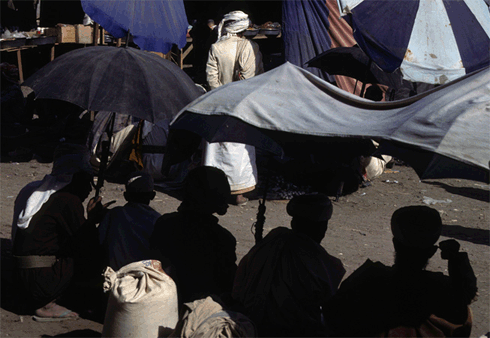
Sa’da, May, 1978; Photo by Daniel Martin Varisco

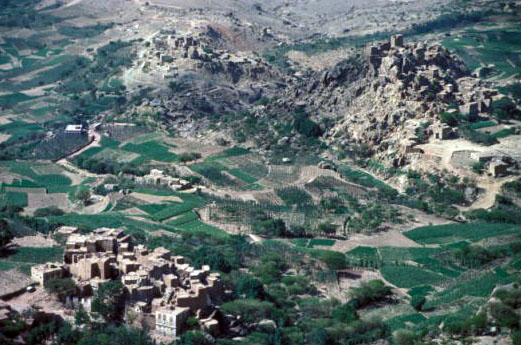
With this post I start a new theme for Tabsir: my photographs taken in Yemen since my initial fieldwork in 1978 in the springfed irrigated valley of al-Ahjur. As Yemen is currently embroiled in political turmoil, it is easy to lose sight of the marvelous scenery and cultural heritage of this land. It is said that a picture is worth a thousand words, but for most of these pictures few words are needed.