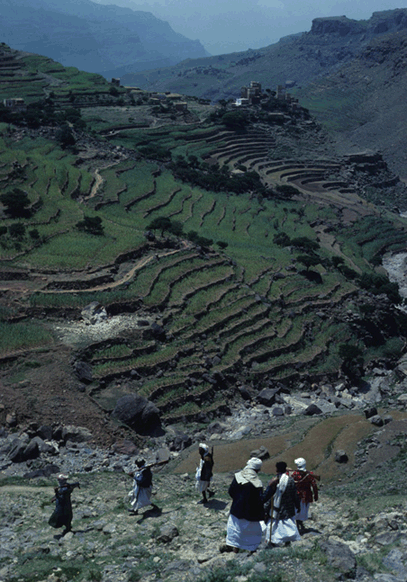
near al-Tawila, September, 1978; Photo by Daniel Martin Varisco
Category Archives: Yemen
A Swede and a camel in Yemen
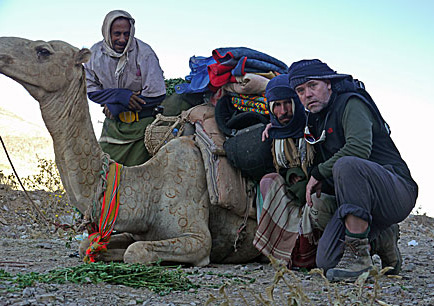
by Iona Craig, The National, January 9, 2012
A Swedish adventurer crossing Yemen by camel hopes his journey will encourage tourists to see beyond the political turmoil and violence that has engulfed the country for nearly a year.
Mikael Strandberg set out on December 7 on a 380-kilometre trek across the treacherous highlands, the first leg of his Yemen venture, to disprove the purveyors of pessimism.
“I don’t know what they [the tourists] are waiting for … it is such a wonderful country with great potential,” he said, after arriving in Sanaa after a two-week march through the toughest terrain in the Arabian Peninsula.
Along with two Yemeni companions, Mr Strandberg is in the initial phase of a journey that will cross the country from the western coastal plains of Hodeida to the edge of the world’s largest sand desert, the Rub’ Al Khali, or Empty Quarter, and beyond to Oman.
The explorer, 48, who fell in love with both the country and his wife Pamela, an American, during a visit to
Yemen three years ago, holds fond memories of Sanaa and the Yemeni people.
“We decided to go and try to make a difference and give a different perspective from the one portrayed by the media,” said Mr Strandberg. Continue reading A Swede and a camel in Yemen
South Arabia and the Berber Imaginary
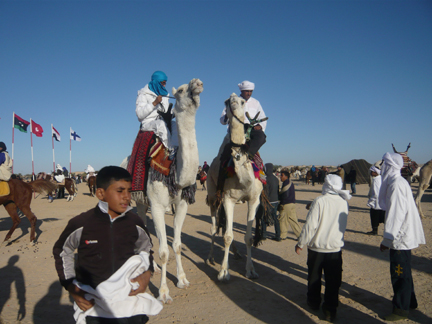
Mahri camels at the International Festival of the Sahara in Douz, Tunisia,
December 24, 2012. Photo by Sam Liebhaber.
by Sam Liebhaber
One of the long-standing myths of Berber ancestry places their origins in Yemen from whence they were dispatched to North Africa in the service of ancient Ḥimyarite kings. Although this chapter in the mythological prehistory of the Arab world can be refuted on the grounds that the Berber are indisputably indigenous to North Africa, the offhand dismissal of the South Arabian-Berber imaginary overlooks an important sociolinguistic kinship between the Berber of North Africa and one of the last indigenous linguistic communities of the Arabian Peninsula: the Mahra of Yemen and Oman.
A number of socio-cultural parallels distinguish the Berber and Mahra from the other minority language communities of the Middle East. For one, the Mahra and Berber are members of the Islamic ʾummah, unlike many of the other minority language communities of the Arab world where linguistic boundaries are frequently coterminous with religious divisions. Further, the Berber and the Mahra did not inherit a written tradition that includes religious and literary texts. As a consequence, the Mahri and Berber languages are frequently consigned to the category of “lahja,†an Arabic term that signifies any non-prestigious, vernacular idiom that lacks of historical or social value.
Without their own written history or affiliation to a prestigious, non-Arab civilization, the Mahra and Berber are more easily “willed†into historical narratives of “Arabness†(Ê¿urÅ«ba) than the other language minority communities of the Arab world. This motif is the mainstay of modern Arabic scholarship on Berber and Mahri genealogical and language origins. A sample of a few recent titles demonstrates this point: The Berber: Ancient Arabs (al-Barbar: Ê¿Arab qudÄmÄ, al-Ê¿ArbÄwÄ«, Tunis: 2000), The Arabness of the Berber: The Hidden Truth (Ê¿UrÅ«bat al-Barbar: al-ḤaqÄ«qa al-MaghmÅ«ra, MÄdÅ«n, Damascus: 1992), Comprehension of Arabic and the Secret of the Mahri Language (Fiqh al-Ê¿Arabiyya wa-sirr al-lugha al-mahriyya, al-Ways, Sana’a: 2004) and Ancient Arabic and its Dialects (ie, Mahri, al-Ê¿Arabiyya al-qadÄ«ma wa-lahajÄtuhÄ, MÄrÄ«kh, Abu Dhabi: 2000).
Even if contemporary scholarship on Mahri and Berber origins is problematic, it is conceivable that historical intersections between the Berber and the Mahra gave medieval Arab historians a justifiable basis to propose their common ancestry. Continue reading South Arabia and the Berber Imaginary
The African Diaspora in the Indian Ocean World

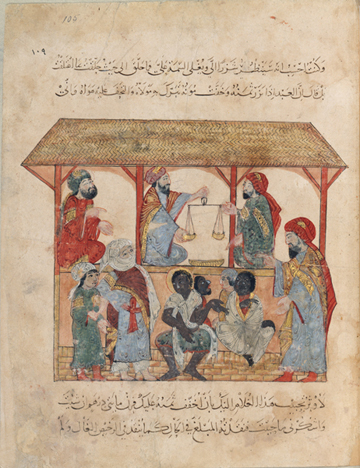
Slave Market in Yemen, 1237
Al-Maqamat, folio 105. Author: al-QÄsim ibn AlÄ« al HarÄ«rÄ« al-BasrÄ«. Illuminator: Yahya ben Mahmud al-Wasiti. Bibliothèque nationale de France. 021, an enslaved Ethiopian, Najah, seized power in the city of Zabid. This image represents the slave market at Zabid—at the time the capital of Yemen—in 1237. The illustration is part of “Al-Maqamat†(Assemblies), a genre of rhymed prose narrative. Both the author and the illuminator of this work were born in Iraq.
The Schomburg Center for Research in Black Culture has posted online a very nice exhibition on the African diaspora in the Indian Ocean World with illustrations and scholarly text. Continue reading The African Diaspora in the Indian Ocean World
Picturing Yemen #6
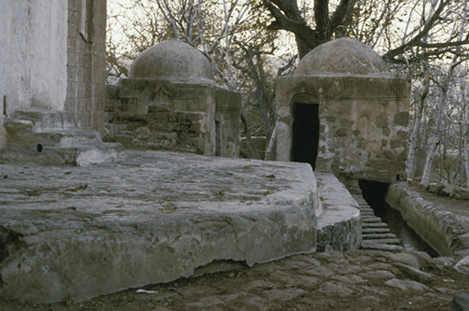
Outside the Hadda mosque, March, 1985; Photo by Daniel Martin Varisco
Into the Snake Pit: The US and Restructuring the Military in Yemen
by Gregory Johnsen, Waq al-Waq, February 24, 2012
The closest thing the US has to a “Yemen Czar” is John Brennan, President Obama’s Deputy National Security Adviser, and so when he speaks on Yemen – as he did recently – it is a good idea to pay attention.
On Monday, the eve of Yemen’s one-man elections, Brennan was in Sanaa, and during his time there he sat down with some journalists, and the US Embassy has since published the transcript of his roundtable.
Brennan has a lot to say, and I would encourage everyone to read his full remarks, but one of the things that stood out to me was Brennan’s comments on military restructuring.
Obviously military restructuring is going to be one of the most important and most controversial processes of the post-Salih era in Yemen. Salih’s relatives and fellow tribesmen have a stranglehold on much of the military and security apparatus in Yemen. Salih spent more than 33 years building this network, and dismantling it is going to require a great deal of patience, effort and knowledge.
Imagine the security services like a giant Jenga tower and you get some idea of the problem: the US wants to remove some key blocks, without seeing the whole thing tumble down. Continue reading Into the Snake Pit: The US and Restructuring the Military in Yemen
The President (of the GPC) Returns

President Salih, well at least in his downsized role as president of the General People’s Congress, has returned to Yemen from New York, where he was receiving medical treatment. Yet, as this news report shows, the hand-shaking is not over. Nor is the head-shaking of those of us on the side lines…
And the game goes on in Yemen
The ink is barely dry on the thumbs of millions of Yemeni voters and the political rhetoric has once again heated up. One of the leaders of AQAP, Fahd al-Qasa‘a, is lashing out against the election of al-Hadi. Hardly any surprise here. But at the same time, as reported in the Yemen Post, he is blasting (so far only in words) Islah, the largest Islamic party in Yemen. For anyone who knows Yemen, this is also hardly a surprise, although many on the outside still think an “Islamist” is an “Islamist” no matter what the facts on the ground. Alienating Islah, which is as much a regional power block as a religious party, seems a sign of desperation or else a calculated outreach to disaffected southerners. Criticism of al-Hadi as a clone of the United States, Saudi Arabia and the GCC resonates well with many southerners, where AQAP hopes to make inroads. The former President of the PDRY and Vice President to Salih after unification, Ali Salim al-Baydh, has also labeled al-Hadi a hack in the grasp of foreign interests. Strange bed fellows indeed.
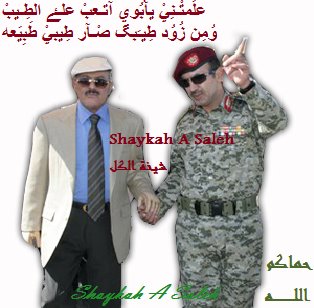
But the plot thickens. The statements by al-Qasa‘a were quoted in a newspaper owned by Ahmad Ali Abdullah Salih, the man who would be king after his father. You can follow his exploits on a Facebook page. The current dissension among the political rivals is anything but tranquil. It almost makes the current Republican debate circus in the United States look like a love fest. But one need not quote Machiavelli to see that the bottom line here is political power, not religious persuasion. Anyone who thinks that Zaydi vs. Shafi’i is still the way to carve Yemen up into sects or that Islah and AQAP are of the same cloth needs to do a lot of rethinking.
And the game is far from over.