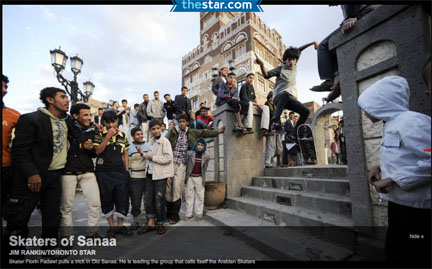
There is a series of photographs of the Yemeni youth skateboard culture in Sanaa in the Toronto Star.
There is a series of photographs of the Yemeni youth skateboard culture in Sanaa in the Toronto Star.
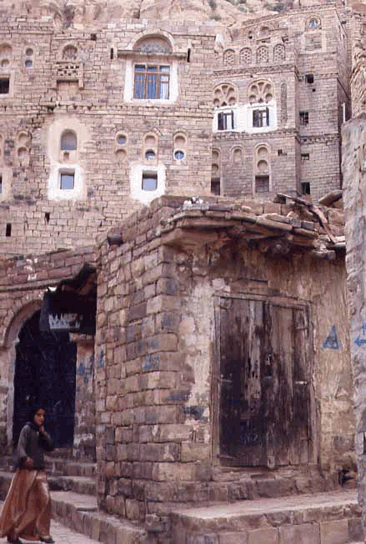
Thula’, May, 2005; Photo by Daniel Martin Varisco
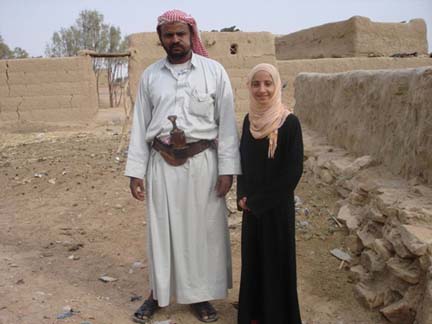
Nadwa Al-Dawsari (with her tribal shiekh colleague)
by Nadwa Al-Dawsari, Carnegie Paper, April 2012
The power-sharing deal signed by Yemen’s President Ali Abdullah Saleh in November 2011 mentioned presidential elections, the formation of a national unity government, and a military commission to reform the armed forces. It was at best the first step in Yemen’s recovery from the protracted turmoil and instability that wracked the country for months.
In this uncertain period of transition, as the new government struggles to establish legitimacy and address its most pressing issues, tribal law and traditions will play an important role in restoring a degree of stability because government capacity is extremely limited. This is particularly true given increasing conflicts and emerging sectarian and political divisions in the country. State and rule of law institutions are not only weak and ineffective outside of the main cities but also widely untrusted.
Yemenis have relied on indigenous tribal traditions to regulate conflict and establish justice for centuries, if not millennia. Tribal law has effectively handled conflicts between various tribes, between tribes and extractive companies, and between tribes and the government. It has successfully prevented and resolved conflicts over resources, development services, and land, and has sometimes managed to contain complex revenge-killing cases. Nationally, tribal mediators have played an important role in promoting political dialogue and building consensus among political groups. During the past year, where government forces withdrew, tribes took responsibility and managed to provide a reasonable level of security within their territories and along the main roads that connect tribal governorates. Continue reading Tribal Governance and Stability in Yemen
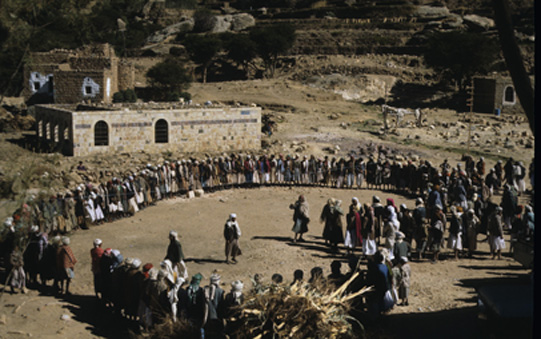
Tribesmen voting in al-Ahjur, Central Highlands, 1978
By Elham Manea, The Daily Star, April 6, 2012
February’s presidential election in Yemen by no means marks the end of the country’s troubles. However, the suggestion that the United States host a new arrangement based on decentralized negotiation between tribal and regional leaders is not the way to solve them.
Such a call ignores lessons from Yemen’s past and underestimates the deep changes that have taken place in Yemeni society over the last decades. Although the tribal system continues to operate as the prevalent mode of social organization, it is crucial to recognize that the nature of tribal networks and institutions has changed drastically.
Historically, tribal networks compensated for the state’s lack of capacity. The tribe assumed the role of protector and provider: securing tribal territory, protecting water wells, and resolving conflicts between its members or with other tribes. In many ways, the tribe was the institution of first resort for financial backing and social support in times of crisis. It is perhaps very telling that Aden – where the nuclear family has displaced the tribe as the main social unit – is more affected by poverty than regions that have preserved tribalism, such as Shabwah, Mahra and Al-Dali.
Tribal sheikhs were also once accountable to their constituents: They were elected and could be voted out. Thus, a sheikh was often regarded as a first among equals, rather than an absolute ruler. Custom (Irf) governed the mediation of conflict within or outside the tribe and could not be violated without loss of honor – a distinct disgrace – and threat of severe penalty. Continue reading Tribalism in Yemen has changed deeply
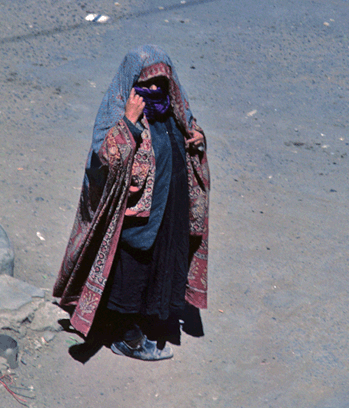
woman in Sanaa, March, 1978; Photo by Daniel Martin Varisco
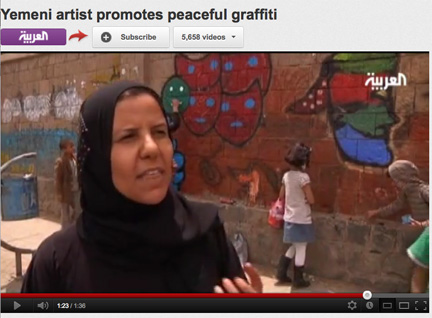
The aftermath of the protests in Sanaa, the capital of Yemen, left many walls filled with dueling graffiti. One Yemeni artist has taken to the streets, bringing neighborhoods together, to take back the walls through art. See the video here.
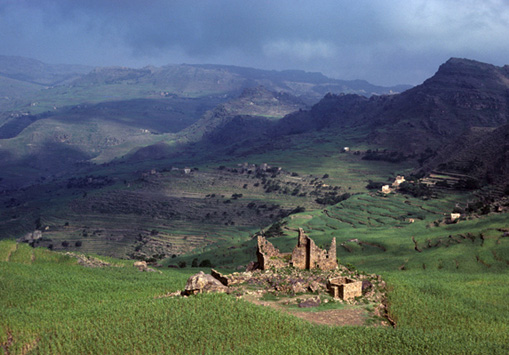
near al-Tawila, September, 1978; Photo by Daniel Martin Varisco
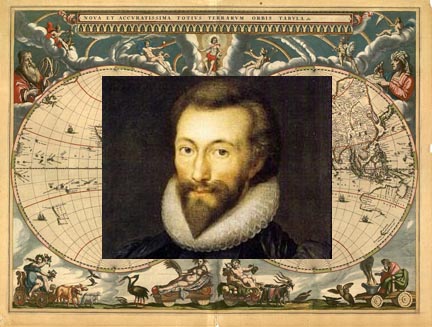
“John Donne and 1664 Dutch map of the world
“No man is an iland, intire of it selfe; every man is a peece of the Continent, a part of the maine; if a clod bee washed away by the Sea, Europe is the lesse, as well as if a Promontorie were, as well as if a Mannor of thy friends or of thine owne were; any mans death diminishes me, because I am involved in Mankinde; And therefore never send to know for whom the bell tolls; It tolls for thee….”
John Donne, Meditation 17, Devotions upon Emergent Occasions, 1624
What was true some four centuries ago for the English metaphysical poet John Donne is timeless, even if his writ shows its linguistic age. Today it can also be said that no country is an island unto itself, no matter where or how you spin the globe. This is certainly the case for the United Sates, with our military still on the ground in Iraq and Afghanistan, targeted drones over Pakistan and Yemen, the smoldering aftermath of the bombs that brought down Qaddafi in Libya, the stench of made-in-the-USA arms just about everywhere. If, as Donne eloquently reflects, the death of any man (or woman or child) diminishes us, then why are we so hell-bent on adding to this diminishing by arming thugs and sending our military to die in other countries?
First, it is important to realize how much the death toll drones on daily. Take today, for example. On Al-Jazeera we learn there are “many dead in Afghanistan suicide blasts,” 18 dead and 45 wounded by the numbers. As the nominal peace part still fails to protect the dictator-weary people of Syria, reports are that some 9,000 have been killed so far by the Assad regime, including refugees over the border in Turkey. There are also “Pakistanis dead in apparent sectarian attack,“adding six more to the thousands who have been killed in the ongoing violence that plagues Pakistan. The see-saw fighting in Yemen’s troubled south leaves “Dozens killed in attack on Yemen army base.” And a few days ago “Hamas hangs three Gaza prisoners“. Continue reading For Whom the Death Toll tolls