Category Archives: Yemen

USAID in Yemen


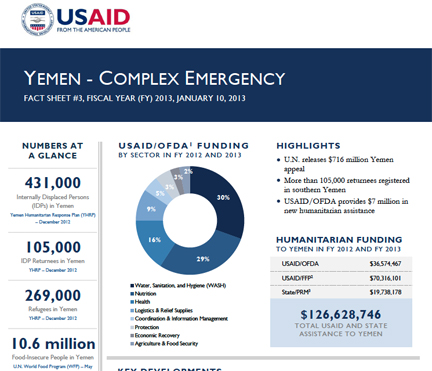
The drones capture the headlines when Yemen makes the news. The development arm of the U.S. State Department, USAID, also works in Yemen, although its activities have been greatly curtailed since the old days when I worked as a consultant on a number of USAID projects, starting in 1982 on the Agricultural Sector Assessment of Yemen of that year. For information on USAID’s current programs in Yemen, check out the relevant website. USAID provides a recent (January) fact sheet on the development situation in Yemen.


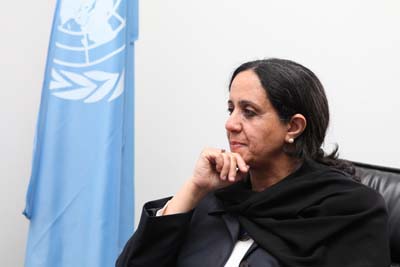
Amat Al Alim Alsoswa on the Yemeni National Dialogue


ROUNDTABLE DISCUSSION;
YEMENI COMPREHENSIVE NATIONAL DIALOGUE: CHALLENGES AND PROSPECTS

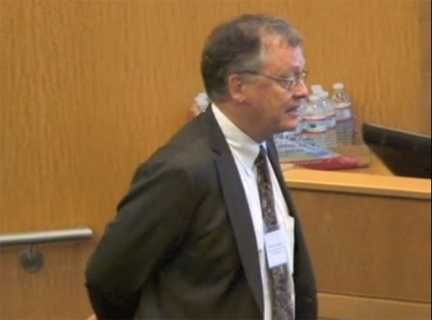
The International Peace Institute (IPI) is pleased to host a roundtable discussion on the Yemeni Dialogue with Ms. Amat Al Alim Alsoswa, former Assistant Secretary-General, Assistant Administrator and Director of the Regional Bureau for Arab States, United Nations Development Program on Wednesday, February 13, 2013, from 1:00pm–2:45pm at IPI’s Trygve Lie Center for Peace, Security & Development on the 12th floor, located at 777 United Nations Plaza.

Yemen’s transition began on November 23, 2011, when an agreement was brokered by the Gulf Cooperation Council (GCC) creating a two-year transitional government led by President (and former Vice-President) Abdu Rabu Mansour Hadi. The agreement mandates holding a National Dialogue to decide the formation of the new movement and address other pressing national issues. According to the GCC agreement, the National Dialogue conference must include “all forces and political actors, including youth, the Southern Movement, the Houthis, other political parties, civil society representatives and women.” Continue reading Amat Al Alim Alsoswa on the Yemeni National Dialogue

Drone Strikes


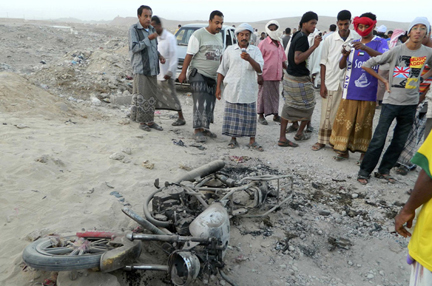
New America Foundation says that US drone attacks in Yemen have risen from 18 in 2011 to 53 in 2012 [Reuters]

[Drones are now at the top of the news cycle. This commentary was originally published in the January online edition of Anthropology News.]

The Error in the War on Terror

In 1978 I arrived in the Yemen Arab Republic to begin 18 months ethnographic fieldwork. At the time North Yemen, as it was called, was in full development mode. A protracted civil war after the fall of the traditional Zaydi imamate had ended only a decade before. Aid was pouring in from the United Nations, the United States, Germany, France, The Netherlands, Russia and mainland China as the country was in the throes of building itself up by its sandalstraps. Once settled in my field site, the beautiful spring-fed highland valley of al-Ahjur, I could not help but notice that just about everyone was armed, many with kalashnikovs. This was a tribal area, where the central government exercised little control, but I never felt safer in my life.

I felt safe because as a foreigner I was protected under tribal customary law. At this time the United States was well liked, often in contrast to the atheist communists of the Soviet Union who supported the socialist regime in South Yemen. This was before any hint of terrorism, before the Iran hostage affair and long before al-Qaeda. Osama Bin Laden had just turned 21 and was still in college. In this tribal area there was an honor code, exemplified by the Yemeni term qabyala, that required protection of unarmed guests, as it did women and children. In 2004, on a return visit to the valley, I found myself in the difficult situation of explaining why I did not support the U.S. invasion of Iraq. One of my Yemeni friends noted that he used to think that America was different, but now he believed that the U.S. president was as bad as his own, Ali Abdullah Salih. Continue reading Drone Strikes

A Bulgarian in 19th century Yemen


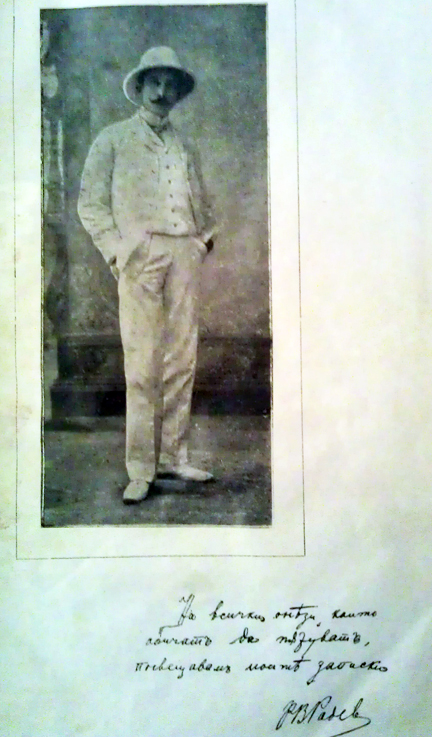
Photo of R. V. Radev with signature: “For these who love to travel, i devote my travel notes.”

The blogger Ruslan Trad has sent along an interesting piece regarding a Bulgarian traveler to Yemen, R. V. Radev, who published a book on his travels in 1906. If you can read Bulgarian, check out the original blog item. Otherwise, Ruslan has sent me a brief translated excerpt and some of the photographs, which I include here.

“Much like the Bedouin in the vast desert – one of those few unknown patches on the Earth’s surface, unexplored by Europeans – the Arab of the Happy Arabian coast today fights a legendary battle that turns fighters into heroes, invulnerable even to the slashes of the vengeful, merciless blade of Istanbul. A revolutionary network with its center in Syria is redoubling its efforts and preparing to sweep over all of Arabia, which has an estimated population of 12 million. Standing in the path of these millions is nothing more than one or two hundred thousand government clerks, looters, Turks and a few garrisons, spread around fortified checkpoints – a battle that would take no more than a couple of days to reach a favorable outcome, were it not for the proverbial scuffles between the various chiefs of the numerous tribes inhabiting Arabia, or for Turkey’s underhanded tactics in handing out bribes – gifts to some, privileges and unlimited power to others. Turkey sows the seeds of rivalry among the Sheikhs so they would fight and destroy each other. Neither the masses, nor the intellectual class, the rich Arabs, seem to understand that it would take no more than a couple of hours to resolve the issue of freedom and independence for Arabia, for which so much blood has, and continues to be shed…” Continue reading A Bulgarian in 19th century Yemen

Buried Christian Empire Casts New Light on Early Islam


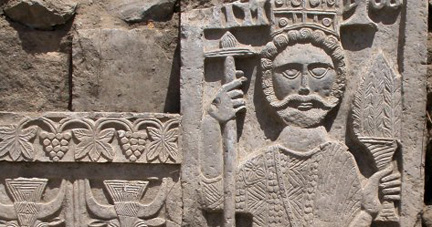
The “crowned man” relief found in Zafar, Yemen is seen as evidence that there was a Christian empire in the region before Islam took hold.

by Matthias Schulz, Der Spiegel, December 21, 2012

The commandment “Make yourself no graven image” has long been strictly followed in the Arab world. There are very few statues of the caliphs and ancient kings of the region. The pagan gods in the desert were usually worshipped in an “aniconic” way, that is, as beings without form.

But now a narcissistic work of human self-portrayal has turned up in Yemen. It is a figure, chiseled in stone, which apparently stems from the era of the Prophet.

Paul Yule, an archeologist from the southwestern German city of Heidelberg, has studied the relief, which is 1.70 meters (5’7″) tall, in Zafar, some 930 kilometers (581 miles) south of Mecca. It depicts a man with chains of jewelry, curls and spherical eyes. Yule dates the image to the time around 530 AD.

The German archeologist excavated sites in the rocky highlands of Yemen, an occupation that turned quite dangerous recently because of political circumstances in the country. On his last mission, Yule lost 8 kilograms (18 lbs.) and his equipment was confiscated.

Nevertheless, he is pleased, because he was able to bring notes, bits of debris and bones back to Heidelberg. Yule has concluded that Zafar was the center of an Arab tribal confederation, a realm that was two million square kilometers (about 772,000 square miles) large and exerted its influence all the way to Mecca. Continue reading Buried Christian Empire Casts New Light on Early Islam

A Conversation with Marjorie Ransom


[The following online video interview with retired diplomat Marjorie Ransom was made by Sama’a al-Hamdani and can be seen here. The description of the interview provided by Ms. al-Hamdani is reproduced below. For a website about Ransom’s work, click here. For an article about her work in Aramco World, click here.]

Many Yemenis feel that their country has been reduced to terrorism. However, many of those who have visited Yemen know that the country has a lot more to offer. At the tip of the Arabian Peninsula, Yemen is one of the few countries that had a culture prior to Islam. Although it is not as prevalent as it used to be, one of the traditions that have survived is the production of unique silver jewelry.

Today’s guest, Ms. Marjorie Ransom, lived the life of a diplomat, traveling for years throughout the Middle East; settling twice in Yemen. Ms. Ransom and her late husband began collecting Yemeni Jewelry and in turn started displaying some pieces in American Museums, like the Bead Museum (DC), Jefferson County Historical Society (NY), Gibson Gallery of the State University (NY), and the Arab American National Museum (MI) (to view the latest exhibit, click here). Jewelry is not just a product of a decorative tradition but it is a historic art that captures the essence of Yemen.

In 2003, Ms. Marjorie Ransom decided to apply for a grant travel throughout Yemen to document this tradition. In October of 2013, the first comprehensive book on Yemen’s tradition of silver-smithing will be available through the American University of Cairo Press. This effort is the first of its kind.

In this interview, Ms. Ransom identifies some types and symbols of Yemeni jewelry. Ms. Ransom also brought several silver-smiths to the US whenever she hosted a Jewelry exhibit. She understands that this trade is becoming less common in Yemen and is one of the few people supporting its revival.