Category Archives: Yemen

Yemen’s National Dialogue


Yemen’s President Rabu Mansour Hadi has issued decree No. (12) for 2013 on Sunday, March 17, forming the presidium of the Comprehensive National Dialogue Conference, which starts today. The officers are listed below:

1- President Abdo Rabu Mansour Hadi as president of the conference.
2- Abdul-Kareem al-Iriani as a vice-president for the conference.
3- Yasin Saeed No’man as a vice-president for the conference.
4- Abdul-Wahab Ahmed al-Anisi as a vice-president for the conference.
5- Sultan Hizam al-Atwani as a vice-president for the conference.
6- Ahmed Bin Fareed al-Sorimah as a vice-president for the conference.
7- Saleh Ahmed Habrah as a vice-president for the conference.
8- Abdullah Salem Lamlas as the conference’s reporter.
9- Nadia Abdul-Aziz al-Sakkaf as a deputy for the reporter.

For a complete list of the 565 participants in Arabic, go here.

The term “dialogue” is ambitious, given the general disrespect held in Yemen for the UN, which is sponsoring this 6-month long exercise. It is hard to imagine how over 500 people can engage in a meaningful dialogue. Is the six months so they can each take the floor and filibuster? While a wide net has been cast, there is still major grievance from the southern secessionists, who staged a strike in Aden on Sunday. Although none of the former major political players will be physically present (including former President Salih, General Ali Mohsen and Sheikh al-Ahmar), they will certainly be represented by some of the participants. One is always hopeful that a path to national reconciliation can be forged. Yemenis did it themselves after the bitter civil war in the 1960s, but that was before decades of military rule eroded most Yemeni support for the central government. Still, talk is always better than bullets, so let the dialogue begin.

Passport Blues

Yemenis seeking American citizenship pay exorbitant dowries in lucrative marriages of convenience

by Nadia Haddash, Yemen Times, March 7, 2013

Getting a visa from the American embassy in Sana’a is not easy for Yemenis hoping to travel to the U.S., and is especially hard for young, single men. So, many seek an alternative route: marrying a Yemeni-American woman.

By doing so, they typically become American, too, but could be in debt for years—they often have to pay huge dowries for their dual citizen brides.

Walid Al-Asimi, 28, met his wife, a Yemeni-American, in an English institute in Sana’a.

“When I knew that she would travel to America I decided to marry her,” he says. “I was surprised when her father asked me to give $30,000 as a dowry.”

The majority of Yemeni youths who marry women with dual citizenship pay very high dowries, ranging between$10,000-50,000, or around YR 2 million- 11 million. By comparison, a typical dowry paid to a bride’s family in Sana’a is around $4,000 or YR 800,000. The dowry paid to brides’ families in rural areas of the country is much less still. Continue reading Passport Blues

Yemenite Jews: A Photographic Exhibition

An exhibition of photographs of Yemenite Jews is on display from February 1- April 30, 2013 at the Katz Snyder Gallery in San Francisco. The entire collection can be seen online.

Israeli photojournalist Naftali Hilger’s breathtaking photos of Yemen reveal a nation and a landscape lost in time. His intimate portraits of the isolated Jewish communities of Yemen, taken over a period of 20 years, have been most recently seen in a widely heralded exhibition at the Museum of Islamic Art in Jerusalem.

Hilger’s life-altering love affair with the mysteries of Yemen began in 1987. Over six subsequent trips from 1987 through 2008, he documented not only one of the most ancient communities in the Jewish diaspora, but Muslim Yemen as well – its markets, its landscapes and the fascinating architecture of Sana’a and the rural villages.

Dro[w]ning life, liberty and the pursuit of not being targeted


Anwar al-Awlaki, left, an operative in Al Qaeda’s Yemeni branch, was targeted in a strike that also killed Samir Khan, the creative force at a militant Web magazine. Both were Americans; Left, Linda Spillers for The New York Times; right, WBTV, via Associated Press

Today’s New York Times features a major article by MARK MAZZETTI, CHARLIE SAVAGE and SCOTT SHANE entitled “How a U.S. Citizen Came to Be in America’s Cross Hairs.” Actually the article discusses how three American citizens were the victims of drone attacks in Yemen in late 2011. The primary target was Anwar al-Awlaqi, who is described in the article as “the firebrand preacher, born in New Mexico, who had evolved from a peddler of Internet hatred to a senior operative in Al Qaeda’s branch in Yemen.” He was a socially mediated firebrand, far better known for his English than having an impact on recruiting terrorists in Yemen. Killed in the same after-breakfast attack was Samir Khan, “the creative force behind Inspire, the militant group’s English-language Internet magazine” and someone (basically a propaganda journalist) who was not considered important enough to specifically target. The article continues: “The next month, another drone strike mistakenly killed Mr. Awlaki’s 16-year-old son, Abdulrahman, who had set off into the Yemeni desert in search of his father. Within just two weeks, the American government had killed three of its own citizens in Yemen. Only one had been killed on purpose.” The 16-year old fell victim to a botched targeting:

Then, on Oct. 14, a missile apparently intended for an Egyptian Qaeda operative, Ibrahim al-Banna, hit a modest outdoor eating place in Shabwa. The intelligence was bad: Mr. Banna was not there, and among about a dozen men killed was the young Abdulrahman al-Awlaki, who had no connection to terrorism and would never have been deliberately targeted.

The drone issue has recently resurfaced, most notably in Mr-Rand-Paul-goes-to-Washington’s 13 hour filibuster. Continue reading Dro[w]ning life, liberty and the pursuit of not being targeted

Bodega Yemeni Style in Brooklyn


Photo by Kiran Sury

Yemeni Immigrant Saga
Every time you buy a beer or a lottery ticket at a bodega run by Mohamed Mohamed or one of his countrymen, you tap into a story of ethnic succession and a struggle to reconcile one culture with another

by Kiran Sury, The Brooklyn Bureau, Monday, Jan 7, 2013

On the corner of Flatbush Avenue and Glenwood Road in Brooklyn, Mohamed Mohamed runs Gold Star Deli Grocery with his father Mohamed and another employee, also named Mohamed, all of them from Yemen. This unique situation arises from Arabic nomenclature. “The customers get confused, but not us,” jokes the younger Mohamed. His father, whose full name is Mohamed Abdullah Alrohani, has come up with a more pragmatic solution: just call him Alex.

Across Glenwood Road, Sadek Almontaser mans the counter of the recently opened Glenwood Deli, a corner store. Cigarettes are sold behind the counter, drinks and chips line the walls, and a small deli section offers fresh sandwiches – staples for any bodega.

But to the discerning eye of a corner-store connoisseur, there are several features that are not so standard.

As Almontaser deals with a steady stream of lottery ticket buyers, he happily discusses how Iranian President Mahmoud Ahmadinejad isn’t a bad man, just misunderstood. His uncle Ali, who runs the deli station, is 11 years his junior, a genealogical feat made possible by his grandfather’s four wives back in Yemen. Ali will be happy to make you a BLT, though he may forget to mention that the bacon is made of beef, not pork. And every so often a man will enter the store, nod to Almontaser, and make his way downstairs. Not every bodega has a prayer room in the basement.

Across the street yet again, on the other side of Flatbush Avenue, the eponymous Yafai Deli and Grocery is run by Saad Yafai. He shares it with his brother Nabil, who is currently back home in Yemen. His entire family is in Yemen, and he and his brother take turns staying in America and running the family store.

Most New Yorkers would agree that the deli/convenience store, once the exclusive purview of Jews, Italians and Germans, has come to be associated with Latinos. The word bodega, which is used interchangeably with deli, is Spanish for “warehouse” or “cellar”. According to data from the Brooklyn Chamber of Commerce, the number of firms in the borough classified as supermarket or convenience stores almost doubled during the first decade of this century. But the three stores on the corner of Glenwood Road and Flatbush Avenue show that Latinos are no longer dominant, as shifting demographics have opened up a new ethnic segment of the market. An influx of Arabs has brought a corresponding increase in Arab storeowners, each eager to pursue his own version of the American Dream.

* * * * *

Clifton Clarke, professor of finance and business management at Brooklyn College, says that shifting populations opened a void for new businesses to fill, and that companies often change according to their target market. When Arab immigrants started to populate new neighborhoods, it made sense for them to manage the corner stores as they could better cater to Arabic needs. “Ethnicity, population, drives the type of businesses that are developed,” he says. “And these bodegas, which are now mostly run by Arabs, just fit in nicely.” Continue reading Bodega Yemeni Style in Brooklyn

7000 Manuscripts in Zabid


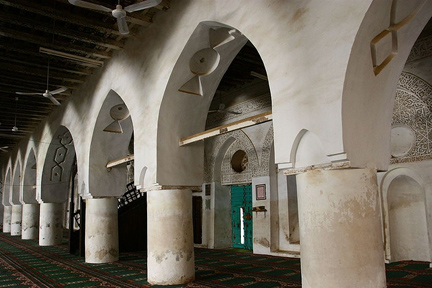
Zabid mosque interior; Photograph by Eric Lafforgue

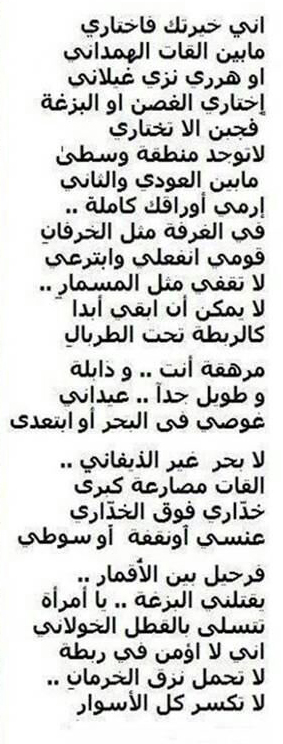
مدير مرگز المخطوطات في زبيلـ

هناك سبعة آلاف مخطوطة في زبيد!

الجمعة 25 يناير-كانون الثاني 2013 الساعة 01 صباحاً / الجمهورية نت – توفيق حسن أغا

لم يتبق لمدينة زبيد التاريخية إلا أربعة أشهر من المهلة التي منحت لها من قبل لجنة التراث العالمي التابعة لمنظمة الثقافة والعلوم (اليونسكو) إما أن تطمس أو تكون في قائمة التراث العالمي؛ ومنذ عام 2007 وزبيد بين مد وجزر وكلما تنفست الصعداء وجدت أحدا ينغصها ويباعدها عن بلوغ بوابة التراث العالمي، كلما اقتربت من البقاء في هذه القائمة التي كتبت فيها زبيد عبارة دون بقاء منذ عام 1993م ، ومن هذا التنفس وجدت هذه المدينة عام 2007 من مبنى دار الضيافة رفاً وجدته حينها هو المكان المناسب لحفظ ما تمتلكه من مخطوطات، ولكن عندما وجدت ضالتها في هذا المكان وجدت من يطمع بأخذ هذه الدار من يدها ليهدم ما بنته “ زبيد” في ساعة زمن

الجمهورية كانت في اليومين الماضيين في أروقة دار الضيافة سابقا ومركز المخطوطات حالياً، وبعد أن رأت العجب العجاب حول ما يدور حول هذا المبنى والذي إذا قدر الله وتحول إلى مكتب أوسكن أو لمصلحة أخرى عما هو عليه كمركز مخطوطات ستكون واقعة أخرى لن تتحملها مدينة زبيد التاريخية، ولمزيد من التفاصيل التقت (الجمهورية) الأستاذ عرفات الحضرمي ـ مدير مركز المخطوطات في مديرية زبيد وأجرت مع الحوار التالي..
من يكسب..؟!

بداية كيف تحدثنا عن هذه الخلفية التي تم فيها التزامن في اختيار دار الضيافة وتحويله كمركز للمخطوطات؟
Continue reading 7000 Manuscripts in Zabid

Vienna Conference


Rasulid polo players, ca. 1260-1270; Museum für Islamische Kunst, Berlin

This week I am participating in a conference in Vienna and will deliver a paper on Rasulid bureaucracy. Details on the conference are noted below. Anyone in or near Vienna is welcome to attend.

3rd International Conference of the Research Network Imperium & Officium: Land and Power in the Ancient and Post-Ancient World, University of Vienna, 20–22 February 2013

In addressing the theme of ‘Land and Power’ we wish to examine the power base of office-holding élites in pre-modern societies. As a tool of analysis we frame our questions in Weberian terms, distinguishing between exercise of power in a bureaucratic mode (ex officio) and power based on economic wealth and privilege in a patrimonial setting, with office being conferred as a consequence. Our focus will be on the interplay between economic power and bureaucratic rationality. In most pre-industrial societies, power and wealth was based on landownership and the control of food production: landownership as the basis of power of an office-holding élite is a recurring phenomenon in ancient states. We also seek to question whether such élites (especially in the periphery) were a force for cohesion or disruption from the point of view of the state, and to investigate the means by which the state sought to integrate and control office-holding élites, e.g. by the use of parallel and/or overlapping chains of command, or by co-optation through court offices and privileges.

Programme (provisional)

Wednesday, 20 February 2013

9–9.30 a.m. Welcome address by Jursa, Michael and Palme, Bernhard (Vienna)

Section 1: Elite Formation

Chair: Jursa, Michael

9.30–10 a.m. Garfinkle, Steven J. (Washington): Landownership and Office-Holding: Pathways to Privilege and Authority under the Third Dynasty of Ur

10–10.30 a.m. Kaiser, Anna (Vienna): Flavius Athanasius, dux et Augustalis Thebaidis

10.30–11 a.m. coffee break

11–11.30 a.m. Scheuble-Reiter, Sandra (Chemnitz): Military Service and the Allotment of Land in Ptolemaic Egypt

11.30–12 a.m. Paulus, Susanne (Münster): The System of Landownership in the Middle Babylonian Time (1500–1000 BC) Continue reading Vienna Conference