Category Archives: Yemen

The Yemen Spring nipped in the bud? Where do we go from here?


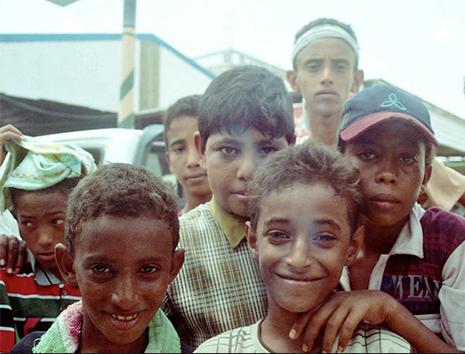
Yemen’s future; photograph by Rayman al-Hamdani

By Samira Ali BinDaair

The Yemeni version of the Arab spring has not received the attention it deserves in international media where most of the attention has been focused on reporting events and the conflicting politics of the different actors on the Yemeni scene; nothing much has been said about the dynamics of the youth revolution in the squares. The countries in the region have not taken the youth-propelled Spring seriously either, conveniently referring to it as fueled by political differences. While hundreds of youth were being brutally massacred, these nearby countries simply procrastinated in efforts to put real pressure on the regime. They played the cards they obviously held seeing that they were the financiers of the regime and the powerful tribal lords in Yemen.

In the later stage of the Spring, there were feeble attempts to persuade the regime to relent, while in another breath making it conditional upon the dismantling of the change square, so that the upheaval did not spill over the borders to ignite dormant fires, in which flames were being extinguished successfully so far. Then there was the long saga of “will he sign or will he not sign?” with the Gulf Initiative which had gone through so many changes with the claim that the red carpet had to be removed slowly lest the regime turn into a ferocious bull that might go charging and throw the country into civil war. There was some truth in that argument seeing that the regime was armed to the teeth, with the military being a family business rather than a national army for the protection of the country from outside aggression. The US in its battle with al-Qaeda had chosen Yemen as the main battleground for this, with all the paraphernalia of unmanned drones, rigorous security screening. All the while, it was training the military and supplying the most sophisticated weapons as part of its anti-terrorist agenda. Therefore to draw a parallel, the US had powerful cards to play with the regime, for as the saying goes,”he who pays the piper calls the tune”. However, despite the murmurs about the regime using the weapons intended for the fight with the al-Qaeda on Yemeni civilians, the regime suffered no penalties for such abuse. Perhaps the US too saw some advantage in keeping the power balance intact, uncertain as it was of the new emerging powers and their loyalties. Continue reading The Yemen Spring nipped in the bud? Where do we go from here?

Agricultural policy in Yemen’s highlands and lowlands


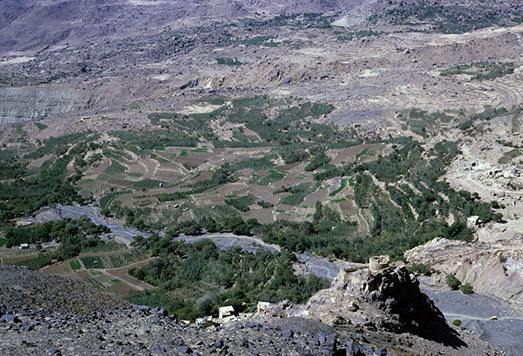
Terraced fields below al-Saraha in valley of al-Ahjur; photograph by Daniel Martin Varisco

by Zaid Ali Alwazir, La Voix du Yemen, June 9, 2013

Agricultural policy describes a set of laws related to the local farming and imported agricultural products from abroad. These laws are supposed to be implemented to get certain results such as utilizing the land, operating it or stabilizing prices of imported and local products.

Since the start of the “youth revolution” in Yemen, talks about the political and economic reforms got increased without focusing on “the agricultural economy” as if it was not part of the general “economy”. Therefore, no attention was paid by reformers to this issue since their talks had been focusing on “the material economy” such as “taxes”, “Zakat” and others.

“Agricultural economy” is not given the required attention despite the fact that agricultural development would feed the budget with more income, boost up farmers’ capacity to give more and optimize their living standards to ensure their welfare. Continue reading Agricultural policy in Yemen’s highlands and lowlands

Yemen’s National Dialogue Behind Closed Doors

by Sama’a al-Hamdani, Atlantic Council, June 17, 2013

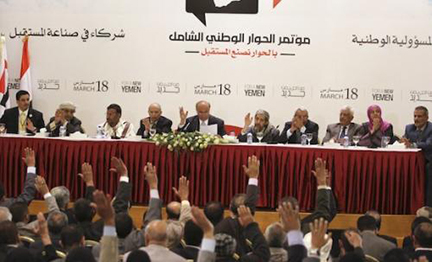
Yemen’s National Dialogue Conference (NDC), which began on March 18 and just reached the halfway point of its six-month mandate, was conceived as a core part of the transition process and is intended to bring together Yemen’s diverse political, social, geographic, and demographic groups to address the most critical issues plaguing the beleaguered country. Unfortunately, the way the dialogue was developed, designed, and directed created intrinsic flaws that may undercut its success. Some argue that the large number of participants and the lack of genuine representation outside of political parties are the reasons it is doomed for failure. Others feel that the process is advancing too quickly, leaving honest reconciliation out of the equation. One of the other major concerns is the lack of clear communication with the Yemeni public, transparency of the proceedings, and oversight of expenditures.

Although some Yemen experts remain pessimistic about the future of the country, they refrain from critiquing the dialogue because the outcome is still unclear and many perceive the dialogue as the only way to prevent a descent into civil war. Particularly because the process is opaque and because there is genuine skepticism about the Gulf Cooperation Council (GCC) transition agreement and the dialogue itself, the NDC should pro-actively report on all working group and plenary proceedings, publish all records and modifications, and disclose all financial contributions and allocations. This is the time to measure the discrepancy between the dialogue’s stated intention and the reality on the ground, if there is hope for effective progress. Continue reading Yemen’s National Dialogue Behind Closed Doors

Displaced in Yemen: A Life on Hold

IRIN’s film, A Life on Hold, tells the story of Qasim and his family, who for the past three years have been living in a camp for internally displaced people (IDPs) in northwestern Yemen.

Years of conflict in the region between the Houthi tribe and government forces has led to the displacement of more than 300,000 civilians, who have to cope with a decline in health and educational services. Malnutrition is common in the IDPs camps, as well as in the apartments, mosques and schools where many have found shelter.

Authorities have tried to encourage the displaced to go back to their homes, but renewed clashes in 2012 actually increased the IDP numbers in the north. Extensive damage to houses and infrastructure, continuing insecurity, fear of reprisals and the lack of livelihood opportunities and basic services all serve as deterrents to return.

For more information on the situation in Yemen, please visit:

http://www.irinnews.org/Country/YE/Yemen