Category Archives: Yemen

Beyond al-Qaeda, the real Yemen


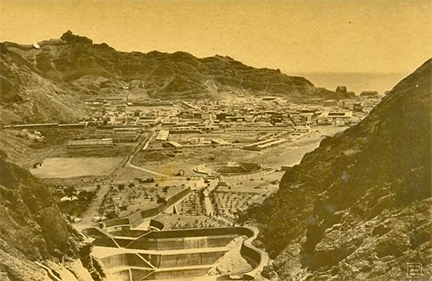
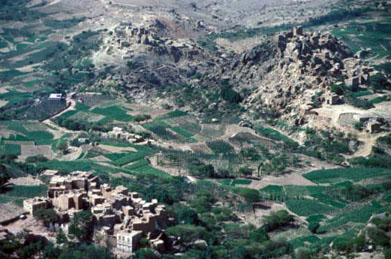
The fertile valley of al-Ahjur

by Abubakr Al-Shamahi, Common Ground News,August 20, 2013

Sana’a, Yemen – This month’s unidentified threat that led to the closure of the United States embassy and several US drone strikes around Yemen has once again shone an international spotlight on the country.

Simply put, as a Yemeni, I fear that all Yemen appears to be to the outside world is a front in the fight with al-Qaeda. But Yemen is more than terrorism and bombs, and many Yemenis are eager to ensure that this does not become the dominant narrative around the world.

Atiaf al-Wazir, a prominent Yemeni activist, voices the frustration of many Yemenis. In a piece for Your Middle East, she talks of a “country with a long history that was once hailed as Arabia Felix, land of generosity, wisdom, coffee, the first sky scrapers, the land with many queens and great architecture,” now overshadowed by “the hysteria of the decade: terrorism.”

If international observers look closer, they will find a country that has the potential to be far removed from a hotbed of fundamentalism. They will find a country undergoing an interesting political transition, one that is hugely important for the region. Continue reading Beyond al-Qaeda, the real Yemen →
Airing out on Area Studies: Confessions of a Middle East Area Specialist

[These remarks were written on the train back to New York after the 1997 AAA meetings in Washington. I had earlier provided extemporaneous remarks on the subject at the business meeting of the Middle East Section. I found these in a set of old files and decided such a confession is timeless, at least in my case. And this year I will again be presenting papers at both AAA and MESA. ]

The idea of “Area Studies,” especially those areas where several centuries of Western colonialism have helped define the modern boundaries, is under attack. One of the more besieged areas is the Middle East, once the Near East and part of the politically uncorrected Orient as such. I am not particularly interested in defending Area Studies as such. But I am dismayed at the weakening of Middle East Studies programs at major universities. As an anthropologist who encourages other anthropologists to work in the Middle East, I appreciate the teaching of Middle Eastern languages, literature, culture, history, politics, economics, etc. as potentially useful information for ethnography. I do not know how trying to learn “too much” about the region could distort one’s anthropologizing.

Each fall I have a major decision to make: should I go to AAA or MESA? Continue reading Airing out on Area Studies: Confessions of a Middle East Area Specialist →

Morsi: The Arab World’s Wannabe Mugabe

I wonder if the judges who dole out the increasingly meaningless Nobel Peace Prize ever have second or third thoughts. In 2011 the Yemeni journalist Tawakkul Karman shared the prize for her visible opposition to the regime of Yemen’s Ali Abdullah Salih. The prize is symbolic to be sure, so it is not surprising that a recipient becomes hyperbolic with the international public attention. Karman was picked because of her advocacy work in Yemen, not because she was a savy expert on Middle East politics. A week ago she decided to cash in on her reputation and lend support to the sit-in followers of deposed President Morsi. The Egyptian authorities, not unsurprisingly, denied her entry for an obvious propaganda tour for the Muslim Brotherhood. Karman is shocked, it seems, that a military regime that would oust a sitting president would then deny her entry to come into Cairo and provide support for the opposition.

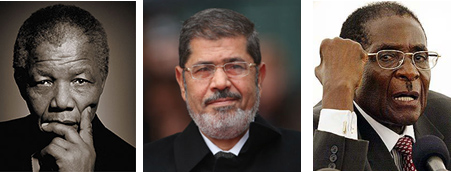
Foreign Policy has posted a commentary by Karman entitled Morsy Is the Arab World’s Mandela, with the subtitle Why we must stand and support the Muslim Brotherhood’s fight for democracy. Nelson Mandela? At a time when this fellow recipient of the Peace Prize (in 1993) is rumored to be near death’s door, this is an insult to the work of Mandela to end South Africa’s apartheid. My point is not to vilify or defend Morsi, but to compare him to Mandela is pure media hype. Continue reading Morsi: The Arab World’s Wannabe Mugabe →