Category Archives: Yemen

Princeton Geniza Project

The Princeton Geniza Project of the Department of Near Eastern Studies at Princeton University seeks to extend the methodologies available to Hebrew and Arabic scholars working with the documents found in the Geniza chamber of the Ben Ezra Synagogue in Cairo in the late 19th century. The project is dedicated to transcribing documents from film copies to computer files, creating a full text retrieval text-base of transcribed documents, developing new tools such as dictionaries, semantic categories and morphological aids to further the study of Geniza texts. The project is committed to disseminating its materials as widely as possible to the international community of scholars with an interest in the life of the medieval Middle East, as well as to all with an interest in Judaica. It is our hope that by making materials from this very esoteric field widely available that new insights can be gained into the interaction of the peoples of the Middle East in past time. Since inception in 1986, funding has been provided by Princeton University, the Department of Near Eastern Studies, and from 2000 to 2005 by the Friedberg Genizah Project.

A Wolff in Shepherd’s Clothing, #2

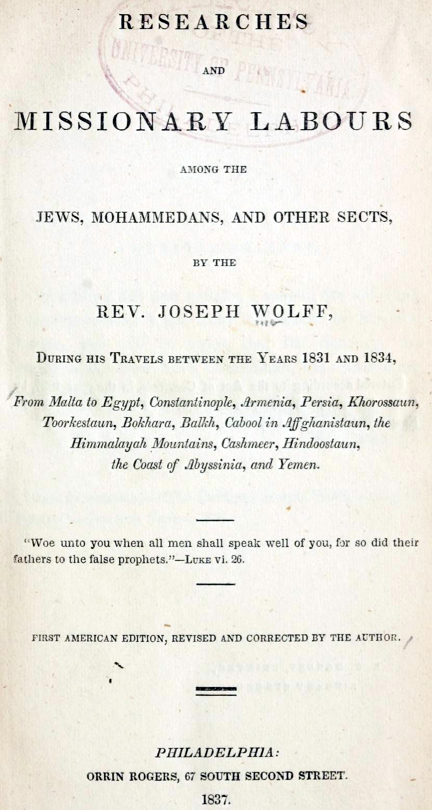
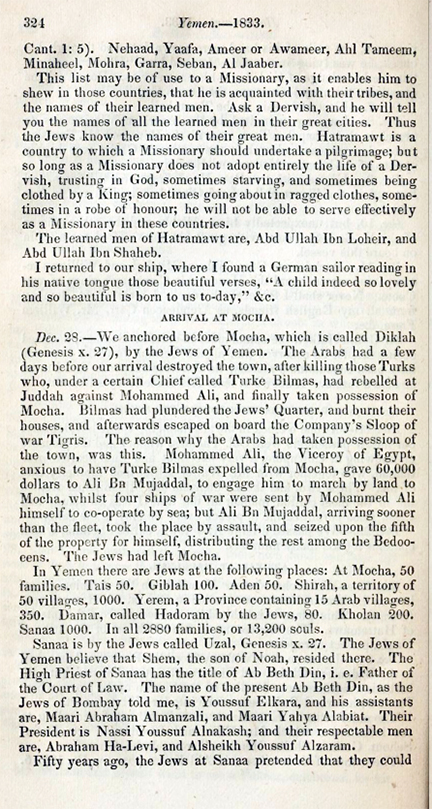
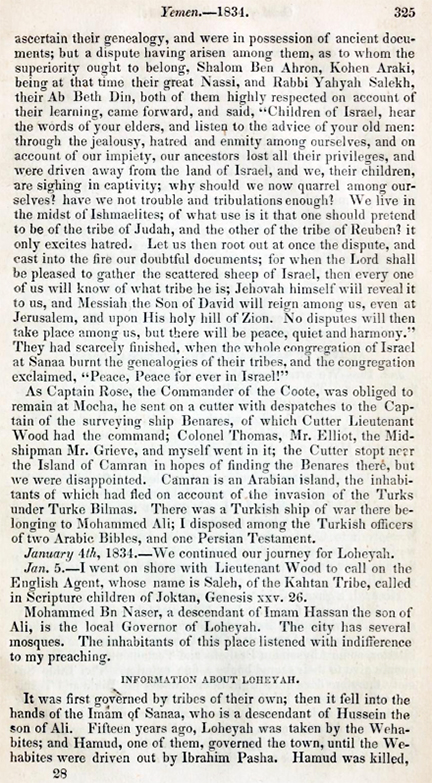
In the early 19th century there was a florescence of Protestant missionary interest in saving Muslim, Jewish and other kinds of Christian souls in the Middle East. This thread continues excerpts from one of the earliest accounts from the 19th century, that of Joseph Wolff (1795-1862), a convert from Judaism to Christianity. In 1837 he published a diary of his travels. Here are the passages related to a brief stop in several of Yemen’s ports:

to be continued…

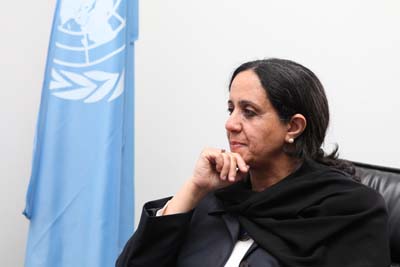
Amat al-Alim al-Soswa at Hofstra

The Middle Eastern and Central Asian Studies Program of Hofstra University is pleased to announce a public talk by the Yemeni diplomat Amat al-Alim al-Soswa, who will be speaking about her recent work on Yemen’s National Dialogue. Details are provided here. This will take place on campus in 101 Barnard Hall on Thursday, October 24 from 2:20-3:45. For more information, please contact me at daniel.m.varisco@hofstra.edu.

Since March 2013 , Amat Al-Alim Alsoswa has been a member of the Yemen National Dialogue Conference and a member of its State Building Team. She also chaired a subcommittee to prepare and suggest the criteria and term of reference for the constitutional drafting committee.

She was appointed in December 2005 by United Nations Secretary-General Kofi Annan as Assistant Secretary-General, Assistant Administrator of the United Nations Development Programme and Director of its Regional Bureau for Arab States. In this post, Alsoswa has led UNDP’s 18 programme offices in the Arab region in their efforts to develop national capacities for poverty reduction, democratic governance, sustainable development, crisis prevention and recovery, and women’s empowerment. She has also provided regional thought leadership through the launching of two editions of the Arab Human Development Report, in 2006 and 2009, and in the preparation of the for the 2012 edition. Continue reading Amat al-Alim al-Soswa at Hofstra

The Boon in Yemen’s Bun


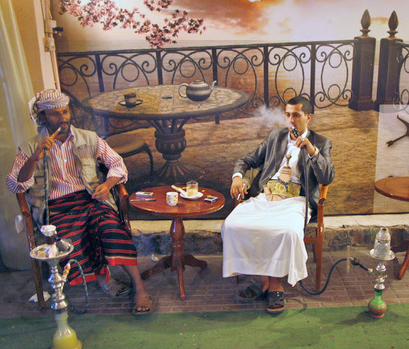
Men smoke shisha water pipes in a cafe in Sanaa, Oct. 1, 2011. (photo by REUTERS/Ahmed Jadallah)

Yemen’s Modern Coffee Shops: Progressive, Yet Exclusive
by Farea al-Muslimi, Al-Monitor, September 5 2013

SANAA, Yemen — Over the past few decades, Yemen has been known to conjure images of serious conservatism, isolation between men and women and male dominance over issues pertaining to daily life.

However, things look different here: A group of boys, girls, men and women are having discussions in modern coffee shops, which have become popular in the past 10 years and have significantly become more common across Sanaa in the past few years, including the historical part of the old city. The coffee shops, however, are more concentrated in the southwest of the city, where the richest and most open neighborhood, al-Siyasi Hadda, is located. They have become posh meeting spots for the privileged classes that can afford it.

There are coffee shops with foreign names that largely resemble any coffee shop in Amman, Cairo or Beirut, but the difference here is that the stone buildings are more elegant and posh.

Waitresses — hailing from Ethiopia and East Asia, alongside a few Yemenis — wear uniforms and serve you with a gentle smile that you cannot find elsewhere in the city. In fact, you usually cannot so much as look at a woman’s body, even if she were covered from head to toe. One can typically see little more than the standard black abaya, or a niqab for the more conservative.

You can order hot or cold beverages and Western snacks, the names of which are unknown to many people. Moreover, you can spot the most modern and cleanest coffee shops if you do not smoke shisha [sweetened tobacco smoked with a water pipe]. Some coffee shops offer it for high prices, while others do not find it suitable to be served in their establishment. Continue reading The Boon in Yemen’s Bun

How to Kill a Terrorist


Predator drone

by Abdullah Hamidaddin, al-‘Arabiyya, September 11, 2013

On May 23, 2013 in a wonderful speech, that is yet to be translated into action, President Obama declared an end to the Global War on Terror (GWOT) which the U.S. has been waging since the early days after 9/11. Yet, killing terrorists is still on his agenda and that of other leaders around the world, albeit in a more “moderate” fashion. So here are some preliminary thoughts which I believe should guide this policy of killing.

The golden rule for killing a terrorist, actually the two golden rules, are simple and direct. The first golden rule is: do not become a terrorist in the process. The second rule is: do not create two or more terrorists for every terrorist you kill.

Very simple!

Yet the record of the past twelve years tells us that those two rules have been broken again and again and again. Some of those fighting terrorism have become as bad, and sometimes worse, than the terrorists they are fighting. Consequently, a new generation of terrorism has been born out of the very war that was supposed to fight and end terrorism. Moreover radicalization in our region has reached new and unprecedented limits; which is in itself a threat to civil peace. So what I will do here is register some of the ways in which those two rules have been broken, as things to be avoided in future killings.

Before I start with the first rule, I need to define what I mean by a “terrorist.” Continue reading How to Kill a Terrorist

Yemeni Artists


Yemeni artist Ziad Nasser al-Ansi, who won fourth place at the Dubai Cultural Innovation Awards, blends Yemeni architecture with local decoration and patterns. Above, al-Ansi’s painting that won the President’s Award in 2006.

Yemenis take home top awards at Dubai cultural competition

by Faisal Darem, Al-Shorfa, September 6, 2013

Yemeni Bassam Shamseddine was taken by surprise when his wife told him she had submitted his novel, “Laanat al-Waqif” (The Curse of the Stander), to the 2013 Dubai Cultural Innovation Awards without his knowledge.

A bigger surprise awaited him when his book placed fifth in the novel category, he told Al-Shorfa.

Shamseddine is one of three Yemenis who placed at the eighth edition of the awards.

Khaled Abdul Haleem al-Absi placed second in the short story category for his collection, “Wa Alam Adhaat Sihruha” (And the Pains Have Lost Their Magic), while Ziad Nasser al-Ansi placed fourth in the fine arts category.

The winners’ names were published in the September issue of the Dubai Cultural Magazine.

Awards were distributed across eight categories, including UAE cultural personality of the year, poetry, short story, novel, fine arts, dialogue with the West, theatre writing and documentary film.

“This is the first time I have taken part in a literary competition, and the award is a significant moral support for me to continue writing novels and stories,” Shamseddine said. Continue reading Yemeni Artists