Category Archives: Syria

Playing Dice with God in the Middle East: The Putin Way

By Samson A. Bezabeh,

The World War II war time correspondent Emie Pyle once said that “there is no atheist in the fox hole”. What he meant does not only indicate the brutality of war but the honesty that can come out in war. In pronouncing these words, Pyle was pronouncing the truth about mankind, a deceptive being with layers of ideas. The whole thinking behind Pyle’s statement is that man need to be cornered to shade the various facades that he has adopted. As a Christian, the core for Pyle was the presences of God.

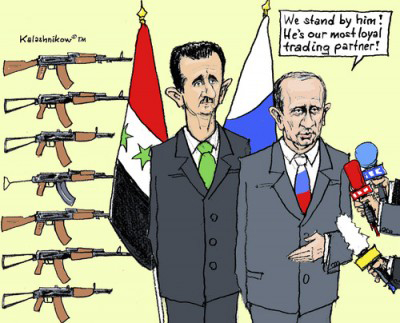
I am not here interested in Pyle or for that matter his view of God but on Putin and his recent comment on the ongoing Syrian affair in New York Times. Russia has been deeply enmeshed in the Syrian affair as a result of a number of strategic interests that the Assad government has been able to give to Russia. Yet Putin goes on to lecture about issues of morality to the American government without mentioning these issues. His focus in that essay was about the animosity as well as cooperation that his country had and is still having with the USA. His other focus was on the American exceptionalism that was pronounced by President Barack Obama. This point he apparently obtained after deeply studying Barack Obama’s recent speech.
Putin’s moralizing article was even more moralizing in its conclusion. Putin invoked the power of the people as he claimed that his article is addressed to the people of America. In his conclusion he even invoked a much higher power: God. He tells us:

There are big countries and small countries, rich and poor, those with long democratic traditions and those still finding their way to democracy. Their policies differ, too. We are all different, but when we ask for the Lord’s blessings, we must not forget that God created us equal (emphasis added).

Although hearing this from an x communist and a former KGB spy is stunning, it is even much more shocking when one realize the dishonesty that is embedded in Putin’s statement. Continue reading Playing Dice with God in the Middle East: The Putin Way
Unbrotherly Brotherhood, Undemocratic Military

The debate over whether or not to send a cruise missile or two into Syria and spank Bashar al-Assad for adding chemical weapons to his bloody arsenal of putting down the revolt in Syria has overshadowed the continuing battle in Egypt for control of the political future. In both situations there is an alarming paradox for most Western observers: there seem to be no good guys wearing white hats, like in an early John Wayne movie. The al-Assad clan has run a security-based dictatorship that, like Saddam Hussein, tortured and killed opponents. But the major opposition, at least at this point in the ongoing civil war, includes a number of extremists who would be as bad a choice to take over. As the American experience in both Iraq and Afghanistan well demonstrates, the friendly (to us) leaders we would like to install (and did with impunity in the old days) do not work out so well these days.

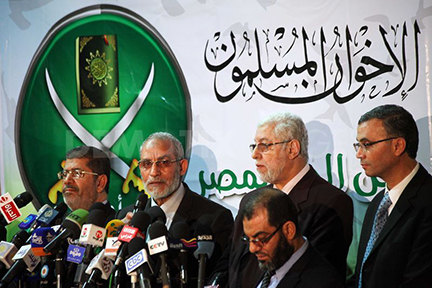
Egypt may not be today’s top story coming out of the Middle East, but it is hardly a stable situation. An article just out in the New Yorker by Joshua Hersh illustrates the clear objective of the Muslim Brotherhood to de-secularize Egypt. Those who came to power around Morsy were not very brotherly brothers and created a backlash by attempting to muscle out those who were not of their ideology. Continue reading Unbrotherly Brotherhood, Undemocratic Military

War is still hell


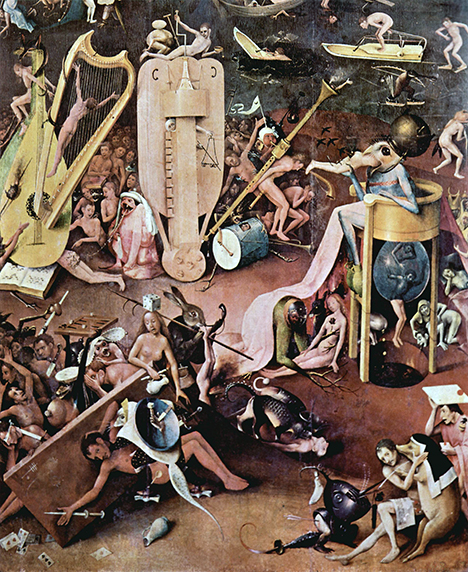
The Garden of Earthly Delights by Hieronymus Bosch, ca 1500

War is hell and it was long before General Sherman figured that out. It helps to remember exactly what “hell” means. In 1741 the Protestant firebrand Jonathan Edwards gave a rather clear picture:

The God that holds you over the pit of hell, much as one holds a spider, or some loathsome insect over the fire, abhors you, and is dreadfully provoked: his wrath towards you burns like fire; he looks upon you as worthy of nothing else, but to be cast into the fire; he is of purer eyes than to bear to have you in his sight; you are ten thousand times more abominable in his eyes, than the most hateful venomous serpent is in ours. You have offended him infinitely more than ever a stubborn rebel did his prince…

Over five centuries ago, the painter Hieronymus Bosch gave an artistic rendering, as noted above. Had he known about poison gas, I suspect we would have seen a few canisters in his registers. In the hell that is war, a Dantean perspective would place the various poison gasses near the bottom level. It now seems that the United States is certain that Syria’s Assad has used poison gas, crossing the rhetorical line drawn by President Obama awhile ago. Foreign Policy is reporting new old evidence that our government is not so much concerned about the use of such poison gas as it is in who are the intended victims. We apparently knew in advance that Saddam would use such gas when we gave him logistical support to fight off the Iranians, whose country he had ruthlessly invaded. And, of course, we did nothing when he gassed the Kurds in Halabja.

The truth is that war has always been hell, since the first historical descriptions. In reality it is never the kind of supposedly heroic “give ‘m hell” bravado of John Wayne or Rambo. Gore trumps the vanity of glory. The problem is that hell is eternally present and not in some far-off ethereal realm. A further problem is that hell has no suitable escape hatch. Thus thousands have died in Syria and many more will be killed on all sides, no matter what the United States does next. The same goes for Iraq, Afghanistan, Pakistan, Palestine and now, it seems, Egypt. Even those who think that by killing someone else because they are … (fill in the sectarian blank) they will go to an imagined heaven only deserve to end up in the hell they create for their victims.

Those of us far away from the fighting, only within Youtube range, may forget how close to hell we really are. The stench of dead bodies and the devastating odorless poison that snuffs out lives lightning quick are not part of the air we currently breathe, but we should not forget that hell is not a place but an attitude, an attitude that kills. It is also an attitude for which there is no real immunity in avoiding its reality. If only we could say “to hell with war,” but then that would be a tautology.

Freelancing the Syrian Conflict


A dark, rancid corner Borri says journalists have failed to explain Syria’s civil war because editors only want ‘blood.’ (Alessio Romenzi)

Woman’s Work
The twisted reality of an Italian freelancer in Syria

By Francesca Borri, Columbia Journalism Review, July 1

He finally wrote to me. After more than a year of freelancing for him, during which I contracted typhoid fever and was shot in the knee, my editor watched the news, thought I was among the Italian journalists who’d been kidnapped, and sent me an email that said: “Should you get a connection, could you tweet your detention?”

That same day, I returned in the evening to a rebel base where I was staying in the middle of the hell that is Aleppo, and amid the dust and the hunger and the fear, I hoped to find a friend, a kind word, a hug. Instead, I found only another email from Clara, who’s spending her holidays at my home in Italy. She’s already sent me eight “Urgent!” messages. Today she’s looking for my spa badge, so she can enter for free. The rest of the messages in my inbox were like this one: “Brilliant piece today; brilliant like your book on Iraq.” Unfortunately, my book wasn’t on Iraq, but on Kosovo.

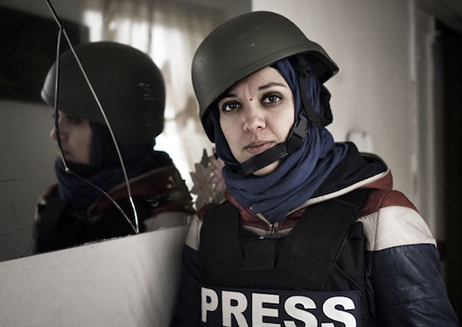
People have this romantic image of the freelancer as a journalist who’s exchanged the certainty of a regular salary for the freedom to cover the stories she is most fascinated by. But we aren’t free at all; it’s just the opposite. The truth is that the only job opportunity I have today is staying in Syria, where nobody else wants to stay. And it’s not even Aleppo, to be precise; it’s the frontline. Because the editors back in Italy only ask us for the blood, the bang-bang. I write about the Islamists and their network of social services, the roots of their power—a piece that is definitely more complex to build than a frontline piece. I strive to explain, not just to move, to touch, and I am answered with: “What’s this? Six thousand words and nobody died?” Continue reading Freelancing the Syrian Conflict

Hezbullies


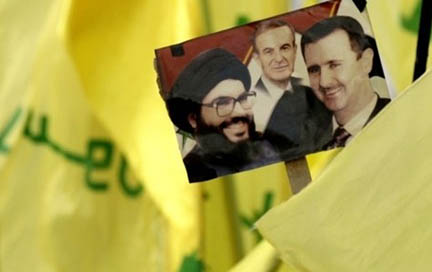
ebanese Hezbollah supporters hold a picture of Hezbollah leader Hassan Nasrallah (L), Syrian President Bashar al-Assad (R) and his late father President Hafez al-Assad (C) in Bint Jbeil on September 22, 2012 (AFP)

[This post was first written a month ago and recently published in Middle East Muddle on Anthropology News.]

The bullet and bomb-blast battle of the bullies is raging in Syria. The biggest bully is Bashar al-Asad, son of Hafez al-Asad who in February, 1982, sent his troops into the city of Homs and slaughtered between 10,000-40,000 civilians who dared to oppose his dictatorial rule. Hafez has slain his thousands, Bashar his tens of thousands. One estimate, reported by Reuters, estimates that between 94,000 and 120,000 Syrians have died in the wake of the Arab Spring that toppled other long-standing dictator regimes. Over a million and half Syrians are refugees who have fled the fighting to neighboring countries, where many do not find even the most basic humanitarian aid. Millions within Syria are in desperate shape, victimized by all sides. But the bully of Damascus hangs on, with Russian backing and Iranian duplicity.

There are other bullies in this fight, from a small faction of radical Muslims intent on reinstalling a caliphate where the Umayyads once ruled to seemingly secular-minded opponents of Asad’s brutal policies. And recently a new bully has arrived, the Hezbollah Hezbullies who control southern Lebanon and thrive as a thorn in the side of Israel. Israel, thus far, has mainly watched from the sidelines, no doubt content to see a bloodbath not directed at them. There was a sharp military response a couple of weeks ago to what appeared to be stockpiles of weapons from Iran on the Damascus road to Hezbollah. Continue reading Hezbullies

Humanitarianism (?) in Lebanon


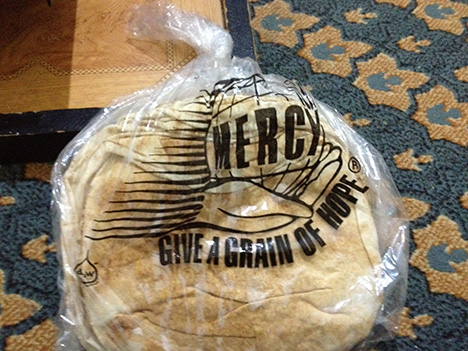
bread provided by NGOs to Syrian refugees in the aid kit in Wadi Khaled (Akkar); photograph by Estella Carpi


A practitioner and a researcher assess humanitarianism in today’s Lebanon

By Fiorenzo Conte and Estella Carpi

In our combined effort of providing the perspectives of the practitioner and the researcher, we would like to take as a point of departure Italian scholar Roberto Belloni’s theses according to which humanitarianism, on the one hand, ends up being the short-term substitute for development, and, on the other, tends to reproduce the same cleavages it tries to overcome.

Humanitarianism as a short-term substitute for development

While conducting research and grounded humanitarian work in Lebanon, we have noticed how humanitarianism, while providing increasing quantity of aid, avoids addressing the root causes of Lebanese chronic poverty, administrative anarchy and recurring war-like events. Predominantly Western and Gulf countries have focused their attention on managing the symptoms of the malaise without effectively addressing its causes and hence engaging in the long term.

The humanitarian needs in Lebanon are surely huge for both Syrian refugees and long neglected Lebanese host communities. With the massive influx of Syrian refugees since August 2011, the Lebanese community, living in the poorest regions, has felt the pinch. Indeed, many residents are currently trying to tackle increased expenditures and a drop in income caused by a variety of factors: the closure of the border and the consequent inaccessibility to Syrian cheaper goods through the usual border-cross smuggling; fierce competition in the labor market that has been increased by the presence of Syrian workers; a deteriorating security situation; and reduced access to the agricultural lands strewn with landmines (1).

The situation for Syrians is similarly grim: according to a recent report, more than 50% of Syrian refugees and Lebanese returnees live in substandard conditions, as Lebanese host communities are no longer able to absorb new flows of refugees in their houses. Continue reading Humanitarianism (?) in Lebanon

Game changer? Game on?


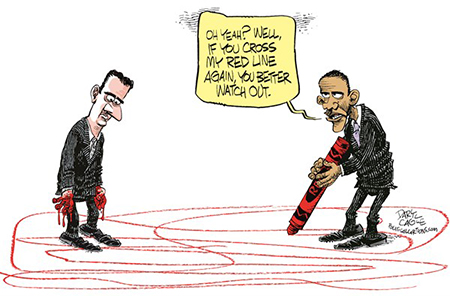
There is always a problem with drawing a line in the sand, especially the shifting sands of Middle East conflicts. President Obama is surely aware of this now, after unguardedly saying that use of chemical weapons by the Syrian regime would be a “game-changer.” The devastation in Syria, where the death toll is now estimated at around 93,000, is no game for the people of Syria or its neighbors, who are absorbing hundreds of thousands of displaced Syrians. In hindsight, President Bush’s “Mission Accomplished” banner summarizes with non-irenic irony the ineptness of his administration’s handling of the last (hopefully the last) Iraq War; will “Game Changer” haunt Obama’s record for future historians? To be blunt, is “game-changer” morphing into “game-on”?

In the rhetorical build-up to the last Iraq War, the hawkish mantra was WMD. Forget the fact that the U.S. gave tactical support to Saddam’s regime in his bloody 80’s war with Iran or had the opportunity to take him out in the earlier Iraq war. The intelligence icing on the “yellow cake” was that Saddam had become a threat to the U.S. (surely Israel was not absent in the equation), even though he had zero to do with 9/11 and was intolerant of any Islamic extremism at home. Although Libya did not seem to have WMDs, it did have the crazy loon Qaddafi, an easy target for removal by an air campaign of the U.S. and its NATO allies. Tunisia and Egypt sprung out of their respective dictatorial nightmares on their own, as the U.S. was basically reduced to observer status. The conflict in Yemen drones on, with the Saudis and the GCC doing the dirty work to redesign Yemen. Forget about changing the scene in Bahrein, where the U.S. docks its naval ships.

So the focus now is on Syria. Well, not just Syria. Continue reading Game changer? Game on?

Poster Orientalism

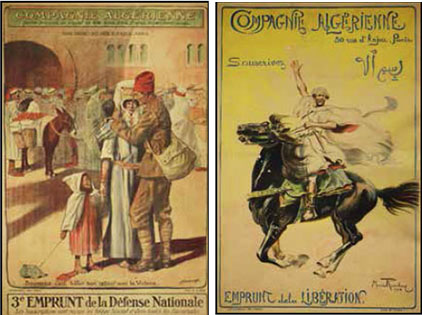
The most recent (April) issue of IMES (Issues in Middle East Studies), the new digital version of the former bulletin of MESA, features an article by Jonathan Casey on posters and old photographs in the National World War I Museum in Kansas City, Missouri. Among theses are two early 20th century era French posters on Algeria, as shown above. The poster on the left is a prime example of the Eurocentric colonialist gaze. Not only is the Algerian pressed into service, but he has a proper nuclear family of wife and child. Of course, as the donkey in the background serves to remind, Algeria is a backward country in need of being civilized. The poster on the right needs no ethnographic context; come to Algeria and be as free as the wind, where the Algerians ride their steeds resplendent in flowing robes. This right one could easily serve as a poster for the 1921 Valentino film, The Sheik.

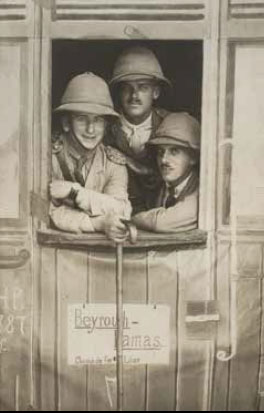
Of the various photographs, the one that struck my attention was of a British soldier named George Mackenzie. This shows the young Lieutenant with his “chums” on the train from Beirut to Damascus. Once again the “Orient” is civilized via the gun. A world war (that did not unfortunately end all wars) that was not caused by anything in the Middle East would change the shape of the region in a dramatic way that is still playing out. To talk of an “Arab Spring,” it is important not to forget the wintry blast that carved up the Ottoman Empire into colonial pieces before oil and the modern state of Israel entered the mix.