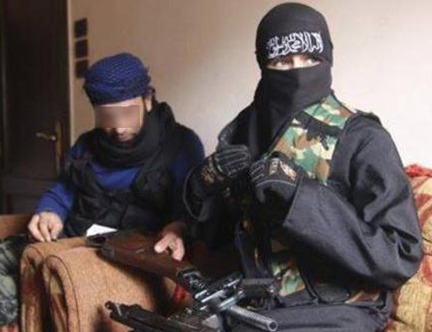
For anyone interested in following the rapidly situation on the ground in Syria, check out the blog “Syria in Crisis” by Aron Lund at the Carnegie Endowment for International Peace.
For anyone interested in following the rapidly situation on the ground in Syria, check out the blog “Syria in Crisis” by Aron Lund at the Carnegie Endowment for International Peace.
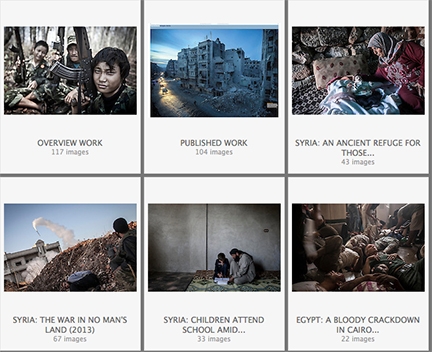
The photographer Narcisso Contreras has an extraordinary gallery of photographs taken in Syria and Egypt on his website.
His biography, as taken from his website, is as follows:
Narciso Contreras is a photographer born in Mexico City, fond of exploring each encounter to precisely capture its most poignant moments. His work focuses in feature stories, reportage and documentary based on religious communities, human nature and conflicts, the later being his main focus for the past years. Contreras has studied Philosophy and Photography, conducting research for many years and dedicating himself to photography professionally for three. Contreras is currently covering the ongoing civil war in Syria. His work has been published in newspapers and magazines all over the world, among others in TIME, the Guardian, the Times, the New York Times, der Spiegel, National Geographic, the Telegraph, the Washington Post, Newsweek, Wall Street Journal, L’ Espresso among others.
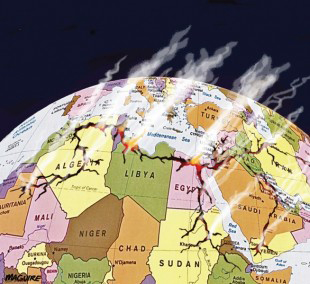
by Daniel Martin Varisco, Middle East Muddle, Anthropology News, November, 2013
As President Franklin Delano Roosevelt prophesied, December 7th, 1941 is a day that lives in infamy, even some seven decades after the event that triggered United States entry into the Second World War. Another date of more recent infamy is December 17, 2010, when a harassed Tunisian vegetable hawker named Mohamed Bouazizi set himself on fire in front of the municipal building in the picturesque town of Sidi Bouzid. Although badly burned, he survived until January 4, just ten days before Ben Ali, the Tunisian dictator for some 23 years, boarded a plane for exile in Saudi Arabia. The first kind of infamy was the beginning of a devastating war, the second became the stimulus for what was hoped to be a sweeping political revolution across the Middle East. Three years later it seems to be politics as usual, a chilly seasonal change from the jasmine scent of the Arab Spring that blew across Tunisia, Egypt, Libya and Yemen and now swirls through the political maelstrom enveloping a surviving dictator in Syria, ongoing instability in Iraq and Afghanistan and a new regime outlook in Iran.
Seasoned pundits know that in many parts of the world spring’s prospects yield to the heat of summer, the cooling autumn and eventually the chilly reality of winter in a never-ending cycle. The Arab Spring is not one season fits all, but the overall effects have been more chilling than thrilling this year. In Tunisia the Islamic party leading the country is in a state of national paralysis following the July killing of opposition MP Mohamed Brahmi. In Egypt the elected president, Muhammad Morsi, remains in military custody and his major party of support, the Muslim Brotherhood, has been banned. The military, under General Sisi, has reinstated martial law in a move that most Egyptians, it seems, support. In both Tunisia and Egypt, the transition to power by Islamic groups who promised not to dismantle the civil state structure has angered a wide range of groups, especially secularists and more moderate Muslims. Continue reading Chilling Prospects for the Arab Spring
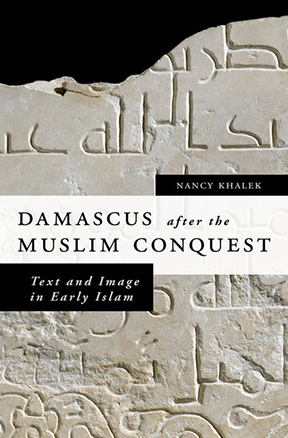
[The following is a link to an interview with Professor Nancy Khalek on her recent book, Damascus after the Muslim Conquest: Text and Image in Early Islam
Oxford University Press, 2011]
by Matthew Long, New Books in Islamic Studies, September 6, 2013
A top five finalist for the Best First Book in the History of Religion Award, Damascus after the Muslim Conquest (Oxford University Press, 2011) by Nancy Khalek, professor of Religious Studies at Brown University, is a study of the city of Damascus, the seat of power for the Umayyad dynasty. More specifically, this book explores the interaction between the recently arrived Muslim Arab rulers and the Byzantine-Christian peoples who made up the majority of the population in Syria. Khalek employs both traditional historical texts, such as Ibn ‘AsÄkir’s TÄrÄ«kh Dimashq, along with art and architecture from the region. She displays a mastery of both the Muslim and Christian sources, discerning the value of their historicity but highlighting the narrative and iconographic significance that can be extrapolate from those sources. During her study of the stories and art, the narratives and iconography reveal that the Muslim and Christian cultures of Syria were in a type of dialogue with each other. She takes care to avoid stating this was a replacement one culture or one borrowing from anther, but instead wishes to portray a blending of these cultures; a blending whose legacy lived on for centuries. Khalek’s work is truly a significant contribution to the field of Islamic Studies and an indispensable interdisciplinary study for both its use of a variety of lesser known source material and its re-imagining of Umayyad history in Syria.
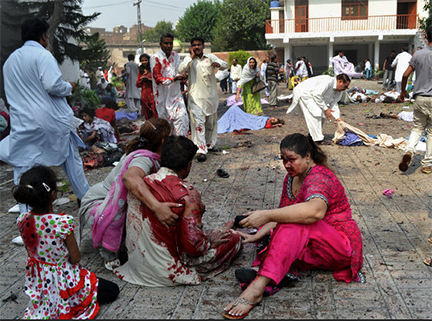
Up to 600 worshipers had attended the service and were leaving to receive free food being distributed on the lawn outside when two explosions ripped through the crowd. Photograph by Mohammad Sajjad/Associated Press
Enough blood has been shed in the past few days to make any sane person question how anyone could possibly justify such cold-blooded and senseless attacks on innocent people. The poison gas in Syria is bad enough, but now we hear that the Somali Shabab have decided to kill shoppers in a Nairobi mall rather than play Captain Hook off the East African coast and now at least 78 Pakistani Christians are killed in a blast at a historic church. This is the ugly side of religion. More than a hijacking of Islam, this is dragging the faith that produced great scholars like Ibn Sina and al-Ghazali into the sewer. To say that the Prophet Muhammad would have condoned this kind of indiscriminate murder is as absurd as the medieval Crusader claim that Jesus would bless the slaughter of Jews and Muslims. But at least the crusades ended several centuries ago.
Muslims killing fellow Muslims or Muslims targeting Christians for death are both equally insane acts. Every day the death toll rises in Iraq and Syria, as though we have returned to the days of the Mongols and Mamluks. Continue reading Enough! Damn this continued violence
Newspapers love a juicy story line. What could be more apt for tabloid sensationalism than one that combines multiple sex partners and jihad fighters? The Telegraph (no one seems to have informed the management that telegraphs are a bit on the ancient side these days) has come up with the following headline ‘Sex Jihad raging in Syria, claims minister” for its September 20th edition. Here are the lead paragraphs…
Tunisian women have travelled to Syria to wage “sex jihad” by comforting Islamist fighters battling the regime there, Interior Minister Lotfi ben Jeddou has told MPs.
“They have sexual relations with 20, 30, 100” militants, the minister told members of the National Constituent Assembly on Thursday.
“After the sexual liaisons they have there in the name of ‘jihad al-nikah’ – (sexual holy war, in Arabic) – they come home pregnant,” Ben Jeddou told the MPs.
He did not elaborate on how many Tunisian women had returned to the country pregnant with the children of jihadist fighters.
Jihad al-nikah, permitting extramarital sexual relations with multiple partners, is considered by some hardline Sunni Muslim Salafists as a legitimate form of holy war.
The minister also did not say how many Tunisian women were thought to have gone to Syria for such a purpose, although media reports have said hundreds have done so.
Here is a new twist that might actually revolutionize the way jihad is being waged by the most militant crazies. Continue reading Make love and make war?
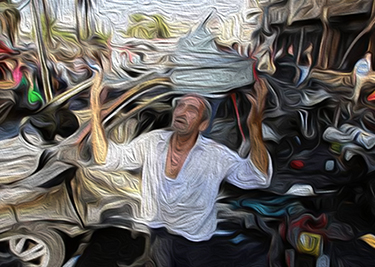
The artificial polarization of “communities of sufferingâ€: when political violence paves the way to a common ground
by Estella Carpi
I still remember when the Secretary-General of Hezbollah, Sayyid Hassan Nasrallah, in the speech he held on occasion of the Martyr’s Day on 12th November 2012, used the term munafis (rival) to indicate the Lebanese opposition parties, instead of ‘adu (enemy), which is only used by the party to point to their enemy par excellence, the Zionist entity. This detail helps create a picture of the Lebanese political scenario of the last two years, in the constant attempt of local parties to maintain relative stability within the country’s boundaries, in spite of the aging bloodshed in neighbouring Syria.
In the currently increasing insecurity of life in Lebanon, community as an interpretation grid – and specifically the “belonging†to a given community – seems to be, again, a sine qua non of any understanding of local suffering, historical scars, and individual worldviews. Community, meant as a primordial notion, has always been used as a protective identity shelter in time of crisis: Lebanon constitutes the perfect historical case in point. As such, community is imagined by all of us as a comforting source for empathy and solidarity, particularly in the chronicity of a fragmented and flimsy state sovereignty. After the bombing in Dahiye – as the southern suburbs of Beirut are locally called – last 15th August, and in Tripoli, in North Lebanon, last 23rd August, all residents apparently have come to reshape two separate communities of suffering. Continue reading Lebanon: Comments on “Communities of Suffering”
In today’s New York Times columnist Nick Kristoff responds to critics of his support for targeted missile strikes on Assad’s regime to send a lesson about the use of poison gas. I agree with his opening comment that columny (whether by a columnist or not) is not a very useful way to think about a complex issue. There is indeed a lot of bluster, so much so that one might metaphorically call the debate over the use of a retaliatory strike on Syria poisoned from the start. For President Obama, drawing a red line in a public speech was bound to be seen as a red flag by the bullshit artists of the Tea Party anti-Obama-anything club. For Republicans who wore their hawkishness on their sleeves under Bush to criticize Obama for daring to apply American military power to a foreign conflict, the irony is very much the epitome of politically expedient hypocrisy. Then we have the normally peace-promoting liberals who want to make a principled statement about the horrific results of using chemical weapons. How could there be anything but contentious calumny?
American public and political outrage at Assad’s callous use of poison gas has a red line as well: virtually unanimous agreement on all sides that there shall be no American boots-on-the-ground. Given that the U.S. has an arsenal that makes that possible, as was evident in Kosovo and Libya, we can forge ahead with smug assurance that as long as our sophisticated missiles do not carry any Sarin gas we are on higher moral ground. There is an ethical dilemma here that transcends who you support in the civil war that is raging in Syria. In sheer numbers Assad’s forces have killed 1,000 times more with so-called “conventional” weapons than the lobbing of several canisters of gas at a Damascus neighborhood. Even if you believe that poison gas is so horrific that its use must be punished, then there is the obvious retort that the U.S. knew Assad had used poison gas earlier, as it knew Saddam used it against the Kurds and against Iranian troops. At best this is a case of situation ethics, where the ethical point only matters if the situation is politically expedient.
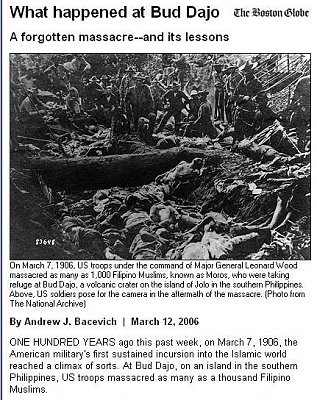
Also in today’s news on Al Jazeera is a report that Philippine troops are securing the southern port city of Zamboanga, where an estimated one hundred Moro National Liberation Front (MNLF) guerrillas have taken a number of hostages in a failed attempt to take over city hall. Although the “Moros” are a nationalist movement, they are also a brand of Muslim extremists who kill fellow Muslims, like the current morass in Syria. I suspect that most Americans are unaware that the Philippines were once under the direct control of the United States, as part of the spoils of the Spanish American War. Continue reading Of Missile Strikes and Moros