
I recently across a copy of The Christian Herald from December 1, 1915 and the lead article by John Maynard Owens is on a recent trip he took to Syria and Iraq. The images are from a century ago and I will attach a few excerpts from the article.
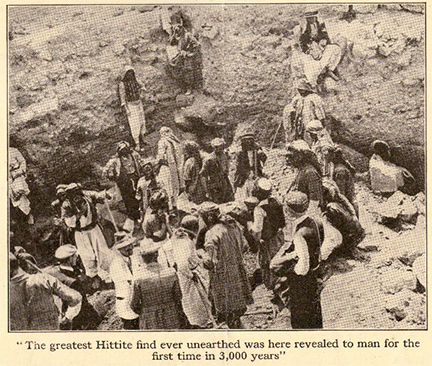
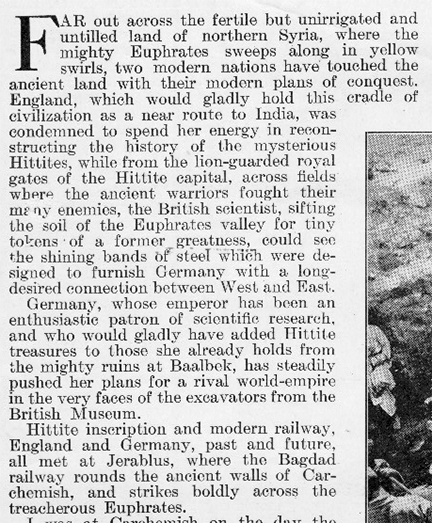
I recently across a copy of The Christian Herald from December 1, 1915 and the lead article by John Maynard Owens is on a recent trip he took to Syria and Iraq. The images are from a century ago and I will attach a few excerpts from the article.
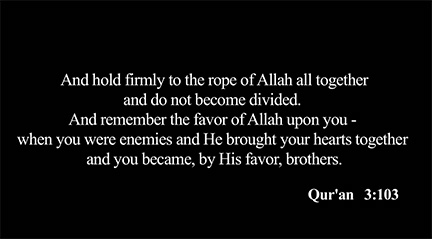
There is a very good Youtube video of interviews with a hundred British imams about the problems with ISIS and how it is doing damage to Islam, especially in Britain. It is well worth seeing. The video was posted on July 11, 2014.
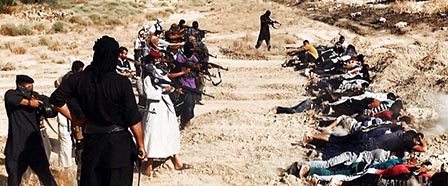
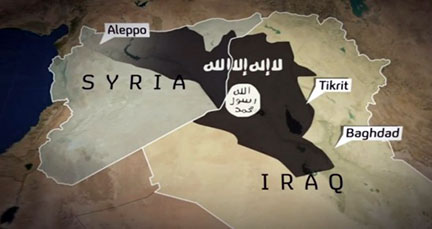
In a recent article just published in the London Review of Books, Patrick Cockburn, a veteran reporter on the Middle East, paints a disturbing picture of the rise and spread of ISIS. He notes that this zealous group now controls, in one way or another, a swathe of Syria and Iraq greater in area that Great Britain and including six million people. Here is his blunt assessment:
The birth of the new state is the most radical change to the political geography of the Middle East since the Sykes-Picot Agreement was implemented in the aftermath of the First World War. Yet this explosive transformation has created surprisingly little alarm internationally or even among those in Iraq and Syria not yet under the rule of Isis. Politicians and diplomats tend to treat Isis as if it is a Bedouin raiding party that appears dramatically from the desert, wins spectacular victories and then retreats to its strongholds leaving the status quo little changed. Such a scenario is conceivable but is getting less and less likely as Isis consolidates its hold on its new conquests in an area that may soon stretch from Iran to the Mediterranean.
While Cockburn is right to say that insufficient attention has been paid to the rapid rise of this radical group, it is premature to think this is the most radical change since the Sykes-Picot Agreement at the end of World War I. A lot of change has shaped the Middle East in the past century, not least the establishment of Israel. ISIS is not an Ibn Khaldunian Bedouin ghazwa about to overthrow either Syria or Iraq. Nor do self-proclaimed Mahdis and Caliphs have a chance to endure in the modern era. As Cockburn notes, there is a loose alliance of the hardcore ISIS group with local Sunni groups in Iraq opposed to the rule of President Nouri al-Maliki, who is likely to be replaced in the near future. Few of these tribes would welcome the ISIS rules of conduct. To be sure, the Iraqi army trained by the United States is inept to an extraordinary degree, but any attack of armored cars and tanks without air support on Baghdad would be foolhardy.
I am not a prophet, nor do I wish to be, but it is hard to imagine that ISIS can continue to advance without air support and more than captured weapons from retreating Iraqi military. As the U.S. has now begun bombing ISIS targets, they will have a difficult time using the captured tanks. The Kurds may have been pushed back from their border, but even Saddam with his superior weaponry was never able to take control of Kurdistan. Nor will the Western powers watch on the sidelines if ISIS did continue to make serious inroads. Nor will Iran, which has military prowess, allow the vehemently anti-Shia ISIS to move close to the Iranian border. The ISIS blitzkrieg has about as much chance for success as Saddam’s ill-fated attack on Khuzistan after the fall of the Shah. While the success of ISIS thus far will fill their ranks, these will be amateurs, not trained (even poorly trained) soldiers.
The seeds of self-destruction are rife in ISIS with its extreme antagonism to other Muslims, Christians and Yazidis, its draconian ideas for applying medieval punishments, the blatant sexism that includes raping women (imagine if any of the raiders in the time of Muhammad came back and reported having raped enemy women…), and inability to ever gain acceptance by major outside powers. ISIS does not present a viable form of Islam as it plays on the distorted sectarian conflict that has riven Iraq since the disastrous American intervention. Before long ISIS will be a footnote to the ongoing conflict in the region.
ISIS right now is indeed a nightmare, but the devastating impact goes beyond the people brutally slaughtered and the human rights violated. ISIS is about the worst possible thing that can happen for most Muslims. The billion and a half Muslims in the world are a diverse group stretching across ethnic groups and nation states, but very few are extreme jihadists or support a return to a medieval caliphate. Anyone who actually knows the history of the caliphate would hardly want to return to such a corrupt and unstable system of government. The damage that ISIS is doing to the perception of Islam in the West is as bad, perhaps even worse, than that of Osama Bin Laden’s attack on the Twin Towers. ISIS is a godsend to Islamophobes, who constantly focus on this kind of violence as an essential part of Islam. The fact that ISIS does not have support from major Islamic leaders or groups does not matter.
It is obvious that the rebel leader al-Baghdadi has little regard for the example of the Prophet Muhammad, who would never have condoned the kind of violence that ISIS is perpetrating. This is a political battle covered with a hateful religious veneer. Al-Baghdadi will meet his fate, no doubt in the near future, but it will not be in paradise. ISIS is not here to stay, but the damage it can do is a sad commentary on the endemic violence that has engulfed much of the Middle East and abused the image of Islam.
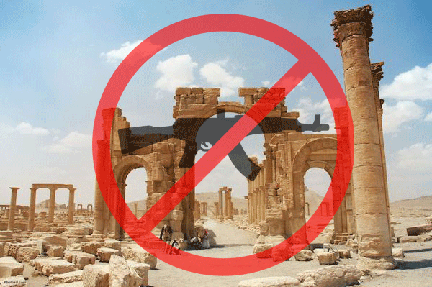
The turmoil and ruthless slaughter that is destroying both lives and heritage in Syria has multiple consequences. Beyond the humanitarian crisis, which is huge, there is widespread looting of antiquities in a country where there is a valuable heritage. Dr. Amr Al-Azm has started a campaign to save these antiquities. Details below. Click here to sign the petition to the UN.
Treasures from our museums and ancient cities in Syria are being looted and destroyed, falling victim to the war’s blind aggression. My former archeology students are working diligently and risking their lives to protect our country’s cultural heritage.
It’s important that our heritage is preserved, not only for its intrinsic beauty and historical value, but also because it helps us reconstruct Syrian identity. Now, the market for stolen artefacts is in the millions, but one important thing can make a difference.
The UN must ban the trade in Syrian artefacts.
So far they have ignored numerous calls to push through a resolution as they did in the past to protect Iraq’s heritage, but there’s something much larger at stake now that should get them to act. Looting Syria’s history is big business and the extremist group known as ISIS have added millions of dollars to their war chest because of it.
Syrians are now not only watching their history being torn down and sold to foreign buyers, but they’re having that money turned against them in the form of more weapons.
— Dr. Amr Al-Azm
Associate Professor of Middle East History, Shawnee University
Professor at the University of Damascus (1998-2006)
Director of Science and Conservation Laboratories at the General Department of Antiquities and Museums in Syria (1999-2004)
by MURAT HAZINE, Turkey Agenda, July 9, 2014
The Islamic State in Iraq and al-Sham (ISIS) is a new shadow that appeared while we were trying to differentiate between the “New Middle East†and the “Great Middle East†which is a result of the Republican tendencies of the US. Nobody has any information regarding which country the ISIS is shadow of. Also, it is unknown that ISIS which acts as an ideal troublemaker in Iraq and Syria today would be carrying out the same duties in any country it has potential members in. Nevertheless, it is necessary to make an evaluation over the structure, methods and the possible actions of this shadow. In that case, we need to initiate our efforts to understand from here: Which ISIS? What influenced trigger the changes experienced by this group that came to prominence with its different sides throughout the time? After the death of Abu Mus’ab al-Zarqawi, his followers had formed an alliance named the Islamic State of Iraq. This alliance was a union of Sunni groups such as Mujahideen Shura Council, Jaysh al-Fatiheen, Jund al-Sahaba and Jaish al-Taiifa al-Mansoura that all served a common purpose. And, the reason behind the break of relations between the Islamic State of Iraq and Sunni tribes was the formation of this alliance. This alliance first called on Sunni tribes to be committed to them and then, targeted the leaders and the important figures of the tribes that did not accept the invitation. Continue reading On the trail of a shadow: Which ISIS?
by Hasan Azad, al-Jazeera, July 11, 2014
What do the Islamic State, Boko Haram and the Taliban all have in common? Extremism? Caliphatism? Violence? All these things are merely incidental to these groups. What is essential to them is that they are all thoroughly modern formations. So what do I mean by this, given that they tend to strike us as the very antithesis of modernity?
First of all, it is crucial to ask ourselves what it is that we understand by modernity. We assume that modernity means reason, science, freedom, justice, racial, gender, and sexual equality. These are the assumptions. They are the ideals that are projected by a strident western discourse, where the West is seen as their progenitor and purveyor.
Perhaps it will strike the reader as a little odd if I say that these ideals are far from being realised within the West. That there are massive inequalities of sexualities, of genders and of races in the West. That western freedom, whether political, economic or consumerist, comes at the expense of the freedom of people living in non-western countries.
And this lack of freedom runs far and deep, reaching into the history of how non-European people were made to think during colonial times. For example, any serious study of the history of colonialism and its educational projects in its colonies reveals the extent to which Europe reconfigured indigenous modes of knowing with its own mode of thinking – a manner of thinking which has its roots in the Enlightenment, with its own idiosyncratic means of reasoning. Continue reading Modernity according to the Islamic State, Boko Haram, the Taliban et al
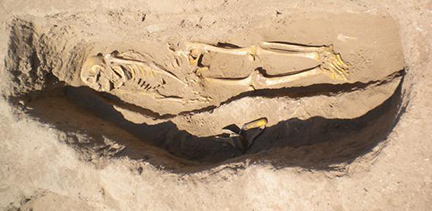
Chalcolithic burial at Zeidan; Credit: Gil Stein, Oriental Institute, University of Chicago
6200-year-old parasite egg may be first proof of early human technology spreading disease
Latest research shows that schistosomiasis, a disease caused by flatworm parasites, may have been spread by earliest crop irrigation in ancient Mesopotamia, suggesting early technology exacerbated disease burden.
The discovery of a schistosomiasis parasite egg in a 6200-year-old grave at a prehistoric town by the Euphrates river in Syria may be the first evidence that agricultural irrigation systems in the Middle East contributed to disease burden, according to new research published in Lancet Infectious Diseases.
Schistosomiasis is a disease caused by several species of flatworm parasites that live in the blood vessels of the bladder and intestines.
Infection can result in anaemia, kidney failure, and bladder cancer. This research shows it may have been spread by the introduction of crop irrigation in ancient Mesopotamia, the region along the Tigris-Euphrates river system that covers parts of modern-day Iraq, Iran, Kuwait, Syria, and Turkey. Continue reading Schisto in Mesopotamia
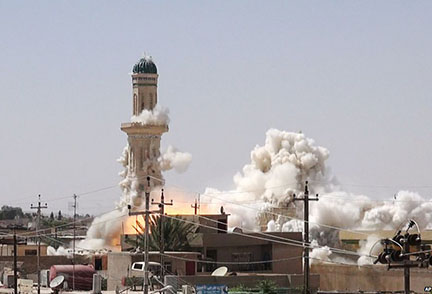
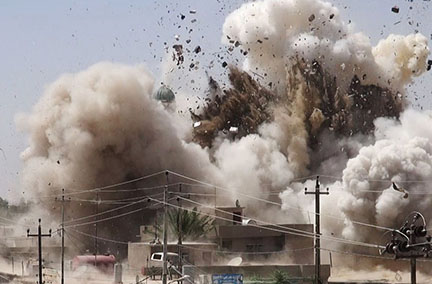
al-Qubba Husseiniya, a Shia shrine, being blown up in the city of Mosul.
Hollywood is known for creating absurd scenarios, especially with special effects of explosions and cars flying through the air. The real damage is done in war with bombs ripping apart buildings and bodies. And then there is the wanton destruction of buildings out of sheer hatred. The would-be caliphate that has taken nominal control of a large swathe of Syria and Iraq is an affront to everyone, including fellow Muslims in Syria and Iraq. There will be no new caliphate created out of such callous regard for human life and eventually the rebel leader Abu Bakr al-Baghdadi will follow Saddam Hussein to the netherworld. But the destruction in the meantime is mean indeed. In addition to the men gunned down in Mosul and elsewhere, bulldozers and bombs are destroying some of the splendid Iraqi shrines from the real caliphates. It is a sad day (far too many sad days, weeks, months and years) for Syria, Iraq, Muslims worldwide and the entire world. But the leader of ISIS cannot erase history, no matter how many shrines and mosques he blows up.