Category Archives: Syria

Exiting Through the ‘Alley Gate’

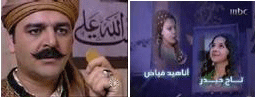
[Note: Numerous excerpts of this popular Syrian Ramadan serial can be found on Youtube, starting with episode 1. The following is a commentary in Asharq Alawsat.]

by Mshari Al-Zaydi, Asharq Alawsat, Saturday 20 October 2007

I will admit to watching the Bab al Hara (Alley Gate) series with the same fervor normally reserved for football finals. Moving from one café to another on Jeddah’s al Tahlia Street, I watched this session’s last episode. The young crowd present, dressed in t-shirts and baggy jeans, burst into a warm round of applause at the end of the show – which is quite a rare reaction among Saudi viewers.

This second-part sequel to the Syrian television series is, in fact, an undeniable phenomenon; some in Saudi even exchanged Eid ul-Fitr felicitations that were inspired by stories in the series.

But this phenomenon has reached farther and wider than just Saudi alone, many viewers in various Arab states; even Arabs living abroad, regularly tuned in and set their alarm clocks to the show’s airing time.

Perhaps this huge success is what prompted the show’s producers to make a third series for next year. Such was its popularity that even some clerics were involved in this commotion; among them was Sheikh Salah Kuftaro, son of the former late Syrian Grand Mufti Ahmad Kuftaro and the Director-General of the Sheikh Ahmad Kuftaro Academy, who publicly acclaimed the show and invited its cast to a Ramadan Iftar held in their honor. Likewise, Kuwaiti Islamist MP Walid al Tabtabai also praised the series. Continue reading Exiting Through the ‘Alley Gate’
A New Old Damascus

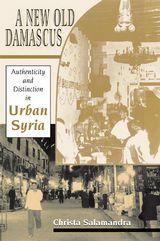
by Christa Salamandra
Lehman College, CUNY

If you enter the Old City of Damascus at Bab Sharqi (the Eastern Gate), walk a few yards along a Street Called Straight, and turn down the first narrow alley on your right, you will find, jutting out from among the inward-looking Arab-style houses of this quiet residential quarter, a sign advertising “Le Piano Bar.” Enter through the carved wooden door, walk along the tile-covered foyer, under the songbird’s cage, past a display case strung with chunky silver necklaces, and step up a stone platform to the raised dining room. Here well-heeled Syrians sit at closely spaced tables, drinking arak and Black Label whiskey, and eating grilled chicken or spaghetti. The walls around are decorated, each in a different style. One features a collection of Dutch porcelain plates set into plaster. In another, strips of colored marble hold a series of mosaic-lined, glass-covered displays of wind instruments. A third wall features two floral wrought-iron gated windows draped in a locally produced striped fabric. Wrought-iron musical notes dance on the last. At the from of the long, arch-divided room is a huge mother-of-pearl-framed mirror. Set into the top of the mirror is a digital billboard across which Le Piano Bar’s menu and opening hours float repeatedly. Patrons listen politely as the proprieter sings “My Way” and other Frank Sinatra favorites to a karaoke backing tape. When he finishes, video screens tucked into corners feature Elton John song sing-alongs. Some nights a pianist and clarinetist play Russian songs as patrons clack wooden catanets. Continue reading A New Old Damascus

The Forbidden Fruit of the Iraq War

War is mainly a man’s game. Men like Osama Bin Laden send men like Muhammad Atta to bomb a New York building. Men like George Bush and Tony Blair react like, well like men, and take it out on men like Mullah Omar and Saddam Hussein by sending young men to dodge bullets and iuds in a real video-game scenario. Men like Nouri al-Maliki are purple-fingered into a Green Zone political club so that mostly men can wear uniforms or hide bombs in order to kill other men, as well as women and children. Even a pacifist like Jesus predicted no end to war and rumors of war.

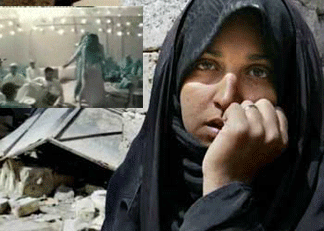
Everyone, not just men, suffers in the manly game of war. But while some men think it honorable to kill others, the burden of war probably hits women harder than anyone else. Suicide bombs are as likely to tear apart female bodies as male bodies, as able to cut short the life of a child as trump the survival of the elderly. In Iraq we see the blood smears that mark death and hear the mourning that haunts the grieving of the left behind. But beyond the battlefield and the car-blown open markets the exercise of war bears more fruit, one that harks back to the forbidden fruit in the innocence of Eden. Continue reading The Forbidden Fruit of the Iraq War

A Taylor Made Bath in Damascus

The American man of letters Bayard Taylor (1825-1878) was one of many travelers to the Near East of his time. His tour in 1853 resulted in a travel account above the common lot of Holy Land roller overs. Of particular interest is his frank account of a Turkish bath in Damascus.

“The Bath is the ‘peculiar institution’ of the East. Coffee has become colonized in France and America; the Pipe is a cosmopolite, and his blue, joyous breath congeals under the Arctic Circle, or melts languidly into the soft airs of the Polynesian Isles; but the Bath, that sensuous elysium which cradled the dreams of Plato, and the visions of Zoroaster, and the solemn meditations of Mahomet, is only to be found under an Oriental sky. The naked natives of the Torrid Zone are amphibious; they do not bathe, they live in the water. The European and Anglo-American wash themselves and think they have bathed; they shudder under cold showers and perform laborious antics with coarse towels. As for the Hydropathist, the Genius of the Bath, whose dwelling is in Damascus, would be convulsed with scornful laughter, could he behold that aqueous Diogenes sitting in his tub, or stretched out in his wet wrappings, like a sodden mummy, in a catacomb of blankets and feather beds. As the rose in the East has a rarer perfume than in other lands, so does the Bath bestow a superior purification and impart a more profound enjoyment… Continue reading A Taylor Made Bath in Damascus

“On the Eve of Modernity”


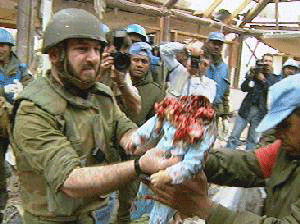
[The Israel bombing of Qana yesterday was not the first such attack on this town. The horrendous picture above is from a similar bombing there in April, 1996, when as many as 300 villagers were killed.]

In a syndicated commentary on July 28, New York Times columnist Thomas Friedman illustrated the journalistic malady that exemplifies biased reportage masquerading as informed analysis. While in Damascus he picked up a copy of the English-language Syria Times and noted an ad box that read “The Middle East on the Eve of Modernity.” He continues:

“I thought: What a perfect way to describe the Middle East today – going back to some pre-modern era? Alas, the Syria Times was not trying to be ironic. It turned out the headline was the title of a book about the 18th century. But had it been a news headline, it would have been apt. Continue reading “On the Eve of Modernity”