Category Archives: Syria

Sufi Soul

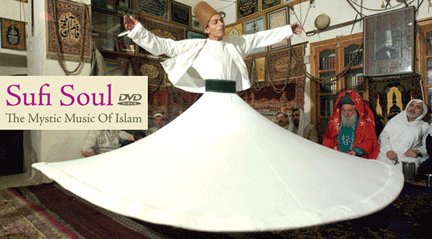
Cyberspace is increasingly crowded with videos, the virtual youtubization of the internet. This is especially the case for documentaries. Youtube has a wide range of videos on Islam, from professional films to homemade khutbas and television reruns. The diversity of Muslim practice is available, as is the worse Islamophobia, with just a click of the mouse and a wifi point. This ease of access is also convenient for professors, who can often find relevant video excerpts to power point into their lectures. Of the numerous videos out there, here is one well worth watching: Sufi Soul – The Mystic Music of Islam, a 50-minute film directed by Simon Broughton for Channel 4 in the U.K. To watch it, click here.

Here is a brief description of the film: Continue reading Sufi Soul
Have Felix, will travel

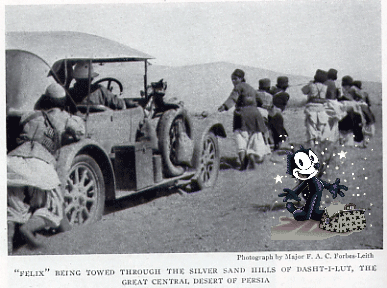
In 1924 Major F. A. C. Forbes-Leith decided to drive a “motor-car” from London to India, a journey that took almost half a year to traverse ten countries. Overall, a total of 8,527 miles were covered, with 3,000 of them devoid of road or track and 1,500 over desert, not to mention detouring around 150 broken bridges. This was three years before Lindy flew from Mitchell Field (next to the university I currently teach at) to France. The rationale for a ridiculously long auto adventure? That was simple: no one had done it before. As Major Forbes-Leith puts it, “Airplanes had already flown to India on several occasions, airships for a regular mail service were in the course of construction, even one of the submarines of the Royal Navy was on its way, but as yet no effort had been made to bridge the distance by mechanical transport.”

Attempting such an adventure at the time no doubt took a sense of humor. In this case the auto was labeled “Felix” after the cartoon character Felix the Cat. Continue reading Have Felix, will travel

Music in the World of Islam

A year ago from August 8-13 an international conference on “Music in the World of Islam” was held in Assilah, Morocco, jointly sponsored by The Assilah Forum Foundation (Assilah, Morocco) and the Maison des Cultures du Monde (Paris, France). The papers from this conference are now available in pdf format online. Music and dance are described for Afghanistan, Algeria, Andalusia, Azerbeijan, Bangladesh, Bosnia, Central Asia, East Africa, Egypt, Ethiopia, India, Indonesia, Iran, Iraq, Kurdistan, Kuwait, Liberia, Malaysia, Morocco, Russia, Syria, Tajikistan, Turkey and Yemen.

A description of the conference is described by its main organizer, Pierre Bois: Continue reading Music in the World of Islam

Picturing Damascus

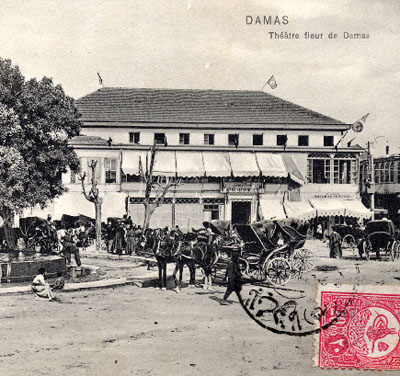
Visual archives abound on the Middle East and a growing number of these now appear on the Internet. One of these is mideastimages.com, which hosts a variety of historic photographs focusing on the cities of Aleppo, Baghdad, Cairo, Damascus, Istanbul, Jerusalem and Palmyra. Here is a postcard mailed from the Thomas Gate post office in Damascus during the Ottoman period. It depicts the Flower of Damascus Theatre, owned by Habib Shamas, in the Marje Square. In 1912 this theatre hosted the first movie played in Damascus. The theatre was converted to a Cinema in 1918. (Source: DAMASCUS BY Dr. K. SHIHABI 1986)

Veiled Voices


Brigid Maher, Director of “Veiled Voices”

Veiled Voices is a one-hour documentary that investigates the grassroots movement of Muslim women in the Middle East who act as religious leaders. It introduces the viewer to a world rarely seen by outsiders: the world of devout Arab Muslim women leading other women in prayers and lessons. Veiled Voices concentrates primarily on Ghina Hammoud, a divorced mother separated from her children, who has a television program and a charitable foundation in Lebanon, and Huda al-Habash, who has a loving and supportive husband and children, and runs lessons and programs in a mosque in Syria. Veiled Voices also travels to Egypt, where women struggle for public recognition in roles of authority over men; this is contrasted with Syria, where some male religious authorities, such as the Grand Mufti, are encouraging of women in leadership roles. The film shows women empowered, while exploring the struggles they face on both a personal and a public level. Continue reading Veiled Voices

Cannons of the Past


Woman and a Fish, Asma al Fayoumi, Syria 1993

by Najeeb Nusair. Translated by Christa Salamandra and Suhail Shadoud
from Artenews, October, 2007

However much we moan and groan, however much we lament, reminisce, mull over, write, dig up, represent, glorify, venerate—even if we use the entire vocabulary of literature and science to conjure it up, the past will not return. Even if we cry, kick the ground with our feet like temperamental children, beg people, societies and nations, even if we consult scholars, historians, doctors, and feminists… the past will not return.

Instinctively we remember, as we practice our everyday cultural life, lavishly praising the past, and seeking to retrieve it in any possible way. But the past is within us; it has not and will not leave us. Asking for it to return is asking for what has fallen away, is gone, because it no longer works and has expired. The past is a gigantic mass, some of which is relatively good, and remains within us, and much of which time has consumed and flung aside, like lines in an arcane, long forgotten book. Continue reading Cannons of the Past