Category Archives: Syria

July 4, 1187


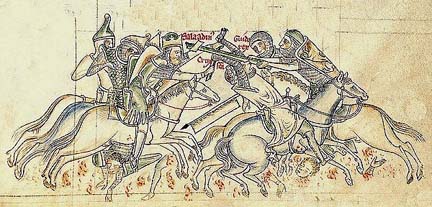
Guy de Lusignan and Saladin in Battle / Mathew Paris, c.1250

[Webshaykh’s Note: July 4 is famous for more than one reason, although firecracker bedlam covers both the annual American celebration as well as a devastating crusader defeat of the Knights Templar almost a millennium ago. The following account is from TemplarHistory.com.]

The Fourth of July, a time for Americans to celebrate their War of Independence from the English in 1776, had an entirely different meaning to medieval Europe. For the Fourth of July, 1187 was to be one of the bloodiest battles of the crusades, the Battle of the Horns of Hattin.

The area is called the Horns of Hattin for the two rocky peaks that rise over the brush covered slopes behind Tiberius on the Sea of Galilee. It was here that Saladin aligned 12,000 of his knights plus an army carrying regular provisions at Tiberius. An army as well mounted and armed as anything that could be assembled by the combined forces of the Templar and Hospitaller orders. On the other side of the battlefield were the crusading forces comprised of 20,000 foot soldiers but only about 1,000 knights. This force, small by comparison, was assembled by depleting the forces of many surrounding cities thus leaving the unarmed cities open to attack.

The Christian army had set out for Tiberius in the early morning hours of July 3rd, leaving in their wake their well-watered camp for the dust and dryness of the desert air. They carried with them that Holy relic so many would die for in coming battles, the True Cross, discovered in 326 CE by the mother of Constantine the Great.

As they made the trek in the hot desert sun they found no water to aid their thirst and in the heavy armor must have been near exhaustion. By evening of July 3rd, the crusading army arrived at a plateau below the Horns of Hattin, which jutted into the air 100 feet above them. Even at this resting spot the Templars and other crusading warriors found no water, as the well was dry and the only stream was blocked. Continue reading July 4, 1187
From Islamist Watch to Islamic Mimbar: The Politics of Hypocrisy


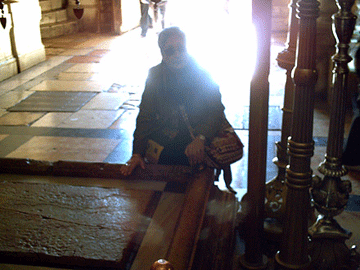
Raheel Raza at the Church of the Holy Sepulchre in Bethlehem

by Huma Dar, Dept. of South and Southeast Asian Studies, University of California at Berkeley

On Thursday, June 10, 2010, Jerome Taylor, the Religious Affairs Correspondent of The Independent posted an article headlined, “First Woman to Lead Friday Prayers in UK.” Two-thirds of the way down this article, we find that:

“Ms Raza’s appearance in Oxford is a repeat of a similar prayer session in 2008 which was led by Amina Wadud, an American-born convert and Muslim feminist. But this is the first time a Muslim-born woman will lead a mixed prayer service in Britain.”

Taylor’s differentiation between “American-born convert” and “Muslim-born woman” and labeling of the latter as the “first woman” in the headline create a false hierarchy and subtly delegitimize Dr. Wadud, a leading Muslim scholar and author of Qur’an and Woman: Rereading the Sacred Text from a Woman’s Perspective, a path-breaking text in the study of gender and Islam. Taylor’s late admission of “repeat” after the (mis)leading announcement of “First” in the headline does not quite cover up for the critical sins of omission and commission, especially as Raheel Raza, the Pakistani-Canadian woman leading the prayer at Oxford, is neither an ‘Alima or a scholar of Islam nor is she known for her advocacy of Muslims at large.

In fact Raza is a rather polarizing figure amongst Muslims in North America and her record does not indicate much learning in the letter or spirit of Islam, as in speaking truth to power and standing with the oppressed. Continue reading From Islamist Watch to Islamic Mimbar: The Politics of Hypocrisy

Tobacco and Toe Stepping

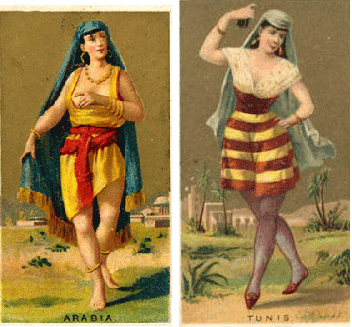
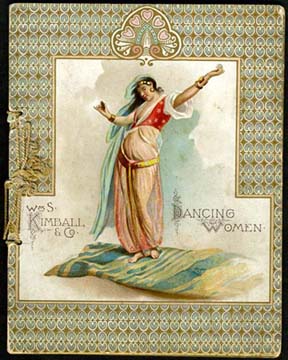
Kimball Tobacco Company Factory (1846-1905) in Rochester, New York, published a series of “Dancing Girls of the World.” These appear to be from the late 1880s. Several of these purport to depict women dancing in the Middle East. But it seems the artist had never actually seen ladies of the exotic harem. Take a peek for yourself.

Continue reading Tobacco and Toe Stepping

Veiled Voices

Veiled Voices

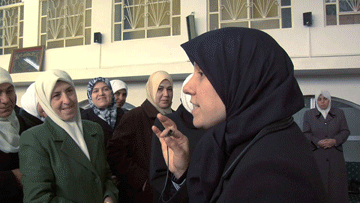
Women across the Arab world are redefining their role as leaders in Islam. Veiled Voices investigates the world of Muslim women religious leaders through the eyes of three women in Lebanon, Syria and Egypt. Filmed over the course of two years, Veiled Voices reveals a world rarely documented, exploring both the public and private worlds of these women. The stories featured in the film give insight into how Muslim women are now increasingly willing to challenge the status quo from within their religion, promoting Islam as a powerful force for positive transformation in the world. Each triumphs over difficult challenges as they carve out a space to lead—both in Islam and in their communities.

For air dates, click here.

Syrian Cuisine, Two Centuries Ago

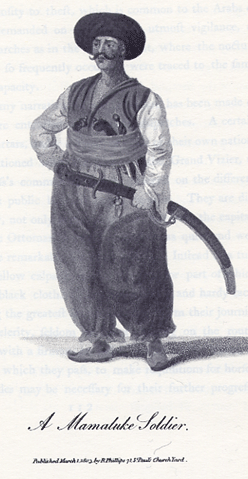
[Note: The following account is by the English traveler William Wittman, who commented on the foods and crops he saw while passing through the Levant in what was then Syria. The spelling is that of the original, from a time when proof reading was a distant concern and spelling was a democratic venture. The picture above is from the original 1803 edition.

Wherever the land is susceptible of cultivation, and has not been neglected, it affords abundant crops of wheat, barley, Indian corn (dourra), tobacco, cotton, and other productions. Fruits and vegetables are in equal abundance. Among the former are pomegranates, figs, oranges, lemons, citrons of an uncommonly large size, melons, grapes, and olives. The melons are large, and have a delicious flavour; as have also the grapes. of which we partook so late as the month of December, when we found they still retained their exquisite flavour. I have already adverted to the uncommon size of the water-melons, many of which weight from twenty to thirty pounds. they are a great and valuable resource to the inhabitants, who are so passionately fond of them, that, during the summer months, they form a great part of their subsistence. Notwithstanding they are as cooling and refreshing, as grateful to the taste, I was surprised to see the natives eat them in such immoderate quantities, without experiencing any unpleasant consequences. Continue reading Syrian Cuisine, Two Centuries Ago

A Photographer among the Syrian Bedouin


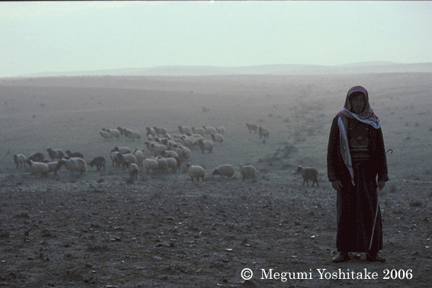
Morning Mist

A Life with a Bedouin family in Syria — from the Far East to the Middle East —

by Megumi YOSHITAKE, JAPAN

At the age of 15 the story of T. E. Lawrence [Lawrence of Arabia] captured my heart and mind. Ever since, I have yearned after deserts and been enchanted by the Arab world, and wanting to convey the essence of these places in my own way is what caused me to choose photography as my path.

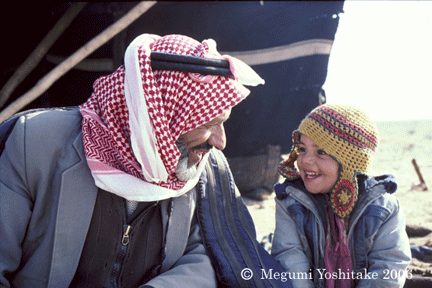
I first visited Syria in 1987, and have spent part of every year from 1995 onwards living with a family of Bedouin in the Syrian Desert. Initially I was single, but visited again on my honeymoon after getting married and introduced my husband. I returned once more in 2004, this time bringing along my 16-month-old son. The time I have spent photographing the Bedouin — amounting to some 14 years — is unique among Japanese and rare even worldwide.


A Bedouin father and his daughter

To read the full story and look at the gallery of photographs, click here.

The Fortress of Saone and Salah al-Din, 2


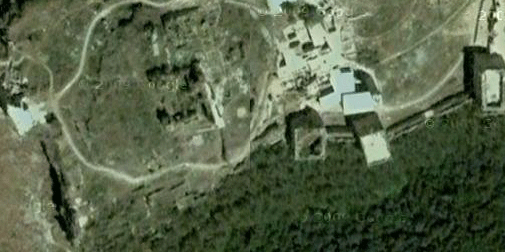
Figure 1: Google Earth map of the southern edge of the fortress area, with north to the top of the picture

[Note: This is the second in a series on a visit to the fortress castle known as Qa‘lat Salah-al-Din, near Lattakiya Syria. For the first, click here.]

Before continuing with my recollections of a tour of the castle fortress of Robert of Saone and Salah al-Din, it might be useful to take an aerial view. Thanks to Google Earth, you can get a bird’s eye view of the fortress, indicated in the above photo (Figure 1) only partially, but available with functions here.

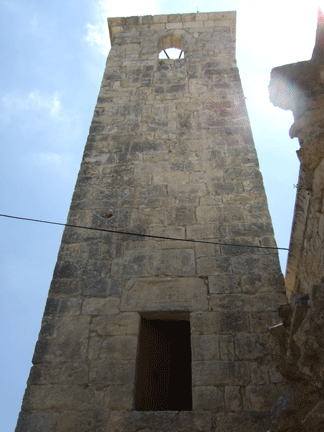
In the Google Earth image above, the formal entrance today is through the tower in the bottom center of the picture, with the mosque and madrasa to the north. The mosque and madrasa were reconstructed with support by the Aga Khan Trust for Culture in 2000. This involved a careful rebuilding of the minaret, which had partially collapsed (Figure 2).


Figure 2: Reconstructed Ayyubid minaret

Continue reading The Fortress of Saone and Salah al-Din, 2

The Fortress of Saone and Salah al-Din, 1


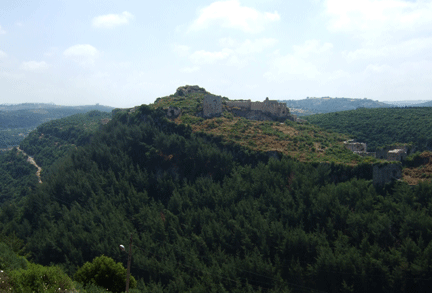
Figure 1: Looking northeast at the western town and central fortification of Qal‘at Salah al-Din

On my recent visit to Lattakiya, Syria, I was given a guided tour of a most extraordinary castle/fortress with visible Crusader and Mamluk ruins. This is the crusader castle named for Robert of Saone, who was given control of it by Roger, Prince of Antioch in 1119 CE. Located almost 30 km from Lattakiya, it was obviously a strategic asset for the Crusaders. But it appears Robert of Saone chose a bad architect for his expansion of the existing fortress. Instead of building up the Byzantine fortress at the high point, he built along the walls, so there was not a second site of defense once the walls were breached. He also failed to consider the range of mangolins, which Salah al-Din used effectively from the nearby ravines to breach the castle walls.

It is no wonder why this impressive location also appealed to defenders from the Phoenician period on. It is recorded that Alexander the Great conquered it, but only with the divine help of Hercules’ club, in 334 BCE. In the 10th century CE the Byzantine Emperor John I Tzimisces gained control and built up the walls, which were expanded by the crusaders. The crusaders did not even last a century, despite the seemingly impregnable aspect of the castle. The walls were breached by the armies of Salah ed-Din in July 1188. In 1957 the official name of the remains was fixed by the Syrian government as the castle (qal‘a) of Salah al-Din, proving once again that to the victor go the spoils and history’s nod. Continue reading The Fortress of Saone and Salah al-Din, 1