Category Archives: Syria

Detained in Syria

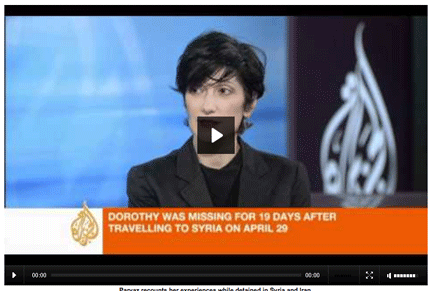
[Webshaykh’s Note: There is a definite frost on the Arab Spring in Syria. Read the chilling report by reporter Dorothy Parviz, who was detained and describes the horrors of those held in detention and beaten.]

Inside Syria’s secret prisons

by Dorothy Parviz, Al Jazeera, May 18, 2011

I was standing in two fist-sized pools of smeared, sticky blood, trying to sort out why there were seven angry Syrians yelling at me. Only one of them – who I came to know as Mr Shut Up during my three days in a detention center, where so many Syrians ‘disappeared’ are being kept – spoke English.

Watching them searching my bags, and observing the set of handcuffs hanging from the bunk bed wedged behind the desk in the middle of the room, I guessed that I was being arrested – or, at the very least, processed for detention.

“Why are you doing this?” I asked.

“Shut up! SHUT UP!” said Mr Shut Up.

I’d arrived there moments before, dragged by a handful of hair from a car where I’d been wedged between two armed men. They’d tried to convince me that they were taking me to my hotel, but, of course, I knew that there was no way plain-clothed security personnel would be kind enough to escort me to my accommodation.

I did, however, manage to resist being forced to wear a blindfold, figuring that if they were going to shoot me, they really didn’t need a reason to do so.

After about 20 minutes, we pulled off the highway and through two checkpoints. By this point, the rather handsy security guard to my left had pulled my scarf over my eyes. Continue reading Detained in Syria
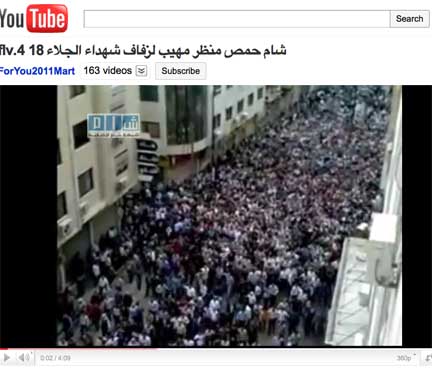
What Syrians want …


What do we want?

by Amina A., A Gay Girl in Damascus, May 9, 2011

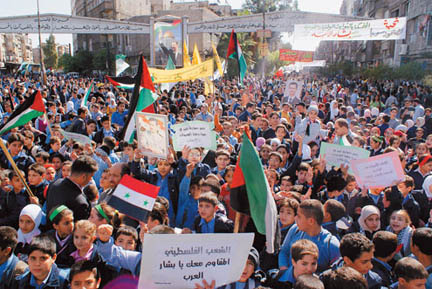
The regime claims that they have no idea what we in the opposition want. I find that hard to believe … haven’t they been watching us, listening to our slogans, reading what we write? Do they have facebook? Seriously, it’s spelled out there: “The solution is simple: Stop shooting at demonstrators, allow peaceful demonstrations, remove all your photos and those of your father, release all political prisoners, allow political pluralism and free elections in six months.”

And for Asad? “You will be the pride of contemporary Syria if you can transform Syria from a dictatorship into a democracy. Syrians would be grateful for that, and it is possible to do”
But maybe they do not get it. Maybe it is too simple. Didn’t Emma herself claim in that awful Vogue article that they practice democracy inside the royal household?
Well maybe more specifics would help …

We want an end to dictatorship. We want free and fair elections. We want freedom. Continue reading What Syrians want …

Sunni-Shi’a Relations in Mamluk and Ottoman Contexts


by Stefan Winter

There is a wealth of literature on Sunni-Shi’a relations relating to many periods and places of Islamic history. I attach a brief list of titles on the Mamluk and Ottoman cases with which I am familiar below.

Beyond that, however, there is probably a good reason why “this confrontation” and “its new relevance in today’s politics” is dealt more with in journalistic analyses than scholarly works. To link all instances of conflict or contact between given Sunni and Shi’a actors throughout Islamic time and space, from Pakistan to Lebanon, from Siffin to Doha, to a single ongoing confrontation, as modern observers often do, is reductionist at best.

Of course there is a fundamental theological dispute between Sunnism and Shiism and there has been no shortage of wars and communal disturbancesthat expressed themselves along sectarian lines. But such events invariably also had political and economic causes that must be investigated in their own specific context, and they should not mask the far more numerous instances when the supposed Sunni-Shii dichotomy explains absolutely nothing of, or is downright contradicted by, political events, from the Ayyubids’ tactical alliances with the Ismailis, to the Ottomans’ commercial relations with the Safavids and recourse to Shii tax farmers, to Iran’s intermittent support of Gülbuddin Hekmatiyar to the posters of Hasan Nasrallah you see all over the (conservative Sunni) suq in Aleppo today. Continue reading Sunni-Shi’a Relations in Mamluk and Ottoman Contexts

The Liberation of Erotic Literature


Interview with Salwa al-Neimi
in al-Qantara, 7/2010

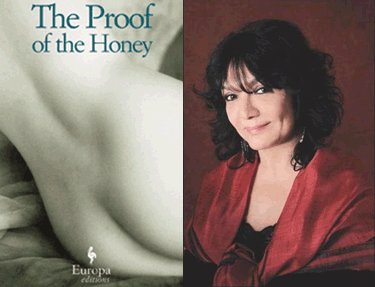
The novel The Proof of the Honey by Syrian author Salwa al-Neimi is celebrated by some as a milestone of modern Arabic literature and condemned by others as scandalous prose. In an interview with Rim Najmi, the author explains that despite the lightness of its literary style, her novel poses fundamental intellectual and political questions

Your first novel, The Proof of the Honey, attracted a great deal of attention from both readers and critics alike. The most frequent response had more to do with your “courage” in tackling one of the greatest taboo themes in Arab culture and less with the literary qualities of your novel. What do you think was the decisive factor for all the attention?

Salwa al-Neimi: Thank you for this question. I always say the success of the book is primarily based on its language and style. I make this claim even though most of the critics tend to emphasize the theme of the novel and the fact that it crosses the red line. Unfortunately, they have little interest in the actual text itself. Some critics constantly talk about freedom of expression, although this often turns out to be just an end in itself. When it comes to a contemporary text, it is often judged in terms of moral categories, which is just another form of censorship.

By Arab standards, your novel, The Proof of the Honey, sold in record numbers in only a short time. It has also been translated into many languages. What does the international publication of your work mean to you?

Al-Neimi: First and foremost, I wrote The Proof of the Honey for Arab readers. Continue reading The Liberation of Erotic Literature

The Poet Adonis


A Revolutionary of Arabic Verse
By CHARLES McGRATH, The New York Times, October 17. 2010

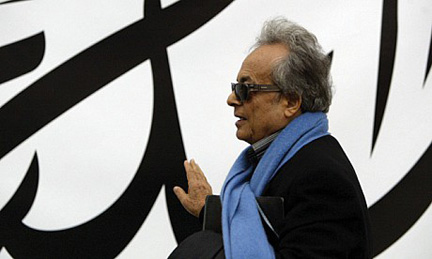
ANN ARBOR, Mich. — Every year around this time the name of the Syrian poet Adonis pops up in newspapers and in betting shops. Adonis (pronounced ah-doh-NEES), a pseudonym adopted by Ali Ahmad Said Esber in his teens as an attention getter, is a perennial favorite to win the Nobel Prize in Literature. This year Ladbrokes, the British bookmaking firm, had his chances at 8-1, which made him seem a surer bet than the eventual winner, Mario Vargas Llosa, a 25-1 long shot. Why Adonis appeals to the oddsmakers, presumably, is that he’s a poet, and poets have been under-represented among Nobelists lately; that he writes in Arabic, the language of only one Nobel winner, Naguib Mahfouz; and that as is the case with so many recent winners, most Americans have never heard of him.

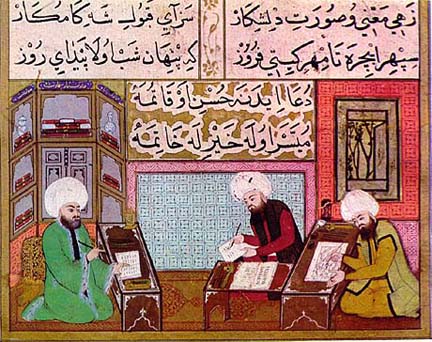
In the Arab world it’s a very different matter. There he is a renowned figure, if not everywhere a beloved one. He is an outspoken secularist, equally critical of the East and West, and a poetic revolutionary of sorts who has tried to liberate Arabic verse from its traditional forms and subject matter. Some of his poems are immensely long and immensely difficult and resemble Pound’s Cantos at their most impenetrable. Others reveal a Paul Muldoonish playfulness, a Jorie Graham-like expansiveness and fascination with blank space. His poems are as apt to cite Jim Morrison as the Sufi mystics, and his 2003 volume “Prophesy, O Blind One” includes some long, leggy lines about traveling that could have been written by Whitman, if only Whitman had spent more time in airports. Continue reading The Poet Adonis

Leaves from an old Bible Atlas #6


Hurlbutt’s Atlas, p. 118

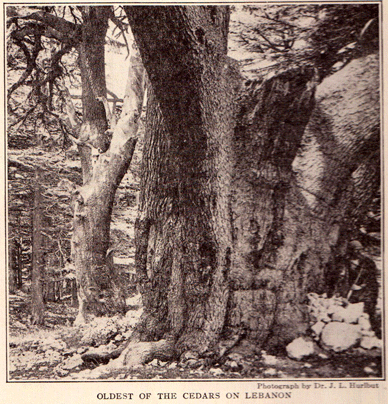
The Christian fascination with the Holy Land as a window into interpretation of the Bible has a long and indeed fascinating history of its own. Here I continue the thread on Jesse Lyman Hurlbutt’s A Bible Atlas (New York: Rand McNally & Company, 1947, first published in 1882). Ah, those cedars of Lebanon, hewn for Solomon’s temple but a few being left for the intrepid explorer, in this case Rev. Hurlbutt himself. Here is his sketch of that temple. Continue reading Leaves from an old Bible Atlas #6

Leaves from an old Bible Atlas #5


Hurlbutt’s Atlas, p. 118


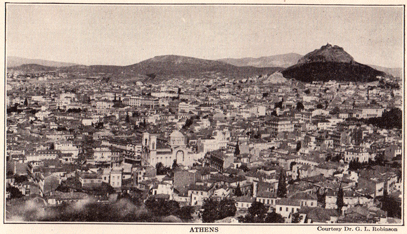
Athens, Hurlbutt’s Atlas, p. 119

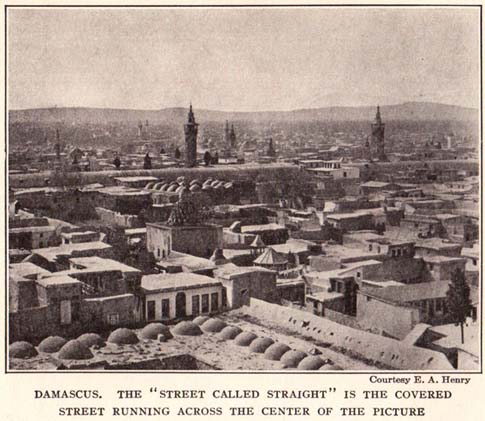
The Christian fascination with the Holy Land as a window into interpretation of the Bible has a long and indeed fascinating history of its own. Here I continue the thread on Jesse Lyman Hurlbutt’s A Bible Atlas (New York: Rand McNally & Company, 1947, first published in 1882). One of the interesting aspects of the accompanying illustrations is the sense that what you see in the photograph is essentially unchanged from the days of Paul’s missionary journeys. Both these images appear to have been taken before the turn of the 20th century.

To be continued …