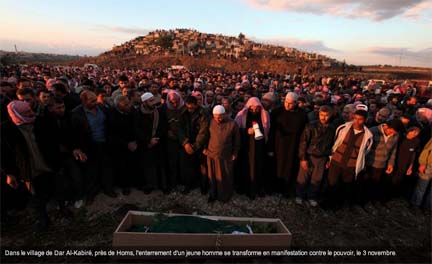
There is an extraordinary photographic montage published online by Le Monde on the protests in Syria. This is Syrie: photos clandestines d’un massacre à huis clos.
There is an extraordinary photographic montage published online by Le Monde on the protests in Syria. This is Syrie: photos clandestines d’un massacre à huis clos.
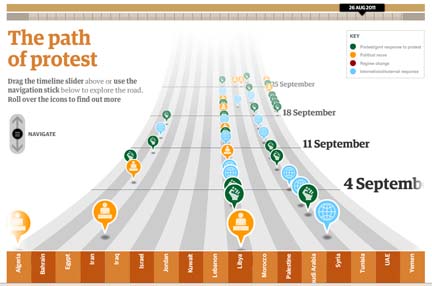
The Guardian has an interactive and updated timeline on the events labeled the “Arab Spring,” with links to articles in The Guardian. You can choose the time period and the country and the type of event or issue. It is current through September 26, 2011.
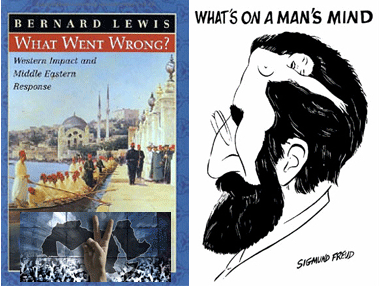
Now that we are about to officially head into the Autumnal paradox of the Arab Spring, there is no limit to the excess of punditry about why it happened, is happening and will continue to happen. Back in February, the historian Bernard Lewis weighed in on the current uprisings for an interview in The Jerusalem Post (which, for those with any historical memory, is not your parent’s Jerusalem Post). The article begins with Lewis’s summation in a nutshell: “The sort of authoritarian, even dictatorial regimes, that rule most of the countries in the modern Islamic Middle East, are a modern creation,†he notes. “The pre-modern regimes were much more open, much more tolerant.†Ah, yes, that Golden Age of Islam when the caliphs of the Arabian Nights were the community organizers of their eras. Surely Al-Hakim bi-Amr Allah did not really mean to destroy the church of the Holy Sepulcher in Jerusalem a millennium ago. That “more open, much more tolerant” pre-modern political paradise is as absurd as the more common Islamophobic trope that Muslims have always ruled by the sword. Indeed, as Lewis notes, the modern dictators in the region are a modern creation, but (as Lewis does not mention) largely the result of Western carving up and interference after World War I.
But the part of the interview that is most telling is the Freudian framing of the Arab twitter generation. I note here the question from the interviewer and the response by Lewis:
As we look at this region in ferment, how would you characterize what is unfolding now? Can we generalize about the uprisings that are erupting in the various countries? Is there a common theme?
There’s a common theme of anger and resentment. And the anger and resentment are universal and well-grounded. They come from a number of things. First of all, there’s the obvious one – the greater awareness that they have, thanks to modern media and modern communications, of the difference between their situation and the situation in other parts of the world. I mean, being abjectly poor is bad enough. But when everybody else around you is pretty far from abjectly poor, then it becomes pretty intolerable.
Another thing is the sexual aspect of it. One has to remember that in the Muslim world, casual sex, Western-style, doesn’t exist. If a young man wants sex, there are only two possibilities – marriage and the brothel. You have these vast numbers of young men growing up without the money, either for the brothel or the brideprice, with raging sexual desire. On the one hand, it can lead to the suicide bomber, who is attracted by the virgins of paradise – the only ones available to him. On the other hand, sheer frustration.
The fact that a young man (or woman) in Tunisia, Egypt, Libya or Yemen cannot get a job and make a living at home is not the tipping point for Lewis; no, it is pure jealousy — give me hamburgers and blue jeans or give me death — don’t tread on my cell phone. Then there is that particular “another thing.” If as a young Arab man you can’t get laid, then you might as well go out in the streets and brave the dictator’s thugs and tanks. After all, unlike the casual West, you can only get sex in marriage and in the whore house. Continue reading If a young [Arab] man wants sex
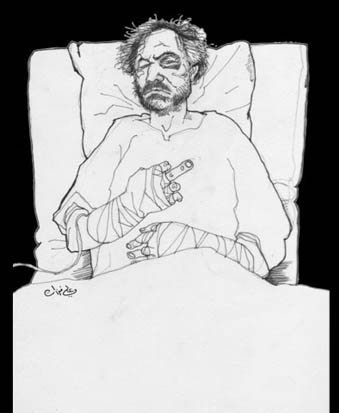
علي Ùرزات يواصل الرسم ويوجه رسالة إلى النظام

The American man of letters Bayard Taylor (1825-1878) was one of many travelers to the Near East of his time. His tour in 1853 resulted in a travel account above the common lot of Holy Land roller overs. Of particular interest is his frank account of a Turkish bath in Damascus.
“The Bath is the ‘peculiar institution’ of the East. Coffee has become colonized in France and America; the Pipe is a cosmopolite, and his blue, joyous breath congeals under the Arctic Circle, or melts languidly into the soft airs of the Polynesian Isles; but the Bath, that sensuous elysium which cradled the dreams of Plato, and the visions of Zoroaster, and the solemn meditations of Mahomet, is only to be found under an Oriental sky. The naked natives of the Torrid Zone are amphibious; they do not bathe, they live in the water. The European and Anglo-American wash themselves and think they have bathed; they shudder under cold showers and perform laborious antics with coarse towels. As for the Hydropathist, the Genius of the Bath, whose dwelling is in Damascus, would be convulsed with scornful laughter, could he behold that aqueous Diogenes sitting in his tub, or stretched out in his wet wrappings, like a sodden mummy, in a catacomb of blankets and feather beds. As the rose in the East has a rarer perfume than in other lands, so does the Bath bestow a superior purification and impart a more profound enjoyment… Continue reading Tabsir Redux: A Taylor Made Bath in Damascus
BY Karim Sadjapour, Foreign Policy, June 15, 2011
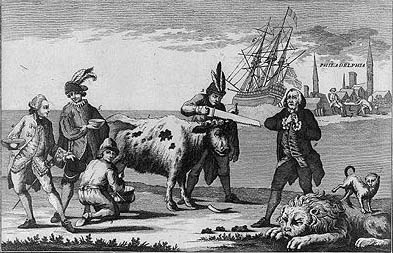
How a couple of cows explain a changing region: equal opportunity offender edition.
In the early years of the Cold War, in an effort to simplify — and parody — various political ideologies and philosophies, irreverent wits, in the spirit of George Orwell, went back to the farm. No one really knows how the two-cow joke known as “Parable of the Isms” came about, but most students of Political Science 101 have likely come across some variation of the following definitions:
Socialism: You have two cows. The government takes one of them and gives it to your neighbor.
Communism: You have two cows. The government takes them both and provides you with milk.
Nazism: You have two cows. The government shoots you and takes the cows.
Capitalism: You have two cows. You sell one and buy a bull.
Over the years, the parables gradually expanded, using the two-cow joke to explain everything from French unions (You have two cows. You go on strike because you want three cows.) to the Republican Party (You have two cows. Your neighbor has none. So what?). While in its original iteration the cows were a metaphor for currency, capital, and property, they later began to take on different meanings.
Today, the Middle East has replaced the Cold War as America’s primary foreign-policy preoccupation. As opposed to the seemingly ideologically homogenous communist bloc, however, the 22 diverse countries that compose the modern Middle East are still confusing to most Americans. Why can’t the Israeli and Palestinians stop fighting already? What’s the difference between Libya and Lebanon again?
Herewith then is a satirical effort to simplify the essence of Middle Eastern governments so that, in the immortal words of George W. Bush, “the boys in Lubbock” can read it. And, rather than symbolizing property, the cows here symbolize people, which — funny enough — is how most Middle Eastern regimes have traditionally viewed their populations.
Saudi Arabia
You have two cows with endless reserves of milk. Gorge them with grass, prevent them from interacting with bulls, and import South Asians to milk them.
Iran
You have two cows. You interrogate them until they concede they are Zionist agents. You send their milk to southern Lebanon and Gaza, or render it into highly enriched cream. International sanctions prevent your milk from being bought on the open market.
Syria
You have five cows, one of whom is an Alawite. Feed the Alawite cow well; beat the non-Alawite cows. Use the milk to finance your wife’s shopping sprees in London.
Lebanon
You have two cows. Syria claims ownership over them. You take them abroad and start successful cattle farms in Africa, Australia, and Latin America. You send the proceeds back home so your relatives can afford cosmetic surgery and Mercedes-Benzes.
Hezbollah
You have no cows. During breaks from milking on the teat of the Iranian cow you call for Israel’s annihilation. Continue reading Tabsir Redux: The Cynical Dairy Farmer’s Guide to the New Middle East
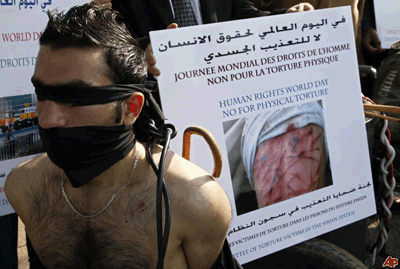
A young man’s account of sadistic torture in a Syrian secret prison, and how a girl’s note helped him through his pain.
Hugh Macleod and Annasofie Flamand, Al Jazeera, June 6, 2011
Arrested during a protest in the first days of the Syrian uprising, a young man endured acts of sadism and torture at the hands of Bashar al-Assad’s secret police.
As his body was beaten, whipped, electrocuted and worse; the prisoner could think only of the girl he loves, clenching a note from her in his hand as the torturers did their worst.
Told largely in his own words, this is his remarkable personal story of endurance and hope in a place filled with darkness and despair.
A small piece of paper held tight in a clenched fist. A lifeline to a better place.
Days become nights become days. The kicks, the punches, the questions, the insults, the humiliation and the pain.
“She was always on my mind in the toughest moments during the torture. The only thing that relieved the pain was my belief that, at that moment, she was comfortable in her bed.”
The beatings begun on the police bus driving arrested protesters to one of Syria’s most notorious secret police branches.
“Your mother is a whore!” screamed one of the policemen, as he slammed the butt of his rifle into the prisoner’s face. “We will f*** her and your sister!”
But the young man wasn’t listening.
“In the first five minutes I was only thinking of her. I was so afraid for her. But when the bus drove off I saw her trying to phone somebody, so I was so happy that she’s wasn’t under arrest. I didn’t know then that they arrested her a few minutes later. Continue reading Love in a Time of Torture
As someone who has a long standing interest in the peoples and cultures of the region geographically maligned as the “Middle East,” I am beyond being overwhelmed by the daily turn of events. To see the streets of Yemen turned into bloody confrontation after three months of amazingly peaceful protests is so sad. I had always wondered if Ali Abdullah Salih was really trying to be a father-of-his-country figure (despite the widespread corruption and nepotism) or if it was mainly his inability to be a brutal dictator in the Ben Ali mode that ruled the day. His recent flirtation with leaving office, only to back down each time, suggests that he has no intention of leaving and is looking for any way to prolong his rule. The Al Qaeda on the doorsteps alibi has not fooled anyone, including the U.S. terrorism money machine. So it seems his latest insane step, right out of a really bad thriller movie, is to foment civil strife. Today’s news about his attempt to alienate the leader of the Hashid confederacy has indeed plunged the capital into street fighting. One thing is clear: Ali Abdullah Salih loves Ali Abdullah Salih and the country he has ruled over for over three decades be damned.
Then there is Syria, where Bashar al-Asad, once thought to be a rather weak version of his towering (at least in all the statues strewn about the former Umayyad enclave) father, has decided to be the old-fashioned Stalinesque strongman. Not content to believe that the mere 96.7% of the votes in his last presidential referendum meant anything other than the normal one-man-rule politics, he is apparently trying to get rid of anyone who opposes him by whatever mean means work. To protest in Syria, as in Libya, means to risk life and limb. Continue reading Crisis Hopping