Category Archives: Countries

Sharing our values…


This post is not about the value of journalism, but about the blind prejudice that infiltrates much journalistic writing about values. I am not talking about the caricature newscasting of a Fox News Geraldo Rivera, who thinks wearing a hoodie is a problem (just like some maintain that a woman wearing a miniskirt is asking for “it”). Rather it is the prize-touting expert-of-all-trades mentality of Thomas Friedman, whose talking-head status is, in journalistic terms, astronomical. Yesterday, Friedman posted a commentary in The New York Times entitled “A Festival of Lies.”

Friedman begins with a quote from the historian Victor Davis Hanson in The National Review:

“Military assistance or punitive intervention without follow-up mostly failed. The verdict on far more costly nation-building is still out. Trying to help popular insurgents topple unpopular dictators does not guarantee anything better. Propping up dictators with military aid is both odious and counterproductive. Keeping clear of maniacal regimes leads to either nuclear acquisition or genocide — or 16 acres of rubble in Manhattan. What have we learned? Tribalism, oil, and Islamic fundamentalism are a bad mix that leaves Americans sick and tired of the Middle East — both when they get in it and when they try to stay out of it.”

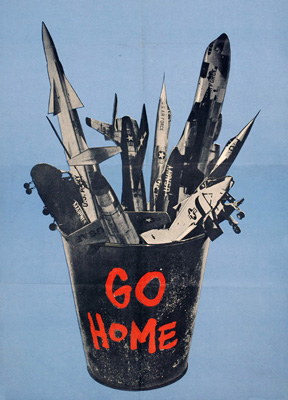
I certainly agree with Friedman’s gut reaction that “And that is why it’s time to rethink everything we’re doing out there. What the Middle East needs most from America today are modern schools and hard truths, and we haven’t found a way to offer either.” Bravo. Bombs make enemies and schools build friendships: this hardly seems like a new revelation, but it is the kind of truth spoken to power that needs to be voiced time and time again.

But it is what underlies the rationale where I find an all-too-familiar ritual of truths that carry along the heavy baggage of assumptions that belie the argument being made. Continue reading Sharing our values…

How safe is home?


On March 11 an American soldier slipped out of his base before dawn and ended the lives of 17 Afghan civilians, who had returned to what they thought would be a safe home near the protection of the American military base. The general reaction to this is that the man “snapped,” an isolated act. Then there is the case of a Florida vigilante who shot an unarmed, young black kid wearing a hoodie and walking home; the man who shot him claims that it was in self defense. Someone must have “snapped” in the encounter. Yesterday an as-yet-unidentified killer took the life of an Iraqi mother living in El Cajon, California. The murderer snuck into her bedroom and bludgeoned her to near death, leaving a note that said “go back to your country.” Perhaps this was also an individual that “snapped”? A trial is now ending for a student at Rutgers who played a prank on his roommate by setting up a web-cam to record a homosexual encounter; his roommate killed himself. I guess one could say that the suicide happened because this young man “snapped”? Four different deaths, but all assumed to be because an individual acted in an abnormal way, a criminal act (suicide is still a criminal act in U.S. law) that goes counter to a society’s moral norms.

Such immoral acts have been going on since the get-go of human civilization; even ardent biblical literalists point to the fratricide of Cain. But assuming that an individual has “snapped” explains nothing, except to say “well, that is not supposed to happen.” Following the media, we are far too snap-happy in explaining away murder. Consider the bumper sticker mentality that “guns do not kill people, but people do.” To me this is like saying that malaria doesn’t kill people, but mosquitoes who carry the malaria do. Obviously it is a combination of the two. People use guns to kill people, either issued by the military (as in Afghanistan) or because of a constitutional American right to bear arms and stand one’s ground (as in Florida). People also use knives and steel rods, or even their bare hands. There are various means, but is it really useful to cite “snapping” as the rationale? Continue reading How safe is home?

Women in Yemen’s Arab Spring


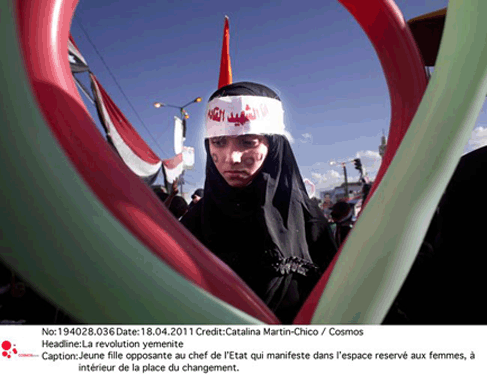
The website arabwomenspring has posted a summary of Yemeni women’s participation in the recent political protests and historical background on their role in governance. Below is an outline of the contents of the online report:

1 Women’s participation in demonstrations
1.1 Time-line of key events
2 Women’s participation in political life: opportunities and obstacles
2.1 Representation in government
2.2 Representation in parliament
2.3 Representation in local councils
2.4 Representation in the judiciary
3 A discriminatory legal framework
3.1 CEDAW
3.2 The Constitution
3.3 Other discriminatory laws
4 Further reading

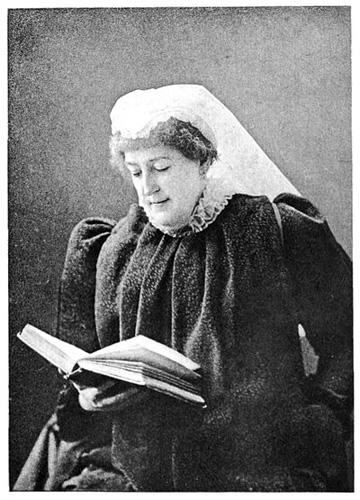
Lady Burton in Jeddah


Lady Isabel Burton, wife of Sir Richard Francis Burton

[The following is an excerpt from The Romance of Lady Isabel with her reflections on visiting Jedda on the way to India in 1876. The entire book is available online.]

I was delighted with my first view of Jeddah. It is the most bizarre and fascinating town. It looks as if it were an ancient model carved in old ivory, so white and fanciful are the houses, with here and there a minaret. It was doubly interesting to me, because Richard came here by land from his famous pilgrimage to Mecca. Mecca lies in a valley between two distant ranges of mountains. My impression of Jeddah will always be that of an ivory town embedded in golden sand.

We anchored at Jeddah for eight days, which time we spent at the British Consulate on a visit. The Consulate was the best house in all Jeddah, close to the sea, with a staircase so steep that it was like ascending the Pyramids. I called it the Eagle’s Nest, because of the good air and view. It was a sort of bachelors’ establishment; for in addition to the Consul and Vice-Consul and others, there were five bachelors who resided in the building, whom I used to call the “Wreckers,” because they were always looking out for ships with a telescope. They kept a pack of bull-terriers, donkeys, ponies, gazelles, rabbits, pigeons; in fact a regular menagerie. They combined Eastern and European comfort, and had the usual establishment of dragomans, kawwasses, and servants of all sizes, shapes, and colour. I was the only lady in the house, but we were nevertheless a very jolly party. Continue reading Lady Burton in Jeddah

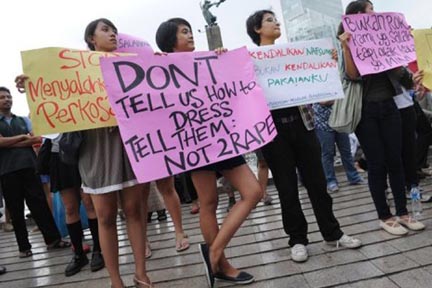
Miniskirting the Issue


Indonesian women’s rights groups said they were outraged by the comments and called for a stop to the demonization of rape victims

Why is it that men blame women for their own failures? Whenever I hear a variant of the phrase, “Well, he couldn’t help himself,” I can’t but think that this excuse is in need of a lot of help. In Indonesia there is a bill being considered in parliament that would ban female lawmakers from wearing provocative clothing, such as miniskirts. Given that the number of Indonesian lawmakers wearing miniskirts must be a whopping minority, why is this needed? Here is the rationale:

“We know there have been a lot of rape cases and other immoral acts recently, and this is because women aren’t wearing appropriate clothes,” house of representatives speaker Marzuki Alie said.

“Women wearing inappropriate clothes arouse men, so it needs to be stopped. You know what men are like — provocative clothing will make them do things.”

So men rape women because women wear miniskirts. I have not seen the statistics, but I suspect the majority of women in Indonesia do not fall for the idea that all they have to do is dress conservatively and there will be no danger of a man raping them. This notion that the male rapist cannot really be blamed because “provocative clothing will make them do things” is not limited to any national or religious group. What is rather bizarre in this case is that the ban would only be to protect male lawmakers and not for the public at large. So either there is an epidemic of male lawmakers raping female lawmakers in Indonesia or these males are so easily aroused that the ban need only be to stop those provocative female lawmakers. I guess once outside the parliament building, male lawmakers can contain themselves. Continue reading Miniskirting the Issue

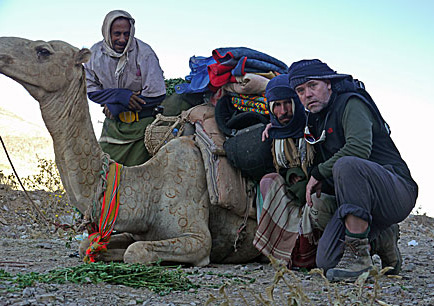
A Swede and a camel in Yemen


by Iona Craig, The National, January 9, 2012

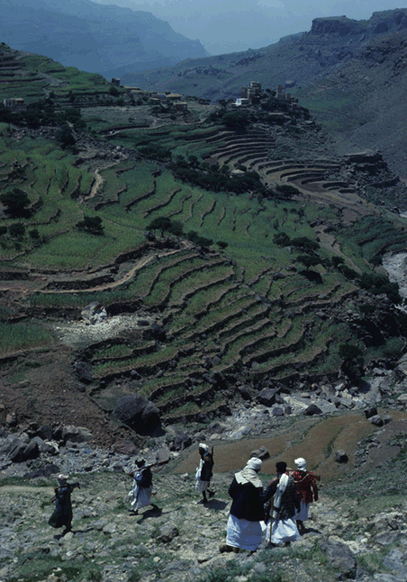
A Swedish adventurer crossing Yemen by camel hopes his journey will encourage tourists to see beyond the political turmoil and violence that has engulfed the country for nearly a year.

Mikael Strandberg set out on December 7 on a 380-kilometre trek across the treacherous highlands, the first leg of his Yemen venture, to disprove the purveyors of pessimism.

“I don’t know what they [the tourists] are waiting for … it is such a wonderful country with great potential,” he said, after arriving in Sanaa after a two-week march through the toughest terrain in the Arabian Peninsula.
Along with two Yemeni companions, Mr Strandberg is in the initial phase of a journey that will cross the country from the western coastal plains of Hodeida to the edge of the world’s largest sand desert, the Rub’ Al Khali, or Empty Quarter, and beyond to Oman.

The explorer, 48, who fell in love with both the country and his wife Pamela, an American, during a visit to
Yemen three years ago, holds fond memories of Sanaa and the Yemeni people.

“We decided to go and try to make a difference and give a different perspective from the one portrayed by the media,” said Mr Strandberg. Continue reading A Swede and a camel in Yemen