Category Archives: Countries

But Are They “The Good Muslims”?

What we talk about when we talk about Egypt’s Salafis
By Haroon Moghul, Religion Dispatches, May 3, 2012

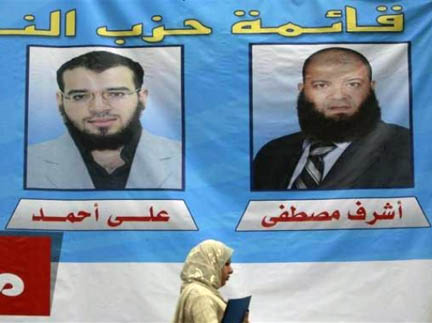
After their strong showing in the Egyptian elections, Salafis are a hot topic. But despite all the talk of Salafis, we still have a difficult time defining Salafism. Take Wendell Steavenson’s recent New Yorker piece, “Radicals Rising,” a portrait of Salafi politicians in Alexandria, Egypt.

Steavenson defines Salafism as “a strain of Islamic fundamentalism that emphasizes the original tenets and practices of the Prophet Muhammad and his companions.” Steavenson’s essay is worth reading—don’t get me wrong. But her definition doesn’t actually distinguish Salafis from most other Muslims.

Islam is rooted in the Qur’an and the Prophet Muhammad. This applies to Salafis (usually considered Sunni) as much as it does to Shi’a Muslims. For both, Muhammad embodies the Qur’an, and they in turn try to embody Muhammad. Continue reading But Are They “The Good Muslims”?

The Barbarian Has to Keep It Real


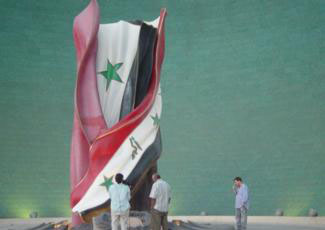
Sinan Antoon (far right) near the Symbolic Tomb at the Martyr’s Monument in Baghdad (2003). Image from Encounter Productions.

The Barbarian Has to Keep It Real: Interview with Jadaliyya Co-Editor Sinan Antoon

Interview with Nahrain Al-Musawi, al-Jadaliya, May 03 2012

[The following interview with Jadaliyya Co-Editor Sinan Antoon was conducted by Nahrain Al-Musawi and originally published in Al-Akhbar English on 2 May 2012.]

Sinan Antoon is an Iraqi-born novelist, poet, translator, filmmaker, and professor. His 2003 widely translated novel I’jaam is a fictional prison memoir. The book is ironic and haunting as it reflects the absurdities of Saddam Hussein’s Baathist regime, futile attempts to escape censorship, and prisoners going mad as a final act of revolt.

Antoon returned to Baghdad in 2003 and filmed About Baghdad, documenting the exhilaration and despair of Iraqis experiencing the fall of the Baathist regime and then the US occupation. He produced two collections of Arabic poetry, which have also been translated into English.

His most recent project is a translation of Mahmoud Darwish’s In the Presence of Absence (2011). Antoon has been at home in the US for decades, so when once asked about the distinction of being an Arab-American writer, he replied, “It’s not easy being a barbarian in Rome. The Romans rarely listen, but the barbarian has to keep it real.”

In this interview, Antoon discusses the distinction of being a barbarian, “an outsider, a stranger,” in the US, as well as the trope of closure that frames the recent US withdrawal from Iraq, sectarianism discourse, and the unique quality of spatial fragmentation and division that now characterizes Baghdad – once Antoon’s home.

Nahrain al-Mousawi (NM): When and how did you leave Iraq? Can you talk about that experience a little bit?

Sinan Antoon (SA): I was supposed to leave Iraq in August 1990 to continue my studies abroad, but Saddam invaded Kuwait on August 2 and there was a travel ban. I survived the war and left in April 1991 after the war was over and the travel ban was lifted. I had always wanted to leave. Living under an authoritarian regime isn’t fun, especially for an aspiring writer who wasn’t willing to write in praise of the leader and his wars. (Some of those who made their names praising Saddam and his wars are running around now posing as patriotic anti-imperialists).

So I took the bus from Baghdad to Amman like thousands of Iraqis did and would do throughout the 1990s and later. I was happy to escape, but I shed a few tears as the bus drove away. I knew that I was leaving some irretrievable parts of my self and my life behind. I stayed in Amman for a few months and then was able to come to the US to do my graduate studies. I worked and did an MA in Arab Studies at Georgetown, then went on to get a doctorate in Arabic literature at Harvard. Continue reading The Barbarian Has to Keep It Real

On Islam, Romney Doesn’t Have the Slightest Idea What He’s Talking About


by Juan Cole, History News Network, May 7, 2012

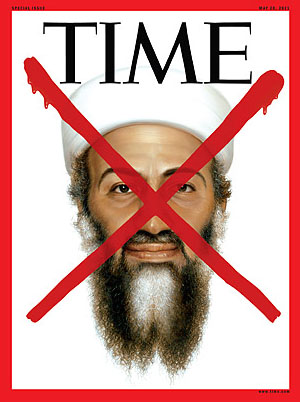
Mitt Romney said Monday that of course he would have taken out Osama bin Laden and that “even Jimmy Carter would have made that call.”

Since Jimmy Carter ordered a brave and risky but failed military mission into Iran, that was a cheap shot on the part of someone who has never had anything to do with the military. Moreover, Jimmy Carter made peace between Egypt and Israel and played a major role in reducing the number of Africans stricken by the Guinea worm from 3.5 million to 1,100. So Romney, who has mainly been sending our jobs overseas, isn’t good enough to shine Carter’s shoes.

Moreover, Romney is forgetting what he said about Obama when bin Laden was killed:

“I think the president deserves credit for approving a relatively high-risk entry into the country with helicopters and special operations personnel, Navy SEALs,” Romney said. “That was the thing that proved to be successful.”

So at the time, Romney acknowledged that Obama made the decision, and that it was a high-risk strategy that he approved (advisors such as Joe Biden preferred a missile strike). Continue reading On Islam, Romney Doesn’t Have the Slightest Idea What He’s Talking About

With Baldensperger in Palestine #1


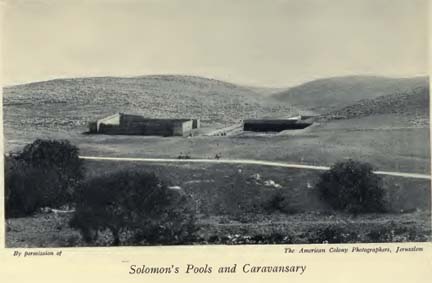
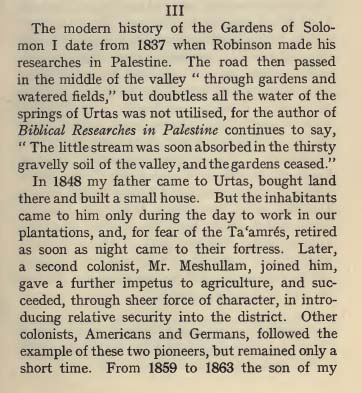
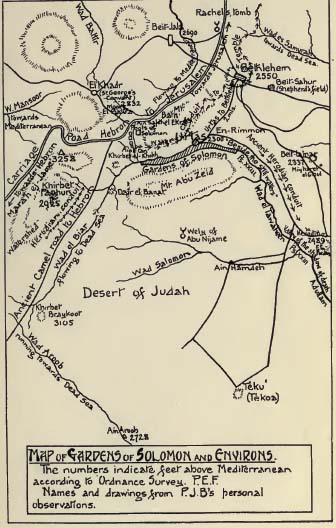
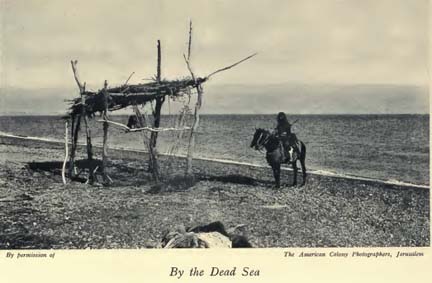
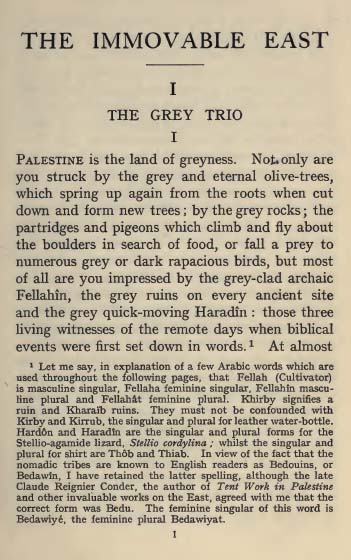
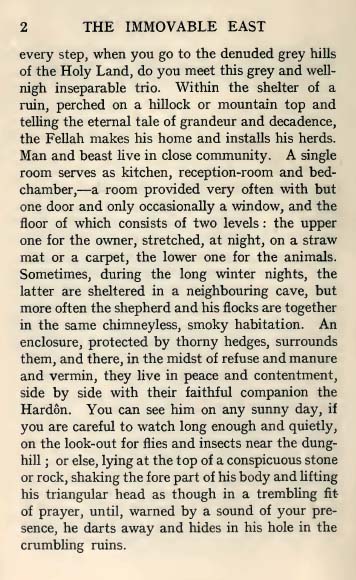
The land currently contested by Israelis and Palestinians has a long history of being contested. In the 19th century, when the area was under Ottoman control, several foreign missionaries settled in the land where Jesus walked. Philip J. Baldensperger, born in 1856, was the son of an Alsatian missionary living near Jerusalem. As a boy who grew up in Palestine, he learned first hand many of the customs and wrote his observations down. His magnum opus is The Immovable East, published in 1913, and available for free as a pdf at archive.org. I attach here the introduction to the work by the bibliophilic Frederic Lees. The pictures are well worth looking at the text, which is a fun read with banal Orientalist trimmings of an area where politics rules the day as never before.

Continue reading With Baldensperger in Palestine #1