Category Archives: Countries

Ansar al-Sharia on the Ropes?


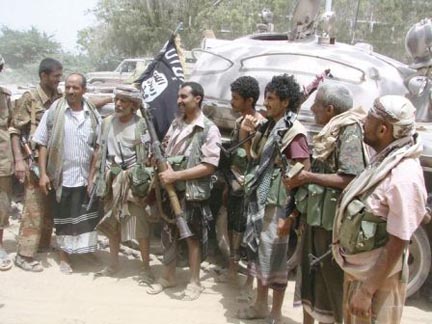
The news today is that Yemeni government troops and local tribal militia have finally dislodged the ultra-conservative Ansar al-Sharia from their base in the southern towns of Ja’ar and Zinjabar. These cities had been under de facto control of the rebels for over a year, with the military weakened during the long drawn-out political turmoil that eventually led to the removal of Ali Abdullah Salih. According to al-Jazeera, “Since the offensive began, 485 people have been killed, according to an AFP tally combined from different sources. This includes 368 al-Qaeda fighters, 72 soldiers, 26 local armed men and 19 civilians.” Without question this is a major blow to a group that used foreign fighters and was increasingly at odds with local tribes. During their tenure both towns had become virtual ghost towns where a distinctively non-Yemeni form of Islamic law was mandated by force. Details thus far are rather skimpy. but it appears that the remaining individuals of Ansar al-Sharia fled east to al-Shaqra.

The question remains, of course, of whether this is a major blow to Ansar al-Sharia and its affiliated partner al-Qaida in the Arabian Peninsula or a skirmish. Given the massive external support now being given to the central government, I strongly suspect that this is the beginning of the end for Ansar al-Sharia as a fighting force. It has survived thus far on weapons looted from the army with almost no direct outside support apart from an influx of foreign fighters from Afghanistan and Somalia. The agenda of Ansar al-Sharia, like that of AQAP, has failed to find fertile ground among the bulk of the population with outright antagonism from most tribal leaders. It has flourished primarily due to the weakness of the government over the past year. Continue reading Ansar al-Sharia on the Ropes?

Tabsir Redux: Mahdi as Hell…

Has your atlas arrived yet? The New York Times reported yesterday that prominent American scientists and politicians are receiving what purports to be an “Atlas of Creation” from a Turkish media guru self-named Harun Yahya. No, it is not revenge for the “War on Terror.” Nor is a glossy book of patent nonsense, no matter how intelligently designed and styled as “probably the largest and most beautiful creationist challenge yet to Darwin’s theory” much of a challenge. Scientists will recognize it for a “load of crap,” as Kevin Padian, an evolutionary biologist at the University of California, Berkeley, impolitely phrased it.

The “War on Terror” has manufactured a whole host of new enemies. But what a strange bedfellow is Charles Darwin, who liberated science from the dogmatic demands of religious apologists like Mahdi Yahya a century and a half ago. Darwin’s approach now summarizes all of modern science, a steady advance in knowledge because no specific idea is ever held sacred. This does not mean that scientists must abandon religion and faith, but it does offer a view of the world in which human reason is not abandoned under the cloak and rhetorical dagger of a supposedly spiritual quest for moral behavior. Continue reading Tabsir Redux: Mahdi as Hell…

Meanwhile in Socotra


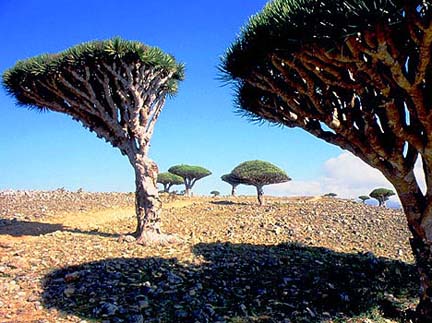
The famous dragons blood tree; Photo by Valerio Pandolfo

Revolution in Socotra: A Perspective from Yemen’s Periphery
by Nathalie Peutz, Middle East Report #263, Summer 2012.

At the beginning of 2012, as Egyptians and Syrians marked the second year of their revolts, protesters also took to the streets of Hadiboh, the tumbledown capital of Yemen’s Socotra archipelago (pop. approx. 50,000). Like demonstrators elsewhere, the Socotrans were calling for both local administrative change and national political reform. While the Socotran protests, occurring since March 2011, were small, they were no less significant than the more spectacular rallies in the epicenters of Arab revolution. Indeed, the spread of revolution to Socotra, the largest and most populated of the archipelago’s four islands, shows the extent to which the events of 2011 have resonated even at the very margins of the Arab world. Moreover, it demonstrates how socially and culturally empowering these events have been for a people who have long been politically subjugated, economically marginalized and, unlike many in mainland Yemen, unarmed.

For if revolution has reached Socotra, as many young enthusiasts in Hadiboh would claim, it is manifest not merely in the biweekly gatherings of male protesters marching through the dusty market to the familiar slogan, “The people want the fall of the regime.” It is evident also in the way that Socotrans have begun to speak openly and forcefully about their preferences for Socotra’s political future. And it was measurable in the islands’ largest cultural event, a five-day festival during which nine Socotran wordsmiths vied for the title of “poet of the year.” Now in its fourth year, the festival, which began on the eve of 2012, featured poem after poem, in the islanders’ native Suqutri tongue, reflecting on the Arab revolts, the turmoil on the mainland and the fate of the archipelago. Where political discontent long found expression in ruminations on a pastoral past, today it is articulated in contending verses on the prospects for Socotran sovereignty.

For the full article, click here to read it on the MERIP website.

Horses of Early Arabia


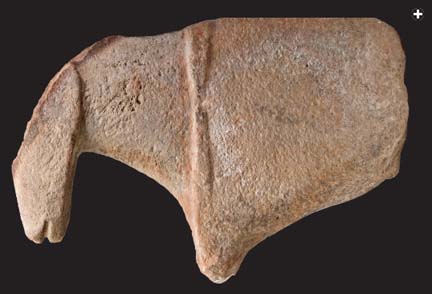
The largest, and to date the most significant, of more than 300 artifacts found so far at al-Magar is a sculpture fragment whose head, muzzle, nostrils, arched neck, shoulder, withers and overall proportions resemble those of a horse, though it may represent an ass, an onager or a hybrid. Eighty-six centimeters (34″) long, 18 centimeters (7″) thick and weighing more than 135 kilograms (300 lbs), it is provisionally dated to about 7000 bce.

The latest issue of Saudi ARAMCO World (May/June 2012) has a fascinating article about archaeological finds at the site of Magar in southwestern Saudi Arabia. It features an early sculpture of a horse, among other artifacts.

Dance at Alwan


Magda Saleh, “Giselle”, Studio Portrait, Cairo, Egypt, 1968, left; Magda Saleh in “Don Quixote”, Guest Artist, Bolshoi Ballet, right

Panel Discussion: Dancing Culture and Controversy: Professional Women Dancers of the Arab World
Monday, June 4, 2012 6:30 pm at Alwan for the Arts

Join renowned professional dancers Magda Saleh of Egypt, Leila Molaei of Arab-Iranian descent, and dance anthropologist Najwa Adra, for a panel presentation and discussion on women professional dancers of the Arab world and diaspora.

Dance by women is the most controversial of all performance arts, because it is the body, the basis for construction of gender difference, which creates it. Traditional or culturally specific dances especially embody cultural ideals and taboos related to the female body.

Panel Discussion 6:30-8:30

$5 at door (Free for members.)

Magda Saleh will share vignettes of her trailblazing career path of classical dance, becoming Egypt’s beloved Prima Ballerina with the Cairo Ballet Company. She will also present footage of her 1979 documentary film, “Egypt Dances”, highlighting women performers of Egyptian traditions such as zar, haggalah and others.

Leila Molaei, expert performer and teacher of raqs sharqi, Iraqi kawleya, and one of a handful of Arab professional dancers of these forms in diaspora, will speak to how she negotiates cultural challenges of performing female solo dances. Leila will also discuss gender issues in performance of dances such as kawleya and khaleegy, including demonstrations of relevant technique and issues such as costuming and context.

Leila will also be teaching a workshop on Iraqi dance and performing in NYC, presented by Mark Balahadia. For more information on the May 31 show, or June 2 & 3 workshop, visit www.markbalahadia.com.

Najwa Adra, cultural anthropologist specializing on dance in the Middle East region will serve as the panel respondent.

About the Artists: Continue reading Dance at Alwan