Category Archives: Countries

Travels with Ibn al-Mujabbir #3


Sailing Seasons in the Red Sea and Indian Ocean:
The View from Rasulid (13th-14th Centuries) Aden

by Daniel Martin Varisco

[This is a lecture presented at the Red Sea Trade and Travel Study Day of the Society for Arabian Studies at the British Museum, October 5, 2002, and subsequently published in Yemen Update. For Part 1, click here; for Part 2, click here.]

Thursday, 15 Sha‘ban, 691, August 1, 1292

We are now but a day’s sail away from safe haven in Aden, if God wills and the wind does not cease to obey his commands. It has been a good journey thus far. No major storms or pirates, though we did see a shipwreck on the reefs south of the Farasan Islands. Our pilot, praise God, knows his way over the shoals, even if blindfolded, I think. In the morning we took aboard some fresh water at al-‘Ara, after coursing around the tip at Bab al-Mandab and leaving Bahr al-Qulzum. After my noon prayer, when the sun beat down so mercilessly and I was sorely tempted to jump into the water with all my clothes on, I suddenly remembered that this was the midpoint of Sha‘ban with only two weeks left until the holy fasting month. Today is the anniversary of the day the Prophet, peace be upon him, was instructed to make Mecca the qibla rather than Jerusalem. God willing, I will make the pilgrimage in the coming year. Even thinking of the well of Zamzam made the warm water in the fantash all the more sweeter.

As night fell, I remembered an earlier trip, when a tormenting monsoon tore our sail and nearly capsized the ship as we departed Zayla‘ for Bab al-Mandab. These were the ‘awasif winds, fouling us with the stench that only Iblis breaking wind could send. That turning point is a dangerous point. An old sailor on board, who has often traveled along the African coast from Mogadishu, told me that only ships like our jalba can make the passage safely; no boat with iron nails could sail past, for God, our Protector, has ordained a magnetic mountain to attract hand-wrought nails and split an intruding vessel asunder. But only the infidel Christians defy nature with such innovations. May God protect the holy cities from the ravenous appetites of crusader cannibals. Continue reading Travels with Ibn al-Mujabbir #3 →

Moderate but Islamist…


A variety of Islamophobes have comfortable media niches, including “opinion writer” Charles Krauthammer, whose Krauthammering away at Islam as a political force in yesterday’s Washington Post is yet another low blow. Krauthammer admits, almost laments, that Libya “appears to have elected a relatively moderate pro-Western government.” But, then who cares since “Libya is less a country than an oil well with a long beach and myriad tribes.” I suppose one could expand on this to argue that Texas is less a state than an oil well with a long beach and myriad rednecks. Libya is a country, Mr. Krauthammer, and one that is struggling to remake itself after decades of a dictator that the West loved to hate but actually did nothing to undo. Ah, but after all, this is obviously an exception in the aftermath of the “Arab Spring.”

They say that ignorance is bliss, so consider the bliss as Krauthammer’s view unfolds: “Tunisia and Morocco, the most Westernized of all Arab countries, elected Islamist governments. ” The most “Westernized”? This might come as a surprise to the Lebanese, unless they fail to qualify as Arab. Does he mean that they happen to be rather close to Europe? Is being “Westernized” a geographical issue? Does being “Westernized” mean accepting American foreign policy without reservations or having access to iphones and Hollywood movies? Morocco, by the way, is still a kingdom and not part of the “Arab Spring.” Continue reading Moderate but Islamist… →

Comment peut-on être Persan?


The French savant and satirist Charles-Louis de Secondat, better known as Baron Montesquieu penned his Lettres Persanes in 1721, almost three centuries ago. This was long before the age of computers or the idea that eventually germinated in the head of Steve Jobs and blossomed into the Mac (and I do not mean the big kind you eat). I suspect that Montesquieu wrote by candle light with a quill for a pen, but he would have been delighted to type away on a Macbook, especially since it comes prepackaged with both a French keyboard and a Persian font. But, alas, poor Usbek and Rica would not be able to board an Air France flight to New York, connect to Atlanta and then walk into an Apple Store and buy a much smaller Air than the one they flew from Charles de Gaulle.

Shocking, is it not. But as Jamal Abdi writes in today’s New York Times, how to be a Persian has taken on new meaning in our globally-fixated-on-terrorism age:

Last month, Sahar Sabet, a 19-year-old Iranian-American woman, was improperly prevented from buying an iPad at an Apple store in Alpharetta, Ga. After she had gone over the various options with two Apple sales clerks, a third clerk, who had overheard Ms. Sabet speaking Persian to her uncle, intervened. He asked what language they were speaking and, when he found out it was the language of Iran, he said she could not buy anything because “our countries do not have good relations” — never mind that she intended to give it to her sister in North Carolina.

Of course, Montesquieu himself could walk into Le Apple Store in Paris and come out high on his own Airs. So I can only wonder what he might have added in the new updated version of Le emails persane. Perhaps it would go like this: Continue reading Comment peut-on être Persan? →

Travels with Ibn al-Mujabbir #2


Sailing Seasons in the Red Sea and Indian Ocean:
The View from Rasulid (13th-14th Centuries) Aden

by Daniel Martin Varisco

[This is a lecture presented at the Red Sea Trade and Travel Study Day of the Society for Arabian Studies at the British Museum, October 5, 2002, and subsequently published in Yemen Update. For Part 1, click here.]

Monday, 13 Rajab, 691 (June 30, 1292)

Bismillah al-rahman al-rahim. I, Ibn al-Mujabbir, begin this diary full of hope, a pilgrim sure of his destination, not a lost soul adrift. Who but God in his indescribable mercy could have provided a calmer sea and more willing wind to our sails than our good fortune holds aboard this ship, Hut Yunis. As Jonah was saved in God’s good time, so I trust in that very God to set foot once again in my homeland. There are three ships under the protection of the Karimi assurances, traveling together for safety and among the last of the season bound south for Yemen. I humbly beg forgiveness from the One before whom I submit, who knows the danger in every unseen shoal.

In two hours time, before the evening prayer, the captain informs me we will put ashore in a safe place. We sail by day in sight of land, but at night we rest. As God is our only guide, the wisely guided do not lead themselves into temptation. There are many dangers here, for they say the devil himself is master of the sea when darkness settles and the afarit do his bidding. Even Solomon, wise and powerful as God made him, took precaution when traveling to see Sheba’s beauty queen. Should I, a poor Yemeni born in Zabid, and now a stranger to no land where freshly minted Kamiliya dirhams are valued, do less. There are, I trust, no monsters in these depths, but the jinn inhabit all seven climes and more, if there be more. Continue reading Travels with Ibn al-Mujabbir #2 →

Travels with Ibn al-Mujabbir #1


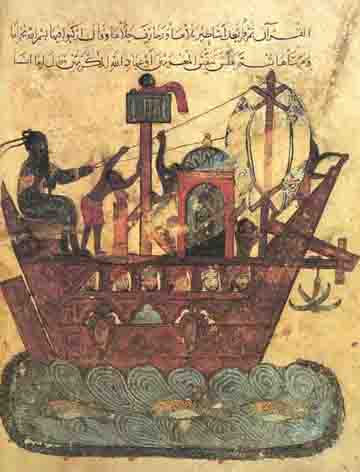
13th century illustration of an Arab ship in the Indian Ocean

Sailing Seasons in the Red Sea and Indian Ocean:
The View from Rasulid (13th-14th Centuries) Aden

by Daniel Martin Varisco

[This is a lecture presented at the Red Sea Trade and Travel Study Day of the Society for Arabian Studies at the British Museum, October 5, 2002, and subsequently published in Yemen Update.]

The province of Aden is governed by a king, who bears the title of soldan… The soldan of Aden possesses immense treasures, arising from the imposts he lays, as well upon the merchandise that comes from India, as upon that which is shipped in his port as the returning cargo; this being the most considerable mart in all that quarter for the exchange of commodities, and the place to which all trading vessels resort… Marco Polo, reflecting in a prison cell on information he obtained at the close of the 13th century.

The subject of my talk today is the view from a vital hub of the vibrant Red Sea and Indian Ocean trading network, the view from the Rasulid port of Aden; more specifically, a fresh re-view of what it might have been like to be an Arab merchant sailing to and from Aden at the same time as Marco Polo set out to return from his epic sojourn under the immense Oriental pleasure dome of Kublai Khan. I invite you to return with me to the year 1292 of the Christian Era – as it is commonly known – for a fleeting Arab businessman’s eyeview from the deck of a trading dhow bound from Aydhab on the Egyptian Coast to Aden, the best natural harbor on the South Arabian coast. Let us call this tajjir (merchant) Muhammad Ibn Mujabbir, a Yemeni by birth and at the time a successful merchant employed by the Karimi syndicate out of Egypt. He is about 35 years old, young enough to marvel at the outrageous tales told by sailors and fellow travelers, old enough to know better than to believe any of them. We will join him aboard ship sailing south of Aydhab and follow his diaried notes until he lands with his entrusted consignment of wares in Aden customs. We shall, in effect, sail through a narrow stretch of commercial maritime history with a seasoned traveler at the helm. Continue reading Travels with Ibn al-Mujabbir #1 →

A Salacious Salafi


Sheikh Wanis and his fellow adulterers

Al-Ahram has published an account of a salacious encounter of an Egyptian Salafi who is a former MP.

Egyptian authorities have decided to put on trial a Salafist ex-MP who was caught allegedly performing an “indecent” sexual act with a woman in public, a judicial source said on Thursday.

Ali Wanis’s trial is set for Sunday and will take place on time although he has gone missing since police found him last month engaged in a sexual act with a 22-year-old woman in a car parked on a highway.

The woman, a university student, is behind bars and the public prosecutor’s office has ordered the arrest of Wanis, a cleric and former MP for the ultra-conservative Al-Nour party.

After the incident in early June, Wanis denied any wrongdoing and said in a video posted on his website that he had parked along the side of the road because his passenger “became sick.”

But the pair have been accused of performing an “indecent” sexual act in public.

Al-Nour party, won the second largest number of seats in parliamentary elections last winter after the Muslim Brotherhood.

It was hit with a scandal in March when another lawmaker was forced to resign from parliament and from his party after claiming he was injured in a carjacking — to explain bandages on his face — when in fact he had had a nose job.

Wow — a blow job and a nose job and the appeal of Salafism takes a nose dive. Continue reading A Salacious Salafi →