
A richly illustrated book in French from 1887 on Iraq and Persia has an incredible number of illustrations. The book can be downloaded here. I attach some of the images below regarding Baghdad, but there are many more.


A richly illustrated book in French from 1887 on Iraq and Persia has an incredible number of illustrations. The book can be downloaded here. I attach some of the images below regarding Baghdad, but there are many more.
At least 337 Books published in Germany on Islam and history of the Middle East are available to read online or download. Most are in German but a few are in English. To check out what is available, click below:
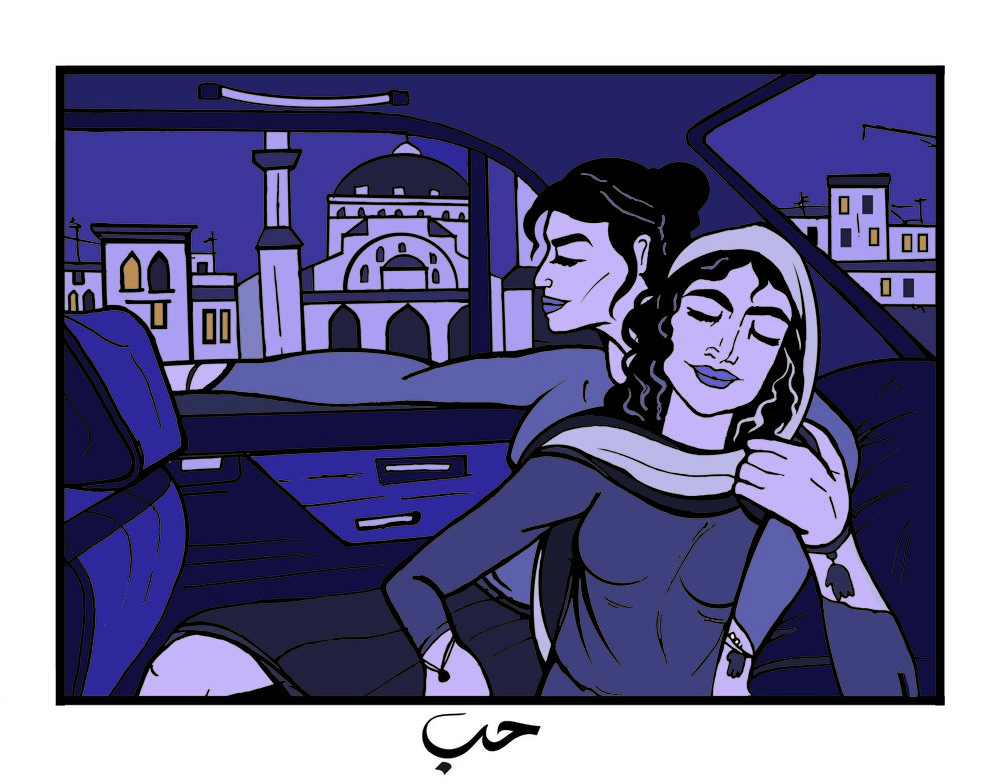
Disclaimer: This is a reworked paper, originally written for a course called "Post-Colonial Perspectives on Audiovisual Media" at Stockholm University, in which I explore orientalism and pinkwashing in the Israeli film HaBuah [The Bubble], 2006, directed by Eytan Fox.
Edward Said begins his landmark text Orientalism (1978) with a statement on “the Orient” as an invention of European, colonial powers, used to define Europe itself: “The Orient was almost a European invention, and had been since antiquity ‘a place of romance, exotic beings, haunting memories and landscapes, remarkable experiences” (p. 9). One part of Said’s critique against orientalists and their work was the construction of “the Orient” as inherently different, opposite even, of that which was considered European, or “Western”. This forms a dichotomy between “the East” and “the West”, in which West is always seen as superior to East. Oftentimes, this perceived superiority would be legitimised through a linear, evolutionistic, and developmental perspective, in which advancement is represented by European academia, and ideals constructed as western (a concept often overlapping liberal ideals) were considered modern. Since development was seen as linear, it was expected that the rest of the world would follow the same path as Europe and to end up in the same place. In other words, modernisation often translated to westernisation.
Said exemplifies how this schism was upheld, and expand on its colonial consequences, by pointing to one of the earliest works of French impressions of Egypt; Description de l’Égypte. He means to say that this work, despite its name, is not an objective account of Egypt, but a placement of Egypt in the orientalist discourse. This worked to establish the French as the height of civilisation and sophistication, i.e. modern as opposed to traditional (understood in this context as uncivilised, unsophisticated and undeveloped). That way it would be almost an act of charity and humanity to colonise the Egyptians, so that the Europeans can educate them and eventually, if they are susceptible to modernisation, they might one day themselves govern, administer and care for their civilisation and its arts and culture.
Said’s own student and protégé, Joseph Massad, has carried on his legacy, and in the book Desiring Arabs (2007) he explores the “influence and impact that Orientalism has had in shaping the Arabs’ own perceptions of themselves and each other since the Arab Renaissance to the present” (p. 48). Furthermore, the book is an elaboration of an earlier essay, offering a critique of what he calls the “universalisation of gay rights:”
Like the major U.S.-based human rights groups (Human Rights Watch, Amnesty International) and many white Western feminist organizations, the Gay International has reserved a special place for the Muslim world in both its discourse and its advocacy. This orientalist impulse, borrowed from predominant representations of the Arab and Muslim worlds in the United States and Europe, continues to guide all branches of the human rights community. (Massad 2002, p. 362)

While Massad’s work is somewhat controversial and has received plenty of critique, for example by Frances S. Hasso and Dror Ze’evi, it provides a framework and foundation for exploring the intersection of orientalism and sexuality studies. Drawing inspiration from Massad – yet staying away from his more controversial arguments about “the Gay International” – I would here like to explore the topic of how Queer Arabs and Muslims are represented in audio-visual media, especially film, as well as how this representation informs the orientalist trope of a sexually repressive Middle East. This paper focuses particularly on the Israeli film HaBuah [The Bubble], directed by Eytan Fox and released in 2006.
HaBuah is a Romeo and Juliet-story (in fact, the original title of the film was Romeo and Julio), depicting the forbidden love between two men: Noam, an Israeli-Jew, and Ashraf, who is Palestinian and Muslim. As such, the forbidden-ness of their relationship is multi-layered, as it deals with forbidden sexuality, religion, nationality, and identity. However, this is in the film made into a point, where Palestine is presented as mostly homophobic, and Ashraf is forced to move to Tel Aviv to live openly. Although it is also made into a point that Ashraf will have to pretend to be Jewish, and flees back to (Palestinian city) Nablus when his true identity is revealed, this is still a typical example of so called “pinkwashing.” This refers to how crimes committed by the Israeli state, as an occupier of the West Bank, are glossed over and justified by portrayal of Israel as a liberal, democratic state and as a sort of safe haven for gays and lesbians. In comparison, Palestinian society is seen as backwards, conservative, and homophobic. This binary portrayal is furthered in HaBuah when Ashraf and Noam are caught kissing by Ashraf’s Islamist brother-in-law, Jihad, who blackmails Ashraf into marrying his cousin. Jihad – now acting as the filmic representation of religious (Muslim) intolerance and homophobia – then plans and executes a bombing in “liberal, gay-friendly” Tel Aviv.

In an Op-Ed in The New York Times, Schulman (2011) writes that pinkwashing is “a deliberate strategy to conceal the continuing violations of Palestinians’ human rights behind an image of modernity signified by Israeli gay life.” This film is a perfect example of this strategy, and also shows its dual functions; on the one hand prop up Israel and the Israeli society as a protector of human rights, rather than a violator, and on the other hand to portray Palestinian society as anti-gay – and thus anti-liberal. As such, it also acts as an ideological justification for Israeli occupation and militarism, since that is portrayed as in defence of “liberal” values. This can be understood in terms of securitisation – a term from the Copenhagen School of International Relations (see Buzan 2015) – whereby Palestinian presence is deemed inherently dangerous.
The myth (in Barthesian terms) of an Arab security threat is so prevalent in HaBuah that not only is Jihad and other Islamist Palestinians portrayed as threats, but, after his sister is killed in a raid by Israeli soldiers, even Ashraf becomes a potential threat, taking the place of Jihad as a suicide bomber. Ashraf kills himself and Noam. While the audience to some extent is invited to empathise with Ashraf, it is clear from the start that Noam, whom is first introduced doing military service at a check-point, is the “proper” protagonist. Ashraf on the other hand is only favourably portrayed when he is in Tel Aviv, living his life as an Israeli Jew, and him returning to Nablus is an upsetting event for the audience, who by now should want Ashraf to stay in Tel Aviv.
This context provides perfect opportunity to reflect Butler’s (2004) book Precarious Life, in which she discusses how only certain lives are considered “grievable.” In the book, Butler examines the ambiguities of terms such as “terrorist” and points out that this is used by “the Israeli state to describe any and all Palestinian acts of resistance, but none of its own practices of state violence” (p. 4). This, she argues, is a means of precluding historical inquiry and to morally justify retaliation. In HaBuah, the death of Ashraf’s sister is portrayed as a direct result of her husband’s involvement in the Tel Aviv-bombing, thus providing a frame in which her death is less grievable. The same goes for the death of Ashraf, in comparison to Noam. While, as mentioned, Ashraf’s decision to take Jihad’s place is somewhat explained with the death of his sister, the audience is not invited to empathise with this decision; it is seen as a tragedy, the final failure of the Palestinian queer to assimilate in liberal Tel Aviv. In a sense, it is the failure of Ashraf’s gayness, in the orientalist discourse understood as Western-aligned/liberal/modern, exactly because of his Palestinian identity, in the orientalist discourse understood as religious, anti-Western, or even inherently violent. Ashraf’s turn to suicide bombing and his subsequent death is inevitable rather than grievable, while Noam has no part in this bombing, and simply becomes a victim.

Another relevant text here is Boggs’ and Pollard’s (2006) “Hollywood and the Spectacle of Terrorism,” in which they write about portrayals of terrorism in media:
The main political and media discourses stress an epic struggle between (Western, democratic, modern) “civilization” and (Jihadic, Muslim, primitive) “barbarism”—a self- serving, hypocritical grand narrative that frames political violence as a monopoly of cultural/national Others whose modus operandi, mostly local attacks, contrasts with the “legitimate” military actions of powerful governments launching high-tech missile strikes and bombing raids. (Boggs and Pollard 2006, p. 336)
This, in HaBuah, is evident in the contrast between the rationalised, justified, and organised military operations of the Israeli soldiers, as opposed to the emotionally and religiously driven violence of the Palestinian Islamists – whose headbands reveal their association to the Izz ad-Din al-Qassam Brigades, the armed wing of Hamas. It is worth noting that it is Ashraf who is killed off (by the director), rather than Jihad or any of the other members of the Hamas brigade. Thus, in the film universe, the threat is still alive and well, allowing for continued justification of Israeli military securitisation.
Ashraf, as a queer person, is in HaBuah a victim of his own cultural identity, and the plot could be described as revolving around Noam’s failed attempt to “save” Ashraf. But, his being saved then, is reliant upon two orientalist ideas: one is that Ashraf is without agency and thus cannot save himself, and the other is that his very being, as a queer Palestinian, is an unresolvable contradiction, requiring erasure of the (less favourable) national identity in favour of his sexual identity. In this manner, HaBuah symbolically, through the blowing up of Ashraf, promotes the erasure of Palestine. A counterpoint to this argument could be that the protagonist, Noam, is actively engaged in the anti-occupation movement. However, this fact does nothing to promote the actual anti-occupation movement, but rather only acts to show Noam as empathetic, and nonetheless he is still murdered by a Palestinian, thus making his anti-occupation stance portrayed as naïve at best.
Lastly, it must be mentioned, as is emphasized by Shohat and Stam (2014), that Israel is commonly imagined as a Western country (while Turkey, located to the West of Israel, is usually Eastern). This idea is further perpetuated by the type of pinkwashed binary portrayal as can be seen in HaBuah, wherein Israel is portrayed as modern, liberal, free, democratic, gay-friendly, as opposed to Palestine, which is then portrayed as illiberal, unfree, undemocratic, and most importantly, far from gay-friendly.
Boggs, Carl, and Tom Pollard. “Hollywood and the Spectacle of Terrorism.” New Political Science, 2006: 335–351.
Butler, Judith. Precarious Life: The Powers of Mourning and Violence. London: Verso, 2004.
Buzan, Barry. “The English School: A neglected approach to International Security Studies.” Security Dialogue, 2015: 126–143.
Massad, Joseph. Desiring Arabs. Chicago: University of Chicago Press, 2007.
Massad, Joseph. “Re-Orienting Desire: The Gay International and the Arab World.” Public Culture, 2002: 361-385.
Said, Edward. Orientalism. New York: Vintage Books, 1978.
Schulman, Sarah. “Israel and ‘Pinkwashing’.” International New York Times. November 22, 2011.
Shohat, Ella, and Robert Stam. Unthinking Eurocentrism: Multiculturalism and the Media. London: Routledge, 1994.

There is an interesting article on Qantara about the significance of the German poet Goethe’s famous West-Östliche Divan, first published 1819. To read an English translation, click here.

Google’s attempt to translate can be charming at times and completely wrong as well. Here is how Google translated a post on Facebook about an old article regarding the transcription of South Arabic “Himyarite” letters. For those who do not know Arabic, the word for donkey is hamir, a close match for a computer… And Playfair was definitely not recent…
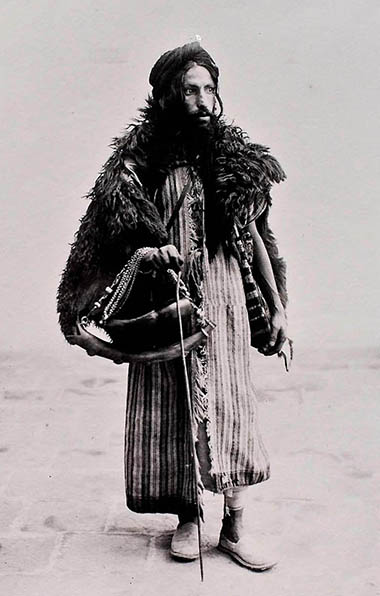
Dervish; photograph by Sevryugin Anton (1830 – 1933),
the official photographer of the Imperial Court of Iran
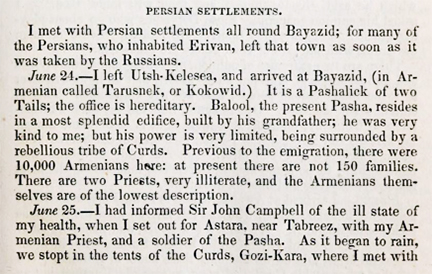
In the early 19th century there was a florescence of Protestant missionary interest in saving Muslim, Jewish and other kinds of Christian souls in the Middle East. This thread continues excerpts from one of the earliest accounts from the 19th century, that of Joseph Wolff (1795-1862), a convert from Judaism to Christianity. In 1837 he published a diary of his travels. Like a number of Christians visiting the Muslim world, Wolff is more impressed by Muslim sobriety and devotion in their ritual than he is by the Christians he sees:
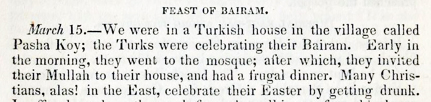
There is also an intriguing encounter between the Christian missionary and a Kurdish Muslim dervish:
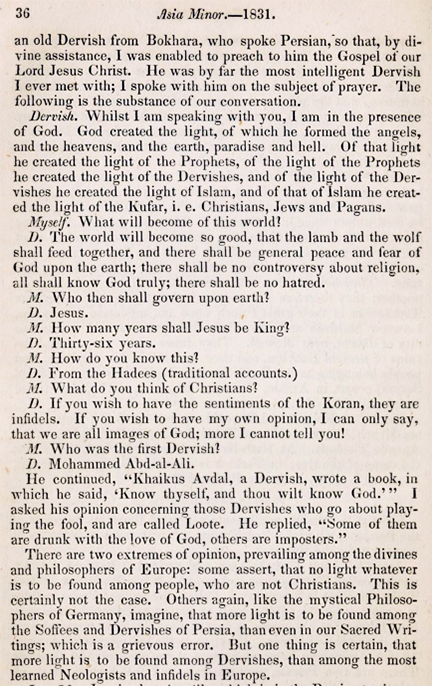
Chalk one up for the Kurdish dervish over the atheists of Europe.


