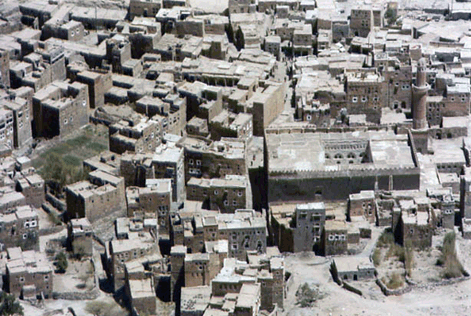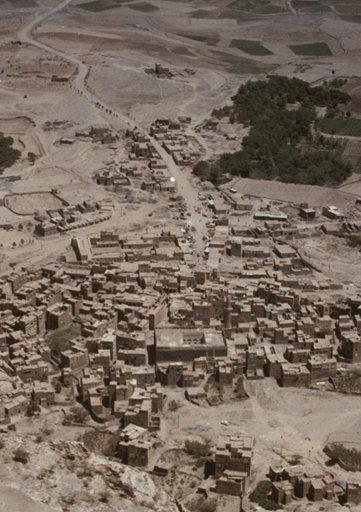
Shibam in Central Highlands, 1979; Photo by Daniel Martin Varisco

Shibam in Central Highlands, 1979; Photo by Daniel Martin Varisco

Shibam in Central Highlands, 1979; Photo by Daniel Martin Varisco

Shibam in Central Highlands, 1979; Photo by Daniel Martin Varisco

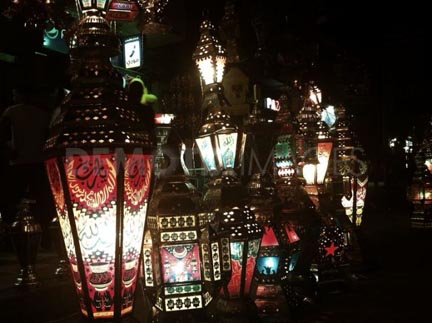
Traditional Ramadan Lanterns displayed on Egyptian streets
by Karim Adel, Open Democracy, 23 July 2012
It’s safe to say Uncle Ramadan is not going to sleep while he’s with us this year…
Uncle Ramadan is back and to Egyptians he’s back after what seems like a long while…
Although it’s an annual event this is the first time in two years that we celebrate without any turmoil and under a civil president… so it’s just safe to say Uncle Ramadan is not going to sleep while he’s with us this year…
Tunis Traditional Ramadan Lanterns displayed on Egyptian streets
You can see him walking down the old ancient alleys in the Al Hussein area in Islamic Cairo making sure all the colourful lights are hung well from building to building, he’s making sure all the giant colourful [12] lanterns [13] are hanging on every balcony…
He’s passing from home to home to make sure everyone, poor or rich gets a chance to eat after sun set…
He makes sure all those who have money have gathered some to give out to the poor and that every area and street has at least one charity group meal, set up for the poor and homeless every day of the 30 days of fasting… Continue reading Uncle Ramadan is back
The Pew Foundation has recently released a report entitled Most Muslims Want Democracy, Personal Freedoms, and Islam in Political Life on July 10, 2012. Click here to read the overview and gain access to a free pdf of the full report.

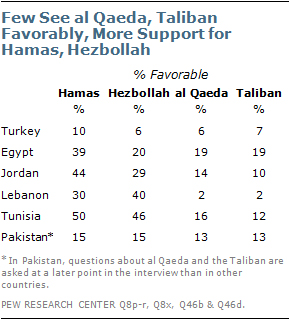
Here is what they say about Muslims views of extremists…
“Extremist groups are largely rejected in predominantly Muslim nations, although significant numbers do express support for radical groups in several countries. For instance, while there is no country in which a majority holds a favorable opinion of the Palestinian organization Hamas, it receives considerable support in Tunisia, Jordan and Egypt.
The militant Lebanese Shia group Hezbollah receives its highest overall ratings in Tunisia, where nearly half express a positive opinion. Sizable minorities in both Jordan and Egypt also have a favorable view, but Hezbollah’s image has been declining in both countries in recent years. In its home country, views about Hezbollah are sharply divided along sectarian lines: 94% of Shia, 33% of Christians, and 5% of Sunnis give the group favorable marks.
Across all six nations, less than 20% have a positive opinion about al Qaeda or the Taliban. In Turkey and Lebanon, support for these groups is in the single digits. However, fully 19% of Egyptians rate these extremist organizations favorably.”

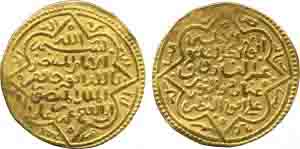
Gold dinar of the Rasulid sultan al-Malik al-Mansur ‘Umar b. ‘Ali
Sailing Seasons in the Red Sea and Indian Ocean:
The View from Rasulid (13th-14th Centuries) Aden
by Daniel Martin Varisco
[This is a lecture presented at the Red Sea Trade and Travel Study Day of the Society for Arabian Studies at the British Museum, October 5, 2002, and subsequently published in Yemen Update. For Part 1, click here; for Part 2, click here; for Part 3, click here.]
Monday, 19 Sha‘ban, 691 (August 5, 1292)
Most travelers that I know complain of the lack of fresh water here in Aden, but I think the more serious omission is basic intelligence. Perhaps the unbearable heat drains their brains as well as their bowels. Instead of unloading our ship on the third day, we were kept waiting a full extra day before finally being allowed into customs. One would think their interest in picking our pockets would speed up rather than prolong this unpleasant process. I was under orders to take the gift directly to the sultan, and I am half tempted to write a letter immediately to the master of this land and apprise him of the inattention that seems to plague his servants in the port. After all, I represent the Karimi, not some cheap junk from Serendib! Continue reading Travels with Ibn al-Mujabbir #4

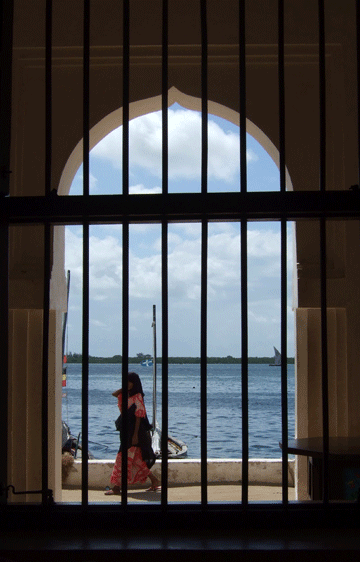
Lamu; Photograph by Daniel Martin Varisco
by Irena Knehtl, Yemen Post, April 15, 2012
One of the city-states founded by Yemeni Hadhrami Arabs was Lamu, an island off the present Kenyan coast, a world heritage site
Throughout its history Yemen has been a seafaring nation, famed for boat building and its mariners navigation skills. While the Yemeni sailors harnessed the monsoon winds to reach distant ports, inland its farmers harnessed water to develop life-sustaining agriculture adopting to a harsh and often formidable environment.
Archaeologists are still investigating these long gone civilizations that have played a major role in transforming global history. These ancient civilizations introduced deep-sea sailing vessels capable of long distance travel and trade. At this time writing, banking, shareholding were established and developed societies were formed for perhaps the first time over.
Linen, cotton, wool and metal were taken to China, where cargoes of silk, camphor, musk, spice were exchanged and Yemen acquired ceramics. Southern Arabia was on cross roads on the trade routes between China and India to the East, and the Red Sea and East Africa to the southwest providing merchants with a huge and lucrative markets. One of the city-states founded by Yemeni Hadhrami Arab travelers was located on the island just off the northern coast of present day Kenya called Lamu. Continue reading Habari Ya Lamu, the Story of Lamu

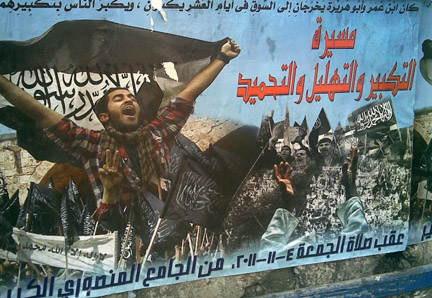
http://www.free-syria.com/
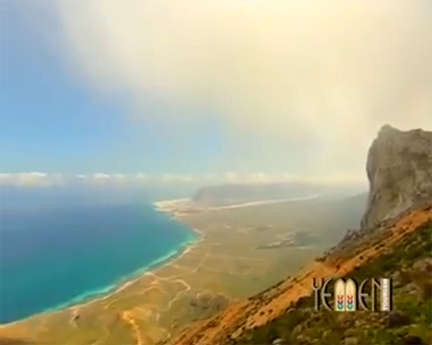
The constant news about fighting and violence in Yemen obscures the extraordinary beauty in the country. Here is a short video with spectacular views, the pristine nature being sold somewhat soiled by the appearance of tourists. If you ignore this aspect, especially the rather distorted account of tourism amenities, it is worth watching.

Bracketing Realities in Lebanon; photograph by Estella Carpi
Confessionalization fundamentalism: commodifying religious identities in the Middle East
by Estella Carpi, Open Democracy, 16 July 2012
Middle Eastern revolutionaries and spectators alike, deprived in the media of any representation of their own agency and denied the chance of producing their own new life chances, end up commodifying the identities they are exposed to within their social pattern.
As Maya Mikdashi has argued in an interview released to Istituto di Studi Politici Internazionali (ISPI), published on Jadaliyya on June 21, the uprising in Syria itself is becoming more sectarian now, packaged in a way such that ‘sect’ seems to be the political marker that matters the most.
This development could be taken as a starting point to point to a more widespread arbitrary confessionalization of Middle Eastern conflicts, and of the Syrian revolution in particular. “Crisisâ€, “sunnization of the revoltâ€, “new balance between Sunnis and Shiites†and “civil war†are key terms used by the media in reporting the current events.
Voices from think-tank and news analysts actually unfamiliar with the Arab world have largely contributed to portraying a patchwork image of the Middle East composed of ethnic and religious groups that do not fight each other only thanks to the power of dictators that discipline and guide these irrational individualities. Continue reading Confessionalization fundamentalism

Sailing Seasons in the Red Sea and Indian Ocean:
The View from Rasulid (13th-14th Centuries) Aden
by Daniel Martin Varisco
[This is a lecture presented at the Red Sea Trade and Travel Study Day of the Society for Arabian Studies at the British Museum, October 5, 2002, and subsequently published in Yemen Update. For Part 1, click here; for Part 2, click here.]
Thursday, 15 Sha‘ban, 691, August 1, 1292
We are now but a day’s sail away from safe haven in Aden, if God wills and the wind does not cease to obey his commands. It has been a good journey thus far. No major storms or pirates, though we did see a shipwreck on the reefs south of the Farasan Islands. Our pilot, praise God, knows his way over the shoals, even if blindfolded, I think. In the morning we took aboard some fresh water at al-‘Ara, after coursing around the tip at Bab al-Mandab and leaving Bahr al-Qulzum. After my noon prayer, when the sun beat down so mercilessly and I was sorely tempted to jump into the water with all my clothes on, I suddenly remembered that this was the midpoint of Sha‘ban with only two weeks left until the holy fasting month. Today is the anniversary of the day the Prophet, peace be upon him, was instructed to make Mecca the qibla rather than Jerusalem. God willing, I will make the pilgrimage in the coming year. Even thinking of the well of Zamzam made the warm water in the fantash all the more sweeter.
As night fell, I remembered an earlier trip, when a tormenting monsoon tore our sail and nearly capsized the ship as we departed Zayla‘ for Bab al-Mandab. These were the ‘awasif winds, fouling us with the stench that only Iblis breaking wind could send. That turning point is a dangerous point. An old sailor on board, who has often traveled along the African coast from Mogadishu, told me that only ships like our jalba can make the passage safely; no boat with iron nails could sail past, for God, our Protector, has ordained a magnetic mountain to attract hand-wrought nails and split an intruding vessel asunder. But only the infidel Christians defy nature with such innovations. May God protect the holy cities from the ravenous appetites of crusader cannibals. Continue reading Travels with Ibn al-Mujabbir #3