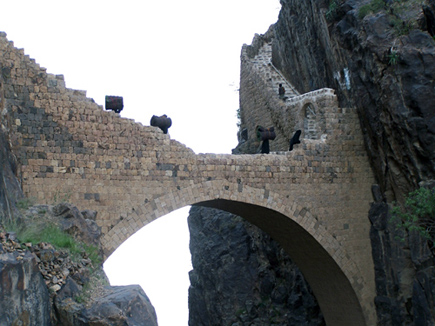
Among the architectural marvels of highland Yemen is the breathtaking bridge at Shahara. For more pictures of the bridge, click here and here.
Among the architectural marvels of highland Yemen is the breathtaking bridge at Shahara. For more pictures of the bridge, click here and here.

A little over six months ago, Ali Abdullah Salih finally resigned himself to the fact that he was no longer wanted by the people of Yemen or the international community as president-for-life in Yemen. But instead of taking his stashed away millions to exile in Saudi Arabia, which has open-armed several past dictators with Muslim names, or bribing a poor country to host him and his family, he remains in Yemen. I suspect when someone is in power for as long as Salih was, that delusion is the normal path. Perhaps he thinks that if things keep on getting worse (ignoring the fact that the problems are largely his own creation), Yemenis will bring him back. Perhaps he has heard those Iraqis who say things were better under Saddam? Perhaps, but his delusion contributes to the problem as long as he is living in Yemen.
Salih played the “dancing on the heads of snakes” game throughout his tenure at the head of the Yemeni state. He built a family-run state, allying himself with tribal powerbrokers like Shaykh Abdullah al-Ahmar, and shaping the military into a private army. Corruption was rampant and few Yemenis were fooled by the state-tun media myth of Salih as the father of his country. His triumph of uniting north and south was a ruse from the start, extending his control rather than actually caring to build a united country. But his downfall is largely due to backing the extremists, the Jihadis back from Afghanistan, those whose ideology he could never uproot for his own advantage. When his troops took over Aden in the 1994 civil war, Salih allowed northern zealots to raze religious shrines and demolish the one beer factory in the country. As the zealots shouted “Allahu Akbar” the guy in the presidential palace could only think of himself as the “akbar.” Building a monster mosque in the capital, not unlike Saddam’s architectural piety, could hardly disguise the fact that here was a man who worshipped himself. He was not the first to do so, is not alone in doing so, and will not be the last. Continue reading Ali Abdullah Salih: Not invincible, not invisible

by Omid Safi, Religion News Service, August 28, 2012
It is time, and past time, to Occupy Mecca.
I am adamantly not talking about a disaster US occupation, a la Iraq and Afghanistan.
What I am calling for is nothing less than millions of faithful pilgrims saving Mecca from destruction.
I would call the destruction imminent, except that it is not imminent. It has already happened.
No, it’s not the Americans, or the Israelis, who would be destroying Mecca.
It’s the so-called Guardians of the two holy sites (Mecca and Medina), the Saudi royal elites, who have negligently stood by over the last two decades as the majority of holy sites in these two most sacred Muslim cities have been destroyed, sacrificed to the false gods of modernization, capitalism, and progress.
Saudi Wahhabis have a long history of destroying shrines, including those of the family of the Prophet in Saudi Arabia and Iraq. Continue reading Occupy Mecca
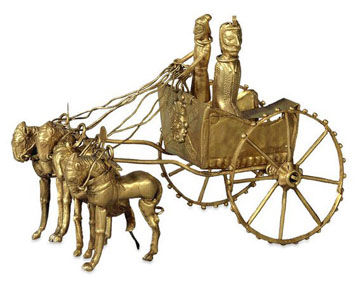
gold chariot from a hoard found near the Oxus River in Central Asia ca 500 BCE, British Museum
Family Tree of Languages Has Roots in Anatolia, Biologists Say
By NICHOLAS WADE, New York Times, August 24, 2012
Biologists using tools developed for drawing evolutionary family trees say that they have solved a longstanding problem in archaeology: the origin of the Indo-European family of languages.
The family includes English and most other European languages, as well as Persian, Hindi and many others. Despite the importance of the languages, specialists have long disagreed about their origin.
Linguists believe that the first speakers of the mother tongue, known as proto-Indo-European, were chariot-driving pastoralists who burst out of their homeland on the steppes above the Black Sea about 4,000 years ago and conquered Europe and Asia. A rival theory holds that, to the contrary, the first Indo-European speakers were peaceable farmers in Anatolia, now Turkey, about 9,000 years ago, who disseminated their language by the hoe, not the sword.
The new entrant to the debate is an evolutionary biologist, Quentin Atkinson of the University of Auckland in New Zealand. He and colleagues have taken the existing vocabulary and geographical range of 103 Indo-European languages and computationally walked them back in time and place to their statistically most likely origin.
The result, they announced in Thursday’s issue of the journal Science, is that “we found decisive support for an Anatolian origin over a steppe origin.†Both the timing and the root of the tree of Indo-European languages “fit with an agricultural expansion from Anatolia beginning 8,000 to 9,500 years ago,†they report.
But despite its advanced statistical methods, their study may not convince everyone. Continue reading Ethnic Indo-European languages?
…

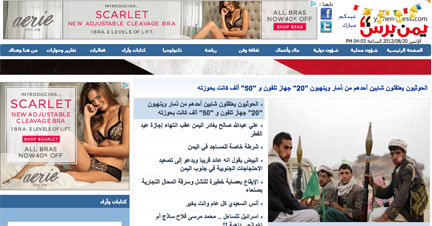
In attempting to keep up with the news in Yemen, I surf a number of Yemeni news sites. When I tried the usually reliable almasdaronline.com this morning, I was redirected to a commercial site called Mojo Pages. So I switched to yemen-press.com, where the top story was about the Huthi forces arresting two individuals in Sa‘da. While reading the article I realized that it was impossible to ignore the Gestalt of the total screen page, which I reproduce above. Here is a scene of several Yemeni fighters, clearly in a qat-chewing mode, and holding what I suspect (not being a military expert) are grenade launchers. What struck my attention was the advertisement adorning the banner and taking a prominent space on the left of the screen: Scarlet, the new adjustable cleavage bra. I have not been in the market for a bra, so I do not think the ad showed up due to any sophisticated Facebook-style marketing strategy. But I am male, so perhaps the assumption is that any Western viewer is in the market for a bra, since the ad is in English after all. And ten minutes later a new ad took its place: this time for a car rental place in New York.
Then a couple of hours later I happened across an article on Haaretz and there she was again: dear Scarlet hawking her gawking adjustable discount bra. Perhaps I am a victim of cookies twisting, but what a coincidence that is probably not a coincidence. Criss-crossing the endemic violence in the Middle East, the ongoing plight of the Palestinians and the voices in the Zionist wilderness of left-leaning Israelis there is the seductive power of an ad, as if politics did not really matter. In this case the bra fits all sizes of religious persuasions and the model is available to be ogled by anyone, at least from a Western computer. How ecumenical can commercial immodesty get.
It is the multifarious irony of these pages that weighs me down. I will focus on the Yemen website, since that was the first encounter with Scarlet. First, how ironic that I devour news by scouring multiple websites, most of which do not explicitly state their de facto bias. While there are a couple of Yemen News sites that are available in English (like Yemen Times and Yemen Post), they tend to be days old and in need of better English editing. Yemen Times, for example has a most recent post of August 15, five days ago, which is hardly Time Magazine timely. Yemen Post has a story only a day old, but its presentation is nowhere near as slick as any of the major Yemeni sites in Arabic. Irony #1 is that what is available but not in Arabic is old and out-of-date internet-wise. This is only an irony for the hubris with which English-speakers assume that news must be packaged in their native language.
The second irony is the critical crux. Where else can you find images of a seductive woman in a bra revealing cleavage (and at 40% off) counterposed with a truckload of qat-chewing Yemenis holding grenade launchers or on a major Israeli online newspaper in English? Continue reading Revealing the News

The Telegraph has published some extraordinary photographs by Goran Tomasevic of the fighting around Aleppo in Syria. To see the pictures, click here.
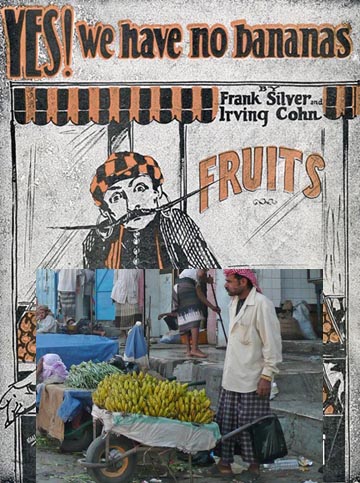
One of the great novelty Vaudeville songs of the early 20th century was “Yes, We Have No Bananas,” a number one hit for the singer Eddie Cantor in 1923. I have the Edison 1923 recording sung by Billy Jones, Arthur Hall and Irving Kaufman, which is also on Youtube. The song made fun of Italian accents, like the one my Sicilian Grandfather no doubt had as a boy. But it seems that in this case, almost a century later, unlike the Little Italy vendor in the song, Yemen does have bananas and very good ones at that.
Here is the report from Yemen’s Saba News Agency:
Yemen comes first among 45 countries exporting bananas
SANA’A, July 24 (Saba)- Yemen has came the first among 45 countries exporting bananas at the Regional Roundtable for exporters of banana products, held in Geneva during the period (July 20-21).
Yemen has sent varieties of bananas from some farms in the Yemeni provinces famous for the production of bananas, through the U.S. Agency for International Development (USAID), which is the mediator for this product in the Regional Roundtable for exporters of bananas, Official of the agricultural export activities at the Small and Micro Enterprises supported by the Social Fund for Development, engineer Samar Abdullah, told Saba.
Samar said that this win motivates the banana growers in Yemen to compete in the improvement of banana production and its cultivation as it has health benefits, and enables Yemen to enter into the global markets of bananas exporters.
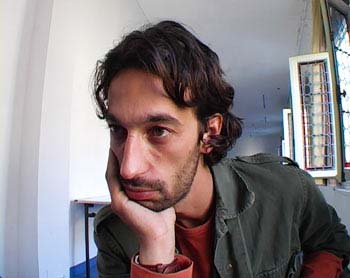
Harvard University has announced its 2013 International Nieman Fellows. Among them is the superb photographer Karim Ben Khelifa, whose work can be seen here.
Karim Ben Khelifa is a photojournalist and the co-founder and CEO of Emphas.is, a website designed to promote crowdfunded visual journalism. For the past 12 years, he has covered conflicts in the Middle East and Africa and other stories around the world. His work has appeared in The New York Times, The Washington Post, The Wall Street Journal, Vanity Fair, Time, Le Monde and Stern. He has exhibited his photos on four continents and has won numerous photography awards including the 2004 Fujifilm Young Reporter Award. He also was selected for the 2000 World Press Photo Joop Swart Masterclass in the Netherlands. At Harvard, Ben Khelifa will conduct research on journalist-audience engagement, analyze the behavioral economics linked to crowdfunding and study new business models promoting the diversification of visual storytelling. He is the 2013 Carroll Binder Nieman Fellow. The Binder Fund honors 1916 Harvard graduate Carroll Binder, who expanded the Chicago Daily News Foreign Service, and his son, Carroll “Ted†Binder, a 1943 Harvard graduate.