Category Archives: Countries

Johnsen on Yemen in New York

Book Night With Gregory Johnsen

12 November 2012 – 6:00pm – 7:30pm

40 West 45th Street, Club Quarters, New York, Free admission

by Sonya K. Fry, Overseas Press Club of America

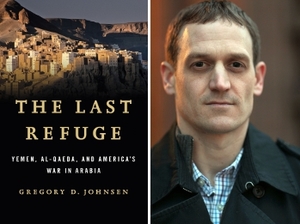
The Last Refuge: Yemen, Al-Qaeda, and America’s War in Arabia [W.W. Norton & Company, November, 2012] is an eye-opening look at the successes and failures in fighting a new type of war in the turbulent country of Yemen, written by Gregory D. Johnsen, who is an OPC Foundation Scholar, a Fulbright fellow in Yemen, part of a 2009 USAID conflict assessment team and is now a doctoral candidate in Near Eastern studies at Princeton University.

Johnsen takes readers into Yemeni mosques where clerics in the 1980’s recruited young men to jihad to fight the Russian invaders in Afghanistan. These men eventually formed the basis for the Al-Qaeda movement. The story also leads to the presidential palace in Yemen where the country’s military dictator, Ali Abdullah Salih vascillated between helping the U.S. get rid of Al-Qaeda in the Arabian Peninsula and hindering the process. Salih himself called this delicate balancing act of staying in power a “snake dance.” For years this dance included concealing Islamists from the prying eyes of U.S. intelligence and yet later he allowed the U.S. to conduct attacks that killed dozens of Al-Qaeda operatives including Abu Ali al-Harithi, who was known as the “godfather” by U.S. intelligence. The dramatic story sounds like a Hollywood movie: Haritihi turned on his cell phone as he left a secret meeting which signaled a predator drone to track him. The first missile from the drone exploded next to Harithi’s speeding car. He threw the phone out of the window and screamed at everyone to get out, but there was nowhere to go since they were in the middle of the desert. The drone fired its second missile and the car exploded in flames. Continue reading Johnsen on Yemen in New York

Unequally yoked is no joke


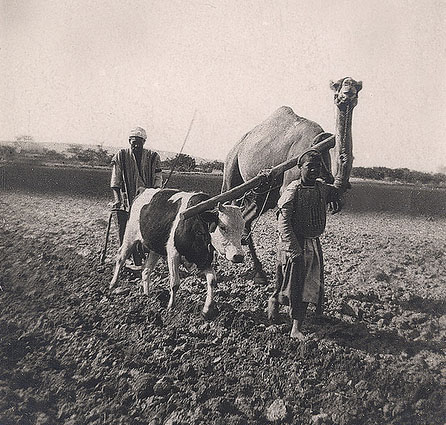
Gelatine silver print (probably made in the mid-1920s) of an American Colony photograph taken in southern Palestine between 1898 and 1911; from the John Garstang collection

“Be ye not unequally yoked together with unbelievers; for what fellowship hath righteousness with unrighteousness? And what communion hath light with darkness?” 2 Corinthians 6:14, KJV

The admonition of the Apostle Paul in his second letter to Corinth is the ultimate justification for separatism. Orthodox Jews, Fundamentalist born-again Christians and ultra-conservative Muslims all have taken to heart the sentiment of this advice, often making it into an outright ban. The latest news sensation is about a Muslim “catacomb sect” in Russia’s Tatarstan region:

Four members of a breakaway Muslim sect in Russia’s Tatarstan region have been charged with cruelty against children for allegedly keeping them underground.

Police discovered 27 children and 38 adults living in catacomb-like cells in an eight-level underground bunker.

The sect’s elderly leader, Faizrakhman Sattarov, had reportedly wanted to build his own Islamic caliphate beneath the ground…

Officials said the children, aged between one and 17 years, had never left the compound, gone to school or been treated by a doctor, and had rarely seen the light of day.

According to the Russian website Islam News, Mr Sattarov, 83, declared himself an Islamic prophet in the mid-1960s after interpreting sparks from a trolleybus cable as a divine light from God.

He and his followers began to shun the outside world in the early part of this century.

One is not sure to laugh or cry at a prophet who gets his revelation from the sparks of a trolleybus cable, but in the end a vision is a vision no matter what the alleged divine source. All three major religions have had their break-away, nothing-to-do-with-this-life prophets and the few sheep that inevitably follow them over the cliff of rationality. The problem here is what may be labeled a dogmatic emphasis on the “unsocial contract.” In other words, this is a kind of cultural suicide, hardly the umma envisioned by the Prophet Muhammad.

The metaphor in the old photograph above is what intrigues me. The supposed rationale is that a team of domestic animals should be the same, generally two oxen. That is all well and good if you actually have two of these rather expensive beasts, but what if you don’t? In many cases farmers in the region had to make due with either a donkey or a camel, but hitching two different animals may not have been as rare as assumed, nor as problematic. Notice in this image that a little boy leads the camel, allowing it to keep the pace of the ox while the ploughman bears down on the blade. Rather than focus on there being two separate animals, think about the social cooperation of boy, man, ox and camel as a unit.

When the emphasis is on what makes the animals different either from each other or from humans, the broader point of cooperation is easily lost. The same is true in religion. Separatists are doomed to failure by their very nature, except as oases sustained within a wider pluralistic context. Those sects which survive learn to adapt to competing views and accept change, no matter what level of reticence. Consider the early Mormons, who were so far out of the mainstream that they were persecuted everywhere they went. No matter the doctrines still enshrined on the main webpage of the Church of Latter Day Saints, the church has embraced the very kind of patriotism that once forced them to the arid wilderness of Utah. This is the only way they could have survived.

I am certainly no prophet, even though I have seen trolleycar sparks in my youth, but I suspect that the future of Islam will see increasing rather than decreasing pluralism. As a religion which has spread well outside its Arabian geographic origin, the ways of being Muslim are far too many to ever be bottled into one halal variety. Even in the heyday of Islamic power there was never a unanimity of belief. Like Judaism and Christianity there will continue to be those who insist they represent the “true” faith, but no religion can resist the perpetual cultural change that envelops the entire globe. Think of that Palestinian fellah in the 1920s photograph above. He could never have imagined the technological and social change in his own backyard today. Today we think we can imagine, but the future is probably not best revealed by looking at a trolleycar, sparks or not.

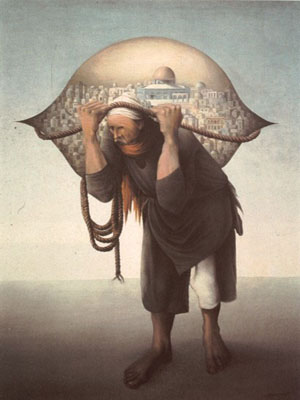
Kicking the Palestinian down (the Road)


“The Bearer of Burdens” painting by Suleiman Mansour

Candidates ignore plight of Palestinians
By Nadia Hijab, The Hill, October 25, 2012

As a Palestinian-American, I awaited the presidential debate on foreign policy with anticipation, given the massive U.S. military footprint in the region of my birth.

I confess to being torn in my attitude to the candidates. From a Palestinian perspective, I know there is little difference: Neither would take effective steps to end Israel’s 45-year occupation, challenge its illegal building of settlements, or shake its draconian hold on Jerusalem.

Their record speaks for itself. President Barack Obama soon gave up on the Israeli settlement freeze he pushed early in his tenure. American and Israeli troops are even now participating in a joint missile-defense exercise The New York Times described as “the largest in the history of the two countries’ relationship.” Continue reading Kicking the Palestinian down (the Road)

Yemen: can southern separatists break up Yemen?


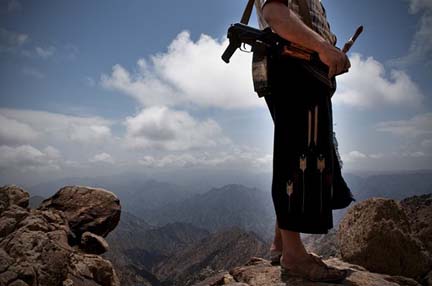
Photo in southern Yemen by Adam Reynolds

by Helen Lackner, Open Democracy, October 23, 2012

Yemeni unity in 1990 was greeted with enthusiasm by Yemenis at large, whether from the former Yemen Arab Republic (YAR) or People’s Democratic Republic of Yemen (PDRY). Although there was considerable discussion and disagreement in the leadership about the form it took, there is no doubt that for ordinary Yemenis the possibility of travelling anywhere in the country was welcome.

While many women in the YAR had looked forward to the spread of the PDRY’s Family Law to the whole country, many men and women everywhere hoped to see the same for qat consumption laws, and southerners were looking forward to economic liberalisation, all were swiftly disappointed when the economy collapsed after the sanctions taken against Yemen by neighbour states following Iraq’s invasion of Kuwait. In addition, after the initial flourishing freedom of expression through a multiplicity of new parties and newspapers in the first years of enthusiasm, the political situation rapidly deteriorated as tension developed between the two former ruling groups. Starting with some clearly targeted assassinations of Southern leaders, this eventually brought about the 5 months Civil War of 1994 which was decisively won by Sana’a’s forces. Continue reading Yemen: can southern separatists break up Yemen?

Yemen Conference at Harvard


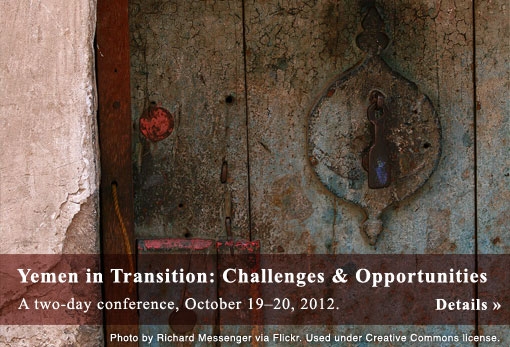
This past Friday and Saturday a conference was held on “Yemen in Transition.” While I was originally scheduled to give a presentation, I was not able to attend. But here is an overview of the conference, with complete details on the conference website.

Date: October 19, 2012 (All day) – October 20, 2012 (All day)
Speaker: various
Yemen in Transition: Challenges and Opportunities
Organized by Steven C. Caton, Harvard University, and the Yemen Working Group, this conference brings together Yemeni American professionals and academics along with some of their counterparts from Yemen, and academics from the U.S., Europe, and Yemen to discuss the future of Yemen and what might be done to help the country as it transitions into its new historical phase. It also brings together students from Harvard and the Boston area who are from Yemen. The main topics to be discussed are: women and youth, economic development, politics and political reform, and the water crisis. As an academic conference, the focus will be on theory and analysis, though concrete proposals and recommendations will also be presented.

The panels and the keynote address are open to the public. These presentations will be videotaped and made available on the website of the Harvard Center for Middle Eastern Studies but they will not be published as part of a conference proceedings. The use of recording devices by anyone other than the organizers is strictly prohibited.