Category Archives: Countries

Black Friday through Black Thursday over and over again


In the United States, after having given thanks for a turkey feast in which only one of the native birds has been officially pardoned and allowed to live a little longer, today becomes Black Friday. One official holiday (blessed by Lincoln, who is the star of a new Hollywood film) has ended and the shopping spree for the next official holiday (which officially keeps the “Christ” in Christmas) has begun. Actually in some places the shopping began last night. Whatever the real reason for the dubbing, it is obvious that this shop-to-you-drop mentality is meant to keep stores in the black rather than bleeding red. As a result, lots of gifts will be be bought to be placed under the Christmas trees of families who really do not need them. Meanwhile in the Middle East (and not just in the Middle East) Black Friday will be followed by a Black Saturday and the blackness will continue all the way through to a Black Thursday to be followed by yet another Black set of days on end.

In the aftermath of Super Storm Sandy I was without electricity in my home for 11 days. Apart from a few candles and flames in a fireplace, I was surrounded by darkness for more than a week. But there are different shades of darkness, despite the semantic homogenization in our concept of “black.” Being in the literal dark or in a situation where there is no light and thus everything is pitch black keeps us metaphorically in the dark as well. I lost power and a few tree limbs, but thousands of people during Sandy lost houses, possessions of all kinds, cars and boats. Some still remain without a home or power as I write this three weeks later. What makes today “Black Friday” here in America is inconvenience at the malls. It was inconvenient not to have electricity or hot showers and to cook on a Coleman stove for a few days, but the unfolding events in the Middle East go far beyond this kind of inconvenience. Continue reading Black Friday through Black Thursday over and over again

Paul on Gaza

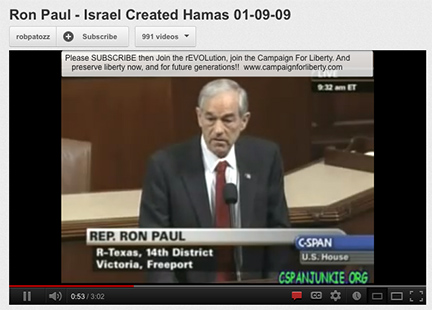
The election circus is over for another four years; at least it is less a rhetorical political cliff than a slippery slope. But I recently came across a C-Span Youtube video of Representative Ron Paul (who is sure to run again for the GOP nod) speaking in congress in 2009 against a resolution to support Israel’s invasion into Gaza (which is why he will never win). It is well worth viewing again, politics aside. You can see it here: http://www.youtube.com/watch?feature=player_embedded&v=Yb3vF6Vcjr0#!

Nader on Gaza


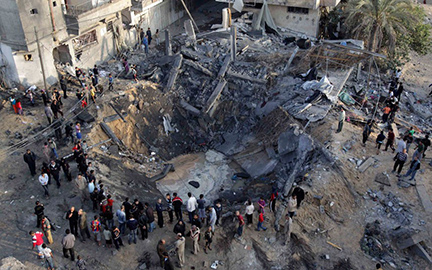
Palestinians gather around an enormous crater after an Israeli air strike levelled a building in Khan Younis in the southern Gaza Strip; photograph for REUTERS by Ibraheem Abu Mustafa

Israel-Palestine: What is the U.S. National Interest?

By Ralph Nader, The Nader Page, Tuesday, November 20, 2012

Israeli elections are coming up in January so it is Palestinian hunting season again. Israeli cynics call it a time “for mowing the grass.”

Out comes the well-worn playbook by Israel’s militaristic government that has worked to silence Israeli politicians and citizens who want a two-state solution. This is an opportunity to use and test advanced weaponry from the U.S., compliments of U.S. taxpayers, and squelch ongoing peace efforts, small and large, by Palestinians, Israelis and international peace advocates.

The playbook’s first chapter is provocation to upset a tense but workable truce with Hamas, the elected government of Gaza. Hamas was encouraged at its creation years ago by both Israeli and U.S. backers to counter the secular Palestine Liberation Organization (PLO). Bit of a blowback there.

Israeli government leaders are expert provocateurs when they wish to seize land, water or prisoners and upset any movement toward a peace that would create a viable Palestinian state back to the 1967 borders, which includes East Jerusalem. When Israel came into being in 1948, it soon broke a UN truce and doubled its territory by taking the large area known as the Negev desert, whose refugees ended up in the Gaza Strip. Now 1.6 million encircled and impoverished humans, blockaded and under siege by Israel, try to survive in an open-air prison little more than twice the size of the District of Columbia.

Israel’s strategy of breaking cease-fires and truces over the years has been documented by Princeton University history professor emeritus, Arno J. Mayer, in his scholarly book Plowshares into Swords: From Zionism to Israel (Verso, 2008). Continue reading Nader on Gaza

The Formation of Syria’s National Coalition


Syrian President Assad; photography by Benoit Tessier/ REUTERS

The Formation of Syria’s National Coalition: An Assessment and Analysis

By Amr al-Azm

Syria Comment, November 13, 2012

Following talks with a number of people who attended the Doha meeting of November 8-11, this is my assessment of the newly formed “National Coalition for Revolutionary Forces and the Syrian Opposition”. The coming together of the various Syrian opposition factions to finally strike a deal based on a 12 point agreement that would unify them under the umbrella of a newly created coalition body is remarkable considering the obstacles that had to be overcome. It faced intense opposition by some groups, particularly the SNC, which viewed this as a blatant effort to sideline them. Its members have fought for a leading role in the new group.

The original Riad Seif plan called for a council of 51 seats, a joint supreme military council, a judiciary commission and the formation of a provisional government selected from technocrats.

The new National Coalition that emerged in Doha on Monday ended up comprising of 65 seats. The SNC was earmarked 22 seats, the local administration councils were allocated 14 seats (one for each of the provinces in Syria), national figures were allocated initially 8 seats, eventually rising to 10 seats, with the balance (19 seats) to be distributed amongst the various remaining opposition groups and entities. The new coalition eventually managed late on Monday evening to eventually select Moaz Al-Khatib (a cleric and former imam of the Ummayad Mosque in Damascus) and two deputies (with a third still to be named by the Kurds) who are Riad Seif (both prominent dissidents and activists). A third position, which is until now poorly, understood is that of Secretary General, to be occupied by Mustapha Sabagh (head of the Syrian Business men Group). It is rumoured (by Al-Jazira and others) that the position would carry sweeping powers to rival even those of the head of the coalition Moaz Al-Khatib and seen as a principle demand by the Qataris. Continue reading The Formation of Syria’s National Coalition

Orientalist Cheesecake


Portrait of a lying woman, Antoine Sevruguin, Iran, 1901 (geheugenvannederland.nl).

If a picture is worth a thousand words, then one like this century-old photograph taken in Iran will leave the reviewer with no loss for words. Here is the quintessential native Ottoman Era odalisque to ogle at. A number of enticing props are they as well: the flowers in hand, the shoes on the bed at the end of a curvaceous bottom in corso flowing down the exposed torso, the half-hidden belly button, long pigtails and dark kohl-laced eyes. Not only is this figure exposed to the viewer, but she engages with a direct gaze, using a hand to cradle her head. Here, visually presented, is the Orient represented: a luscious and willing consort for the taking.

The photograph above is part of a series of Ottoman Era images from the Ottoman History Podcast, a radio program and Facebook site based in The Netherlands. The site has a splendid selection of photographs from the Ottoman Era, the vast majority of which are not odalisque cheesecake, and it is well worth perusing.

Regarding the photograph above, here is how the Facebook site describes it: Continue reading Orientalist Cheesecake