Category Archives: Countries

Mind your manures…


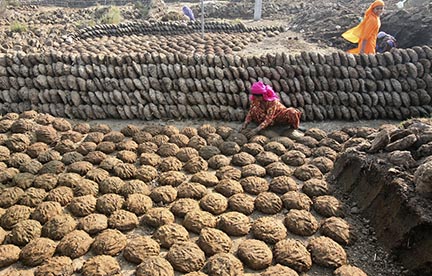
A villager makes cow dung cakes used as cooking fuel at Maloya village on the outskirts of the northern Indian city of Chandigarh on January 31, 2011; photograph by Ajay Verma / Reuters

[Webshaykh’s note: Here is a great story coming out of Indonesia about two young female science students contributing to society. I believe Marvin Harris would love this, as would anyone appreciates the Hindu doctrine of ahimsa. Yet another sacred cow sacrificed in the interest of science.]

Fermented Cow Dung Air Freshener Wins Two Students Top Science Prize

by Kimberley Mok, Care2.com, March 16, 2013

Conventional air fresheners are known for their toxic soup of chemicals that may be linked with asthma, reproductive disorders and even lung disease. While there’s no shortage of environmentally-friendly and human-healthy air fresheners on the market, two Indonesian science students are behind a rather bizarre concoction that you may be seeing soon: an affordable air freshener made from cow dung.

Yes, cow dung — as weird as it sounds, the formulation actually has a pleasant herbal smell, and has won Dwi Nailul Izzah and Rintya Aprianti Miki a gold medal at Indonesia’s Science Project Olympiad (ISPO). According to Oddity Central, the young women overcame 1,000 other competitors with their surprising freshener, which was painstakingly created by collecting unused cow manure from a cattle farm and fermenting it for three days:

Then they extracted the water from the fermented manure and mixed it with coconut water. Finally, they distilled the liquid to eliminate all impurities. The whole process took 7 days, which is pretty long, but in the end they obtained what they were looking for – a liquid air freshener with an herbal aroma from digested cow food. Continue reading Mind your manures…

Orientalism and Bibliolatry:
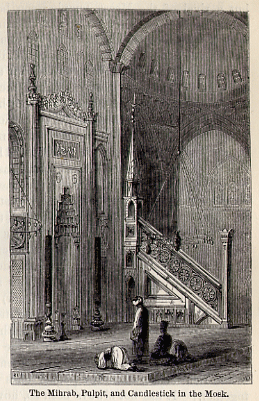
Framing the Holy Land in 19th Century Protestant Bible Customs Texts

I have recently published an article in a volume edited by Ian Netton, entitled Orientalism Revisited: Art, Land and Voyage (London: Routledge, 2013, pp. 187-204). I provide the introductory paragraphs below.


Orientalism and Bibliolatry:
Framing the Holy Land in 19th Century Protestant Bible Customs Texts

“The Orient was almost a European invention, and has been since antiquity a place of romance, exotic beings, haunting memories and landscapes, remarkable experiences.” Edward Said, Orientalism, 1979

“In a word, Palestine is one vast tablet whereupon God’s messages to men have been drawn, and graven deep in living characters by the Great Publisher of glad tidings, to be seen and read of all to the end of time.” William M. Thomson, The Land and the Book, 1859

This essay begins with a famous opening phrase from Edward Said’s Orientalism not because there is a need to validate or dispute it, but because of what it leaves out. Indeed, Said’s caveat of “almost” is telling, since his text only describes the “Orient” invented through the writings of Western writers. What is remarkable about Said’s styling of the Orient as a form of politicized discourse is that the most important part of this invention is missing: the Orient invaded by Napoleon is also the Holy Land, the “vast tablet,” as American missionary William Thomson phrases it, which brings the Bible to life. Napoleon may have initiated Western imperialist ambitions in this Holy Land, but the ultimate failure of his military mission stands in stark contrast to the perpetual array of Christian pilgrims, scholars and missionaries who visited this holiest of Holy Lands for Christians and Jews. Absent from Said’s text is the genre that was most widely read in 19th century Europe and America, specifically Holy Land travel texts that cited contemporary customs and manners of Arabs and other groups encountered as illustrations of Bible characters for popular consumption, especially among Protestants.

Said’s genealogy of the discourse he identifies as Orientalism is a thoroughly academic one. Continue reading Orientalism and Bibliolatry:
Framing the Holy Land in 19th Century Protestant Bible Customs Texts

Passport Blues

Yemenis seeking American citizenship pay exorbitant dowries in lucrative marriages of convenience

by Nadia Haddash, Yemen Times, March 7, 2013

Getting a visa from the American embassy in Sana’a is not easy for Yemenis hoping to travel to the U.S., and is especially hard for young, single men. So, many seek an alternative route: marrying a Yemeni-American woman.

By doing so, they typically become American, too, but could be in debt for years—they often have to pay huge dowries for their dual citizen brides.

Walid Al-Asimi, 28, met his wife, a Yemeni-American, in an English institute in Sana’a.

“When I knew that she would travel to America I decided to marry her,” he says. “I was surprised when her father asked me to give $30,000 as a dowry.”

The majority of Yemeni youths who marry women with dual citizenship pay very high dowries, ranging between$10,000-50,000, or around YR 2 million- 11 million. By comparison, a typical dowry paid to a bride’s family in Sana’a is around $4,000 or YR 800,000. The dowry paid to brides’ families in rural areas of the country is much less still. Continue reading Passport Blues

Yemenite Jews: A Photographic Exhibition

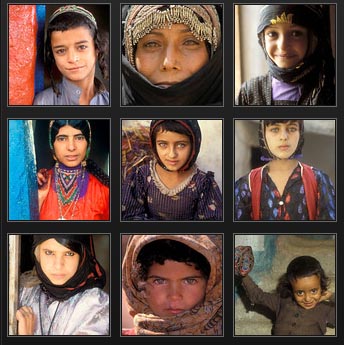
An exhibition of photographs of Yemenite Jews is on display from February 1- April 30, 2013 at the Katz Snyder Gallery in San Francisco. The entire collection can be seen online.

Israeli photojournalist Naftali Hilger’s breathtaking photos of Yemen reveal a nation and a landscape lost in time. His intimate portraits of the isolated Jewish communities of Yemen, taken over a period of 20 years, have been most recently seen in a widely heralded exhibition at the Museum of Islamic Art in Jerusalem.

Hilger’s life-altering love affair with the mysteries of Yemen began in 1987. Over six subsequent trips from 1987 through 2008, he documented not only one of the most ancient communities in the Jewish diaspora, but Muslim Yemen as well – its markets, its landscapes and the fascinating architecture of Sana’a and the rural villages.

Dro[w]ning life, liberty and the pursuit of not being targeted


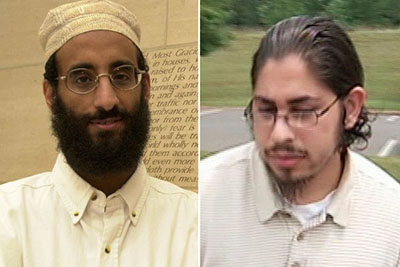
Anwar al-Awlaki, left, an operative in Al Qaeda’s Yemeni branch, was targeted in a strike that also killed Samir Khan, the creative force at a militant Web magazine. Both were Americans; Left, Linda Spillers for The New York Times; right, WBTV, via Associated Press

Today’s New York Times features a major article by MARK MAZZETTI, CHARLIE SAVAGE and SCOTT SHANE entitled “How a U.S. Citizen Came to Be in America’s Cross Hairs.” Actually the article discusses how three American citizens were the victims of drone attacks in Yemen in late 2011. The primary target was Anwar al-Awlaqi, who is described in the article as “the firebrand preacher, born in New Mexico, who had evolved from a peddler of Internet hatred to a senior operative in Al Qaeda’s branch in Yemen.” He was a socially mediated firebrand, far better known for his English than having an impact on recruiting terrorists in Yemen. Killed in the same after-breakfast attack was Samir Khan, “the creative force behind Inspire, the militant group’s English-language Internet magazine” and someone (basically a propaganda journalist) who was not considered important enough to specifically target. The article continues: “The next month, another drone strike mistakenly killed Mr. Awlaki’s 16-year-old son, Abdulrahman, who had set off into the Yemeni desert in search of his father. Within just two weeks, the American government had killed three of its own citizens in Yemen. Only one had been killed on purpose.” The 16-year old fell victim to a botched targeting:

Then, on Oct. 14, a missile apparently intended for an Egyptian Qaeda operative, Ibrahim al-Banna, hit a modest outdoor eating place in Shabwa. The intelligence was bad: Mr. Banna was not there, and among about a dozen men killed was the young Abdulrahman al-Awlaki, who had no connection to terrorism and would never have been deliberately targeted.

The drone issue has recently resurfaced, most notably in Mr-Rand-Paul-goes-to-Washington’s 13 hour filibuster. Continue reading Dro[w]ning life, liberty and the pursuit of not being targeted

Central Asian and Middle Eastern Numismatics Seminar


‘Great Ruler of Sogdiana, of the Tchao-ou Race’/Alram’s ‘Imitationsgruppe V’
Yueh Chih Principality of Sogdiana AR Tetradrachm, 130 BCE – 80 CE

The Fifth Seminar in Central Asian and Middle Eastern Numismatics in Memoriam Boris Kochnev will be held at Hofstra University on Saturday, March 16, 2013.

This seminar is free and open to the public. Hofstra is located in Hempstead, NY, easily accessible from NYC by the Long Island Railroad. For directions click here or here. The seminar will be held in Breslin Hall, room 112. For more information, contact Aleksandr Naymark or Daniel Martin Varisco.

Seminar Program:

10:00 am
Daniel Varisco (Hofstra University)
Opening Remarks

10:15
Vadimir Belyaev (Zeno.ru, Moscow) and Aleksandr Naymark (Hofstra University)
Archer Coins from South Sogdiana (1st – 3rd centuries C.E.)

10:45 pm
Pankaj Tandon (Boston University)
Notes on Alchon Coins

11:15 pm
Waleed Ziad (Yale University)
The Nezak – Turk Shahi Transition:
Evidence from the Kashmir Smast (mid 7th c. C.E.) Continue reading Central Asian and Middle Eastern Numismatics Seminar

Bodega Yemeni Style in Brooklyn


Photo by Kiran Sury

Yemeni Immigrant Saga
Every time you buy a beer or a lottery ticket at a bodega run by Mohamed Mohamed or one of his countrymen, you tap into a story of ethnic succession and a struggle to reconcile one culture with another

by Kiran Sury, The Brooklyn Bureau, Monday, Jan 7, 2013

On the corner of Flatbush Avenue and Glenwood Road in Brooklyn, Mohamed Mohamed runs Gold Star Deli Grocery with his father Mohamed and another employee, also named Mohamed, all of them from Yemen. This unique situation arises from Arabic nomenclature. “The customers get confused, but not us,” jokes the younger Mohamed. His father, whose full name is Mohamed Abdullah Alrohani, has come up with a more pragmatic solution: just call him Alex.

Across Glenwood Road, Sadek Almontaser mans the counter of the recently opened Glenwood Deli, a corner store. Cigarettes are sold behind the counter, drinks and chips line the walls, and a small deli section offers fresh sandwiches – staples for any bodega.

But to the discerning eye of a corner-store connoisseur, there are several features that are not so standard.

As Almontaser deals with a steady stream of lottery ticket buyers, he happily discusses how Iranian President Mahmoud Ahmadinejad isn’t a bad man, just misunderstood. His uncle Ali, who runs the deli station, is 11 years his junior, a genealogical feat made possible by his grandfather’s four wives back in Yemen. Ali will be happy to make you a BLT, though he may forget to mention that the bacon is made of beef, not pork. And every so often a man will enter the store, nod to Almontaser, and make his way downstairs. Not every bodega has a prayer room in the basement.

Across the street yet again, on the other side of Flatbush Avenue, the eponymous Yafai Deli and Grocery is run by Saad Yafai. He shares it with his brother Nabil, who is currently back home in Yemen. His entire family is in Yemen, and he and his brother take turns staying in America and running the family store.

Most New Yorkers would agree that the deli/convenience store, once the exclusive purview of Jews, Italians and Germans, has come to be associated with Latinos. The word bodega, which is used interchangeably with deli, is Spanish for “warehouse” or “cellar”. According to data from the Brooklyn Chamber of Commerce, the number of firms in the borough classified as supermarket or convenience stores almost doubled during the first decade of this century. But the three stores on the corner of Glenwood Road and Flatbush Avenue show that Latinos are no longer dominant, as shifting demographics have opened up a new ethnic segment of the market. An influx of Arabs has brought a corresponding increase in Arab storeowners, each eager to pursue his own version of the American Dream.

* * * * *

Clifton Clarke, professor of finance and business management at Brooklyn College, says that shifting populations opened a void for new businesses to fill, and that companies often change according to their target market. When Arab immigrants started to populate new neighborhoods, it made sense for them to manage the corner stores as they could better cater to Arabic needs. “Ethnicity, population, drives the type of businesses that are developed,” he says. “And these bodegas, which are now mostly run by Arabs, just fit in nicely.” Continue reading Bodega Yemeni Style in Brooklyn