Category Archives: Countries

A Rich Look at the Kurds, #1

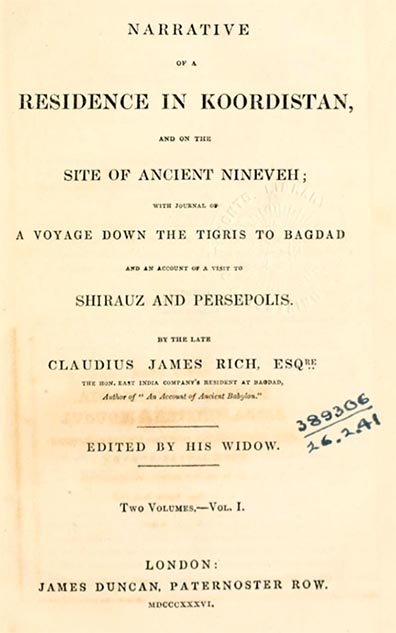
Old travel books never cease to delight me. While century-and-more books used to be available mainly in rare book collections of major libraries, the magic of archive.org brings digital life to the genre. Take, for example, the travel account of Claudius James Rich, whose 1820 trip from Baghdad, where he was posted as a British diplomat, to Kurdistan is a fascinating account of the Kurdish area almost two centuries ago. Born on March 28, 1787 near Dijon in Burgundy, the lad grew up in Bristol, England. He was tutored in Greek and Latin, but at the age of eight or nine he saw a book in Arabic and his appetite was whetted. By the age of fifteen, he had made great progress in Arabic, Hebrew, Syria, Persian and Turkish. Rich came of age when “Oriental Studies” carried no stigma. In 1804 he made his way through Malta and Italy to Istanbul and Egypt.

Like Burton, who would follow, Rich dressed as a Mameluke and left Egypt for Palestine and Syria. In Damascus he visited the Great Mosque. Then on he trekked to Aleppo and Baghdad before continuing on his way to India, where he arrived in 1807. A year later he married and set off to be the British Resident in Baghdad. He was an avid collector of manuscripts, many of which ended up in the British Library, coins and antiquities. He was one of the first Englishmen to describe the ruins of Babylon. His health began to deteriorate in 1813 and by 1821 he died of cholera in Shiraz.

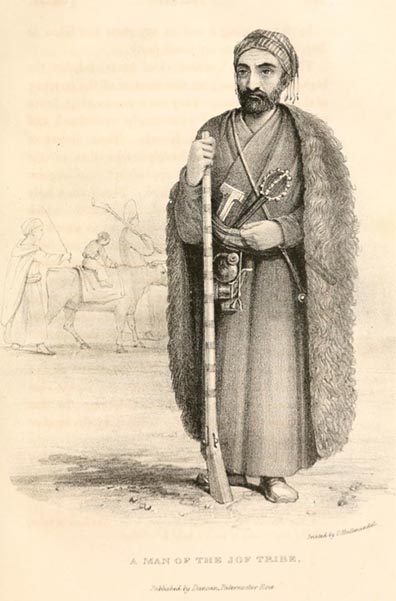
Among the people he met in Kurdistan were important members of the Jaff family, as he describes below:

Continue reading A Rich Look at the Kurds, #1 →

The Egyptian Blue Lotus

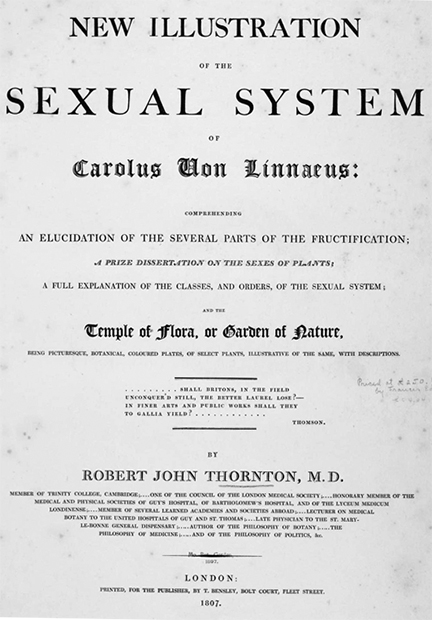
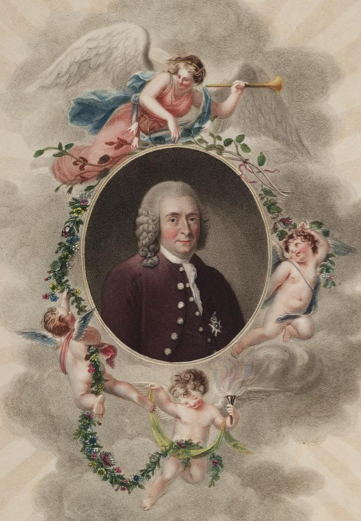
Few names are more revered in the early history of botany than Linnaeus, whose taxonomic system systematized the effective ordering of plants and animals according to sexual reproduction. Although he himself did not doubt that certain genera were created by the God of Genesis, his system could easily be adapted after Darwin introduced a mechanism that challenged the previous dogma of “fixity of species” since Eden. There were numerous artists who contributed to drawing the vast amount of new plants and animals that Linnaeus began to classify. One of my favorite works is by the physician Robert John Thornton, a fellow of Trinity College, Cambridge, who in 1807 published his New Illustration of the Sexual System of Carolus von Linnaeus.


Robert John Thornton

Thanks to archive.org, this beautiful volume can be read online. This is a delightful read, when it is not possible to visit a real garden. The volume is dedicated to the British queen, and begins with the following metaphor:

In Eastern Language high and mighty Potentates are compared to lofty Trees which afford Food and Shade to the sun-burnt Traveller. In the more temperate Regions of the Earth, Kings and Princes are contemplated as the Sun, which sheds his benign Radiance everywhere, inspiring each Object with new Life and Refreshment: by the Concurrence, therefore, of all Nations, the great Attribute of Sovereignty is Protection-, from conferring of which by Your Most Gracious Majesty, the Science of Botany in Great Britain chiefly owes its present Advancement…

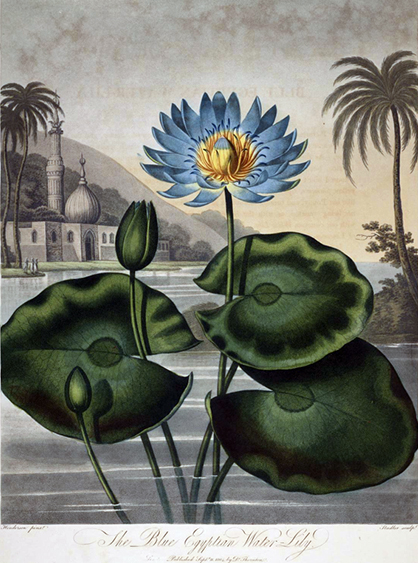
The text consists of charts explaining botanical terms and a series of illustrations and basic descriptions of flowers. I present here the pages dealing with the blue Egyptian water-lily (Nymphaea coreulia), with the exquisite image of the plant.

Continue reading The Egyptian Blue Lotus →

Hezbollah and Bashar: Another Unholy Alliance


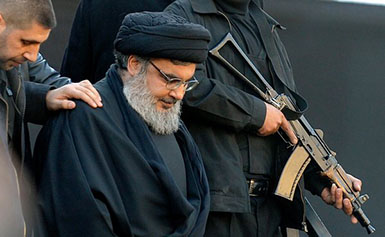
Hezbollah leader Hassan Nasrallah; Photograph by Wael Hamzeh/European Pressphoto Agency

My friend Omid Safi has created a provocative blog entitled What Would Muhammad do? Today I would like to ratchet up the commentary game to an approach which may, at first glance, seem sacrilegious. Given that the Lebanese “Party of God” (Hezbollah) is now known to be sending its fighters to support the Syrian dictator Bashar al-Asad, it is time to ask “What Would Allah do?” As much as I admire the spiritual sentiment of the crucified mystic al-Hallaj, I am not advocating oneness with the Supreme Being. But if I were to try and imagine what Allah would say about the current trials besetting his umma, I think I might begin by insisting that those who spread messages of hate and turn jihad into an excuse for political gain stop using my name. The Shi’a at least had the common decency to call themselves shi’at Ali, rather than presume from the start that they exclusively spoke for me. If these partisans of the hundreds of sects that have evolved since the Prophet Muhammad received the Quran want to hear me, they should stop selecting isolated verses from my message for their own agendas. Submission to Allah is the message of Islam, not submission to any party claiming to be Allah’s party.

Muslims should remember the history not only of their faith, but also the religions founded by other of my prophets. Jews and Christians are not infidels; their lives are as precious to Allah as those of Muslims. Muhammad was sent as the “seal” of the prophets, not to brag that he was superior to my other prophets. Each prophet was sent for a specific purpose, to guide people at different times in history. Muhammad received the Quran not so everyone after that could stop time and live as though it was still 7th century Mecca and Medina. Look at his life and you will see that he was a mediator, who preached salam and knew full well that the greater jihad took place within the individual. Jews and Christians heard from their prophets that humans are not divine, not perfect, and easily seduced to go astray. But Moses gave commandments to run society, Jesus showed the power of love to conquer hatred and Muhammad was a living example of how to live, but not an icon to follow blindly because of the recorded faulty memories of his companions. Continue reading Hezbollah and Bashar: Another Unholy Alliance →

Hope and Fear Documentary

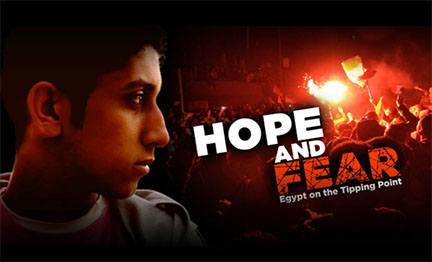
Hope and Fear: Egypt on the Tipping Point

Kickstart the post-production of this Film!

Go Deep: View Director’s Cut Trailer – HOPE & FEAR Long Trailer
Get Deeper: HOPE & FEAR website – www.HOPEandFEARmovie.com

HOPE & FEAR is unlike any documentary you’ve ever seen – providing a rare glimpse into the lives of four young liberal-minded Egyptians as they struggle to reshape their nation. Their story is one of aspiration and empowerment in the face of fear and chaos which dominates Egypt’s ongoing revolution.

Hi Kickstarters!

I’m Hosam Khedr, co-director and producer of HOPE & FEAR. Along with my partner Anjuli Bedi and our crazy dedicated team we set out on an audacious and dangerous quest to tell a more personal and timeless story.

HOPE & FEAR presents an insider’s-perspective on the lives of four young Egyptian activists who are pushing for freedom of expression through their art and community activism. We follow Salman, Nada, Ammar, and Reham beyond the idealism, euphoria and revolution of Tahrir Square as they struggle to navigate the difficult terrain of an Egypt hindered by an oppressive security force, corruption, political and economic instability, and religious intolerance under the new Islamist government.

HOPE & FEAR’s characters along with our special guest appearances, give a broader view of the challenges and implications of Egypt’s revolution. Will the homeland of civilization maintain civility? Nothing less than the future of the region hangs in the balance. With the outcome of Egypt’s liberal youth movement, HOPE & FEAR’s intimate portrayal of its characters shows the common thread that unites all humanity: the human spirit’s refusal to capitulate to oppression despite the costs.

Do We Care?


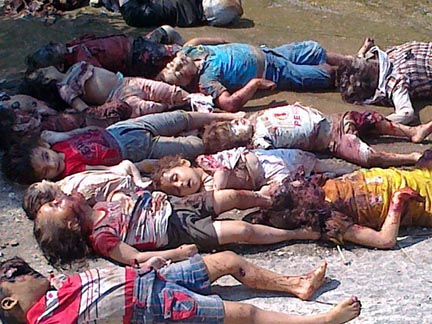
Scene after a massacre in a coastal Syrian village on May 4

Do we care? When the news media report yet another attack on civilians in Syria (or Iraq or Afghanistan or anywhere outside of Boston and New York), do we really care? It is hard to be sympathetic to the picture above without feeling the pain caused by imagining your own child’s body bloodied and lifeless. It is not easy for those of us in the fabled “land of the free” to admit that in war and civil strife everyone is presumed guilty by being in the way of a bomb and only proven innocent as a victim. These are bodies that have stopped growing, faces forever locked into expressions of horror. There can be no rest for these children in the grave for there can be no end to the grief of those who knew them.

But what do we care? It did not happen here. We make sure of that by sending arms to our erstwhile allies and droning anyone abroad who looks like a terrorist. As long as we proclaim our rhetorical support for human dignity, who can blame us? This was the act of a vicious dictator struggling to hold on to absolute power. Asad is Russia’s bastard, not ours. The weapons used to rip apart these childrens’ lives were Cold-War-forged Soviet, not Free World. Thank God, our God of course, there is no “Made in the USA” trademark on any of the bombs used here. But our’s will soon be in play here, as they are in Iraq and Afghanistan and Pakistan and Yemen, and even more children will never be able to play again.

Should we care? We did not know them. There are seven billion of us living and dying on this planet. What does it matter if a few children do not have a chance to live? Perhaps they would die of cancer before their teens or be run over by a car? What if one of these children had grown up to be a violent terrorist and take some of our lives? There are many ways not to look at these dead bodies, not to count them as our own. You can ignore what you see here, quickly click your mouse to escape caring. But tomorrow there will be another picture just like this, perhaps with women or men. Perhaps with soldiers who have little choice but to follow orders or risk their own lives. You need not worry, though, because you will not know any of them, not their names, not the sound of their laughter, not their dreams, not the goodness that shines through in every corner of our globally disconnected world.

So go ahead. Ignore what you see. Thank your God it’s not about you. Life goes on here no matter how many lives end over there. They say a picture is worth a thousand words. I have said what I want to say in less than 500. The rest is up to you.

Bedtime for Bibi

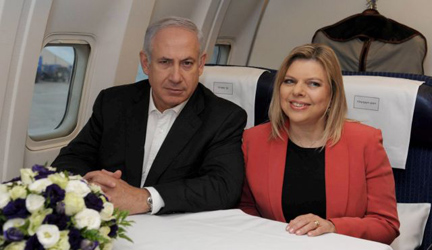
Austerity and sequestration are the dismal economic buzzwords of the day. While thousands of airline passengers in the United States waited for late flights due to a lack of air traffic controllers, and while tens of thousands of Israelis protested the latest cutbacks, Prime Minister Benjamin Netanyahu of Israel had his own solution. He flew to the funeral of Margaret Thatcher last month in a specially fitted plane. There are obvious perks to being a leader, especially a sleepy one. So why not rent a retrofitted El Al superliner to take 75 guests to London for a mere $427,000 from the national treasury. It was not the latest in security secrets that upped the price, but rather a newly installed rest cabin in which a $127,000 bed was installed for his wife and himself for a five hour trip. I am not sure if Bibi has ever watched the Lialda ad that warns a man to consult his physician if he experiences an erection lasting over four hours. No doubt some Israelis feel as though Israel has suffered enough from electoral dysfunction throughout his tenure.