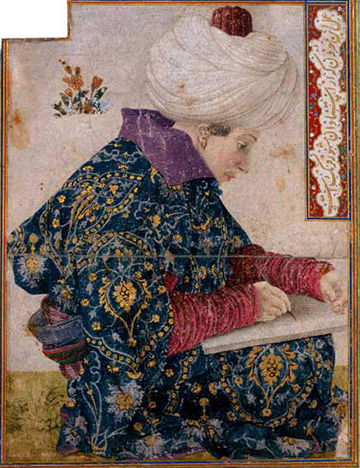
A Seated Scribe, 1479-80, Attributed to Gentile Bellini, Italian, 1429–1507
The painting above is located in the Gardner Art Museum in Boston. Here is the description posted on their website:
Curious visitors who lift the cover from the unassuming Seated Scribe will be richly rewarded by what they see: an intimate painting in miniature of a young member of the Ottoman court bent intently over a writing pad. Dressed in a navy velvet caftan woven with gold, the elegant youth wears bright silks at his arms and neck. The generous folds of his turban hold in place a ribbed, red taj – headgear worn in the court milieu of Ottoman sultan Mehmed II (1432–1481), who nurtured a passionate interest in portraiture and particularly in western traditions of the genre.
Striking for its gleaming tones and stunning delicacy of line, the Seated Scribe is spectacular not only visually, but also in historiographic terms. The painting’s original dimensions have been trimmed, and a later hand has taken care not only to embellish the image, but also to frame, mount, and, ultimately, historicize it. An added inscription in Persian records the image as the “work of Ibn Muezzin who was a famous painter among the Franks.†Scholars have never doubted that a European or “Frankish†artist painted the Seated Scribe. The pressing issue of late has been who, precisely? Whether the Venetian Gentile Bellini, a renowned portraitist sent to Istanbul in 1479, or Costanzo da Ferrara, a court artist at Naples who also sojourned at the Porte, the specificity of detail in the Seated Scribe leaves little doubt that the artist drew from life.
Once the debate over attribution subsides, the more intriguing issue to raise is whether one can call the work a portrait. Might western pictorial realism have been the point of the exercise? A pronounced crease just above the youth’s elbow suggests the image was initially handled as a loose-leaf, autonomous work of art before being mounted (and in this way preserved) in a sixteenth-century album. Like other western-style works Mehmed II commissioned or obtained during his sultanate, the Seated Scribe may have been used as a pedagogic tool for rising artists of the Ottoman royal workshop. A slightly later copy of the miniature (Freer Gallery of Art, Washington) certainly affirms its value for Ottoman and Persian artists as a pictorial model worthy of imitation. If the pictured youth is not a scribe but an artist, shown in the act of drawing while he himself is being drawn according to Western pictorial practices, the Seated Scribe taught by poignant example – it sits indeed at the nexus of Ottoman art and European traditions of representation.
Source: Susan Spinale, “A Seated Scribe,” in Eye of the Beholder, edited by Alan Chong et al. (Boston: ISGM and Beacon Press, 2003): 97.