Category Archives: Countries

An 1873 Geography Lesson #1

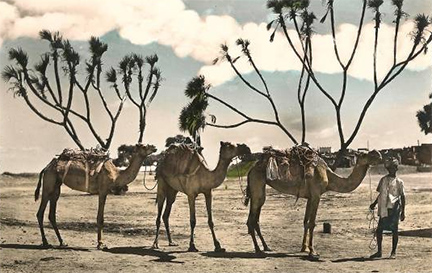
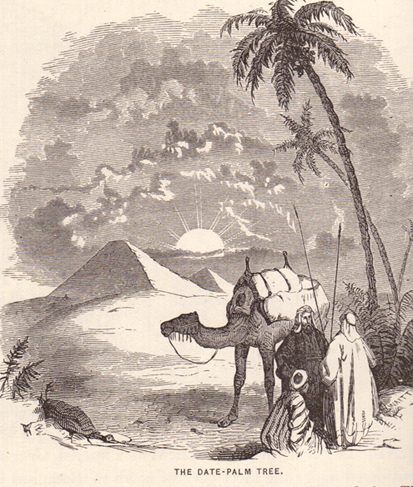
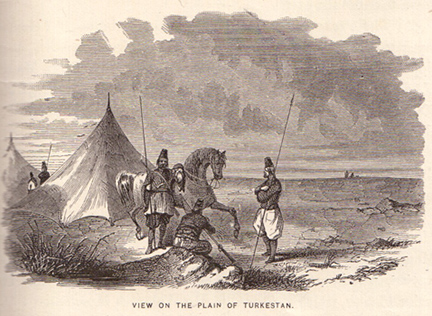
My grandmother’s aunt, Ms. Ida Hoyt, owned an 1873 geography textbook entitled An Elementary Treatise on Physical Geography by D. M. Warren (published by Cowperthwait & Co of Philadelphia). The book itself, which I recently leafed through, is falling apart, but it is worth taking a brief look at some of the lithographic images. The text itself shows how far we have come since 1873, especially for the dated views of “race” and the ethnocentric views of the time. I will start with several of the images, as shown here.

Continue reading An 1873 Geography Lesson #1 →

Making Music in Yemen


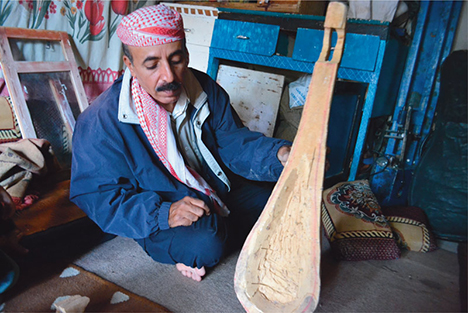
Photograph by Ali Abulohoom

The Yemeni Turbi

by Ali Abulohoom, Yemen Times, August 22, 2013

When he was 8 years old, Fuad Al-Qotari found a piece of wood lying around while playing with some neighborhood kids. He later learned that the object was actually a turbi, an instrument that had nearly disappeared from the Yemeni music scene after the 1920s.

Shortly after discovering his new find, Al-Qotari left Hashed district and moved with his family to the country’s capital, Sana’a, exposing him to more music. He began to follow many of the day’s most accomplished musicians and starting saving money for his own instrument.

His first instrument was the oud, and he was fascinated with its construction. “How [this] instrument was made interested me more than playing [it],” Al-Quotari said.

While he played some tunes of other musicians, his curiosity about the oud’s design was too strong. He put his instrument in water for hours and waited until it fell apart so that he could study each individual part. Continue reading Making Music in Yemen →

War is still hell


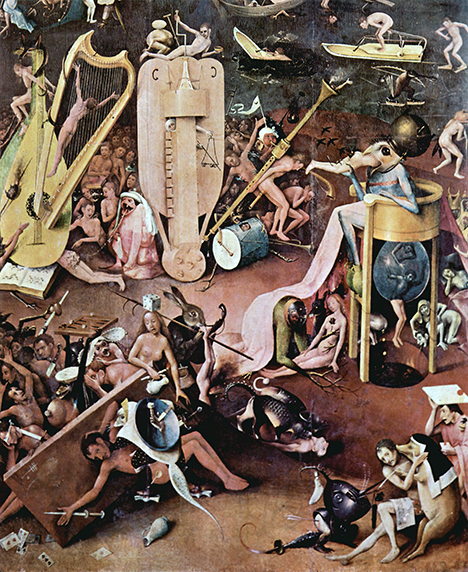
The Garden of Earthly Delights by Hieronymus Bosch, ca 1500

War is hell and it was long before General Sherman figured that out. It helps to remember exactly what “hell” means. In 1741 the Protestant firebrand Jonathan Edwards gave a rather clear picture:

The God that holds you over the pit of hell, much as one holds a spider, or some loathsome insect over the fire, abhors you, and is dreadfully provoked: his wrath towards you burns like fire; he looks upon you as worthy of nothing else, but to be cast into the fire; he is of purer eyes than to bear to have you in his sight; you are ten thousand times more abominable in his eyes, than the most hateful venomous serpent is in ours. You have offended him infinitely more than ever a stubborn rebel did his prince…

Over five centuries ago, the painter Hieronymus Bosch gave an artistic rendering, as noted above. Had he known about poison gas, I suspect we would have seen a few canisters in his registers. In the hell that is war, a Dantean perspective would place the various poison gasses near the bottom level. It now seems that the United States is certain that Syria’s Assad has used poison gas, crossing the rhetorical line drawn by President Obama awhile ago. Foreign Policy is reporting new old evidence that our government is not so much concerned about the use of such poison gas as it is in who are the intended victims. We apparently knew in advance that Saddam would use such gas when we gave him logistical support to fight off the Iranians, whose country he had ruthlessly invaded. And, of course, we did nothing when he gassed the Kurds in Halabja.

The truth is that war has always been hell, since the first historical descriptions. In reality it is never the kind of supposedly heroic “give ‘m hell” bravado of John Wayne or Rambo. Gore trumps the vanity of glory. The problem is that hell is eternally present and not in some far-off ethereal realm. A further problem is that hell has no suitable escape hatch. Thus thousands have died in Syria and many more will be killed on all sides, no matter what the United States does next. The same goes for Iraq, Afghanistan, Pakistan, Palestine and now, it seems, Egypt. Even those who think that by killing someone else because they are … (fill in the sectarian blank) they will go to an imagined heaven only deserve to end up in the hell they create for their victims.

Those of us far away from the fighting, only within Youtube range, may forget how close to hell we really are. The stench of dead bodies and the devastating odorless poison that snuffs out lives lightning quick are not part of the air we currently breathe, but we should not forget that hell is not a place but an attitude, an attitude that kills. It is also an attitude for which there is no real immunity in avoiding its reality. If only we could say “to hell with war,” but then that would be a tautology.
The Battle for Baghdad

How to Invade Iraq: The Mongol Way

By Peter Konieczny

[Paper given at the 42nd International Congress on Medieval Studies, held at Western Michigan University (2007) and online here.]

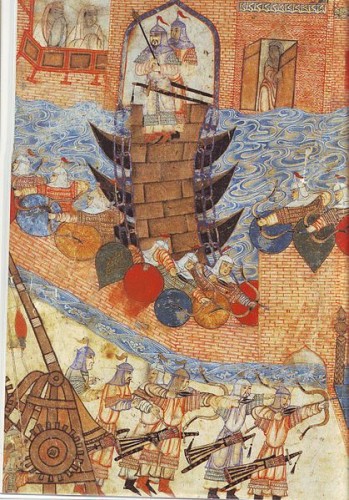
When I began researching the Mongol conquest of Baghdad, I came across an account by an Iraqi writer from the early fourteenth-century. With much excitement I found the relevant passage, and began to read it. He summed up the siege and fall of Baghdad with these words: “Even a brief mention of it would be terrible to hear – how much worse its recapitulation in detail! Things happened which I shall not record, imagine them and do not ask for a description!”

Despite this unpromising beginning, I soon found a wealth of information from contemporary writers and chroniclers, including those who were on the saw the event firsthand. For the last couple of years I have been piecing this story together, not only because the story of the first conquest of Baghdad is an interesting one in its own right, but also because it adds some insights into the present-day situation in Iraq.

Despite it being such an important historical event, the story of Baghdad’s fall has been poorly served by historians. Most Muslim historians deal more with alleged collaboration by Shi’ites with the Mongols against the Sunni Abbasid Caliphate than with anything else, while Western historians have usually focused on the most outrageous stories associated with the invasion, often repeating wild claims that millions of people were killed and that Baghdad was completely destroyed by the Mongols.

The short amount of time here prevents me from saying everything I want to say, so in some sections I am going to be very brief. Hopefully, most of you have got my handout which outlines the events and gives some chronicle excerpts. I also have a couple of overheads to show some maps of Iraq, in case someone is not familiar with the country. Continue reading The Battle for Baghdad →