Category Archives: Countries

Burqa Avenger

Most of the debate over a Muslim woman who wears the burqa, niqab or hijab centers on how this restricts her freedom of choice. Those who are against the burqa argue that it is a preeminent icon of patriarchy and that societal pressure, valorized with religious rhetoric, does not give a Muslim woman a true sense of choice. The issue is hottest in Western contexts, where a woman wearing a burqa or niqab stands out almost as much as if she was walking around naked. On the other side, there are Muslim women who insist they are exercising free choice and choosing to dress in the conservative manner they want. Regardless of where you stand on the issue, the burqa is inevitably seen as an item that limits a woman’s movement or protects her, not one of empowerment.

So here comes Burqa Avenger to the rescue. This is a video cartoon series in which the star is a female Superwoman/Spiderwoman/Batwoman takeoff, a contemporary way of commanding the right and forbidding the wrong. The series itself is state-of-the-art in its cinematic presentation. You can even get a free app for a Burqa Avenger game on your iphone. As in all cartoons, the characters tend to be stereotypes. Of course, this makes the good stand out from the evil in a stark way that is seldom the case in real life. But the inspiration for the series is to provide young Muslim girls with a positive role model. Continue reading Burqa Avenger

The Damning of Dammaj


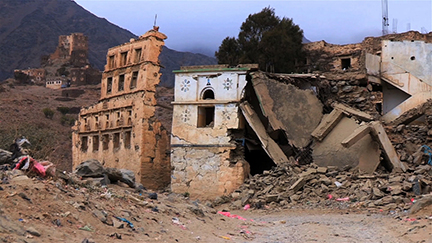
Destruction in northern Yemen caused by the civil wars with the Houthis, 2004-10 ; Photo: Mike Healy/IRIN


“Catastrophic” humanitarian situation in Yemen’s Dammaj

DUBAI, 6 November 2013 (IRIN) – A fresh outbreak of sectarian fighting in northern Yemen between militants of the Houthi-led Shia movement and (Sunni) Salafists has entered a second week with at least 50 people killed, according to a senior government health official, and aid workers getting little access to the besieged village of Dammaj, a Salafist stronghold.

Humanitarians are concerned that thousands of vulnerable civilians, some of them injured and sick, are unable to flee as Houthi forces continue to bombard the village from surrounding hills. In a statement last week the Houthis said a Salafi religious centre in Dammaj, Sa’dah Governorate, was being used to recruit Sunni fighters.

Attempts at a ceasefire on 5 November failed, and a further six people were reported killed overnight, with further fighting today, according to the government hospital in Dammaj.

“The humanitarian situation is catastrophic. There is no food, no medicine, no fuel, artillery shelling is non-stop and they are using all kinds of arms,” said Ahmad al-Wade’i, director of the hospital. “Diseases are spreading in a catastrophic way. Every day that passes the suffering of the people increases.”

The fresh fighting puts at risk a fragile truce that ended the civil war in the north in 2010. An escalation of the conflict around Dammaj could spill over to the neighbouring governorates of Hajjah, Amran and Al Jawf. Continue reading The Damning of Dammaj

Democracy … the West … and Islam: Part Two


By Samira Ali BinDaair, Sanaa, Republic of Yemen

[for Part One of this essay, click here]

Islam and Democracy

“Al-adala” (Justice) is a keyword in Islam, and Islam like the great religions preceding it came to regulate man’s life on earth and Allah sent many prophets to admonish the people who had gone to excesses and violated “Nawamis al-kawn” (Allah’s laws governing human interaction with the cosmos). Islam came to complete all the preceding messages in its being comprehensive, encompassing both the spiritual and material. When it is said in the Holy Quran that Allah has created man and jinn to worship Him, obedience to Allah’s laws of how man is to conduct himself on earth is part of that process of worship. In reading the Hadith literature (sayings of the Prophet PBH) and the Sira (biography of the Prophet,PBH), one can see how Islamic teachings were operationalized and exemplified, and what stands out is the absolute sense of justice in Islam.

The way Islamic affairs are to be conducted is through a consultative process (Shura) and in fact the concept of Shura is so important in Islam that a whole Sura (chapter) has been devoted to Shura. In Surat al Shura (ayya 38), it says: “Those who hearken to their Lord and establish regular prayer ….. who conduct their affairs by mutual consultation”. In choosing their leaders, Muslims should undertake the “Mubaya” ( declaring allegiance through the process of “Ijmaa” ( general consensus). No one practiced Shura more than the Prophet (PBH) himself. He always consulted with young and old on all matters. He consulted with Um Salama and Zainab bint Gahsh (wives of the Prophet) and respected their opinions. When the message was first revealed to him, he consulted with Khadija (his first wife) who reassured him and allayed his fears and consulted with her couisin Waraka ibn Nofal Christian monk at the time) who in turn reassured him that it was the angel Gabriel who had also been sent to prophets before him. During the battle of the “Khandak” (trenches) Salman Al-Farisi had informed the Prophet(PBH) about building trenches in battles as practiced in Persia where he came from; this was then adopted by the Muslims. The Prophet(PBH) was not autocratic and left some worldly matters to others who knew better than him. When when farmers in Medina asked him about cross pollination in date planting, his answer was:”You know better about these affairs”. Continue reading Democracy … the West … and Islam: Part Two

Democracy … the West … and Islam: Part One


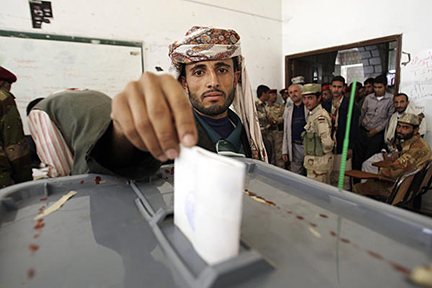
Yemeni man voting; photo by Hani Mohammed/AP

By Samira Ali BinDaair, Sanaa, Republic of Yemen

This essay is an attempt at shedding some light on the relationship between democracy, Islam and the Western world and in the process dispelling some of the misconceptions about the chasm between Islam and democracy. It is nowhere easy for the entire society to have unanimity on any given issue let alone such a complex one as what constitutes good governance and the best political system to be adopted. The Arab world has tried it all but I would like to point out that any system when transplanted and adopted without the necessary conditions for its success is bound to fail, leading to the condemnation of the system rather than analysis of the causes of failure in implementation.
Democracy as a pure concept

I would like to start with the concept of democracy which some Muslims have rejected on the basis of its emanating from the West within secular governments and secular ideas. However, if one examines the concept in its pure form it simply means rule of the people by the people for the people. To demystify it further, what it simply boils down to is that people have a voice in national affairs and choice of their leader and by virtue of the same fact are able to remove the leader through general consensus and legal means if the leader proves to be incapable of living up to the responsibilities entrusted to him/her. Continue reading Democracy … the West … and Islam: Part One

A Wolff in Shepherd’s Clothing, #3


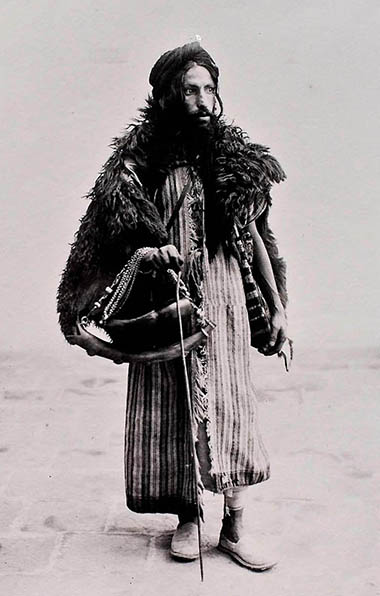
Dervish,; photograph by Sevryugin Anton (1830 – 1933), the official photographer of the Imperial Court of Iran

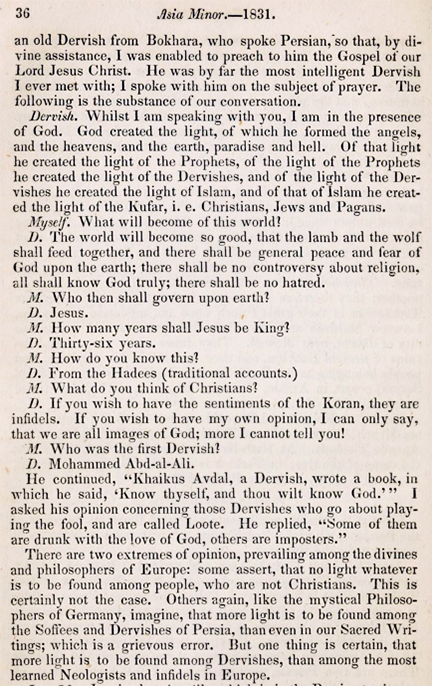
In the early 19th century there was a florescence of Protestant missionary interest in saving Muslim, Jewish and other kinds of Christian souls in the Middle East. This thread continues excerpts from one of the earliest accounts from the 19th century, that of Joseph Wolff (1795-1862), a convert from Judaism to Christianity. In 1837 he published a diary of his travels. Like a number of Christians visiting the Muslim world, Wolff is more impressed by Muslim sobriety and devotion in their ritual than he is by the Christians he sees:

There is also an intriguing encounter between the Christian missionary and a Kurdish Muslim dervish:

Chalk one up for the Kurdish dervish over the atheists of Europe.

Women picturing women


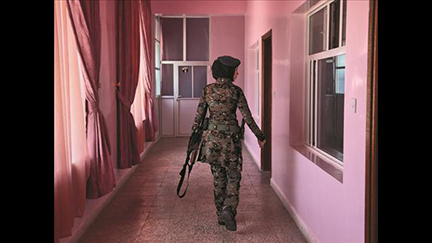
A lieutenant in the elite female counterterrorism unit patrols the women’s barracks in Sanaa, Yemen. Photo from the “Women of Vision” exhibit. Photography by Stephanie Sinclair

Associated Press, WASHINGTON (AP) – The National Geographic Museum in Washington has a new exhibit featuring the photography of 11 award-winning female photojournalists.

The exhibit is kicking off a three-year tour for “Women of Vision: National Geographic Photographers on Assignment.” It features nearly 100 photographs depicting a variety of cultures and topics. The exhibit is on view in Washington until March 9.

The photographers tackled subjects ranging from memory and teenage brain chemistry to social issues like child marriage and modern-day slavery. Visitors will also see how National Geographic magazine photo editors work with photographers to select images to tell a story.

The photographers featured in the exhibit are: Lynsey Addario, Kitra Cahana, Jodi Cobb, Diane Cook, Carolyn Drake, Lynn Johnson, Beverly Joubert, Erika Larsen, Stephanie Sinclair, Maggie Steber and Amy Toensing.


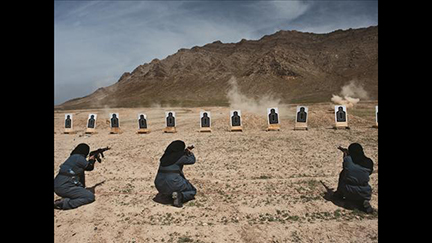
Women – mostly widows – train for police force jobs at a firing range near Kabul, Afghanistan. Photo from the “Women of Vision” exhibit. Photography by Lynsey Addario

For all the pictures, click here:

What’s Up with Our Mosques?


Image: Rihanna’s Instagram

by Fatimah Jackson-Best, Aquila Style, October 28, 2013

International pop icon Rihanna recently made the news after being asked to leave the Sheikh Zayed Grand Mosque in Abu Dhabi. According to a statement issued by the mosque, the singer’s removal from the grounds was based on several reasons, which include attempting to enter the mosque through a gate that was not allowed for visitors, failing to get the proper permission to visit and tour the mosque, and failing to behave in a way that was in accordance with the sanctity of the mosque.[i] Instagram photos of the singer posing in front of the mosque also sparked reactions from Muslims and non-Muslims around the world.

I learnt that she had been barred from entering the mosque on my Facebook wall, from a friend who jokingly reminded me that I could relate to the story, because I had also been prevented from visiting a mosque here in Barbados – twice. Continue reading What’s Up with Our Mosques?