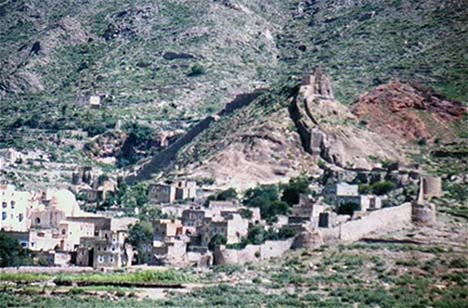
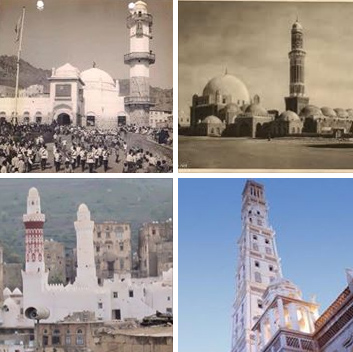
Historic photo of Yemeni city of Taiz in 1961; courtesy of Dr. Muhammad Gerhoum
Category Archives: Countries
On Dar al-Kutub in Cairo

A review of the manuscript collections viewable at the Bab al-Khalq branch of Dar al-Kutub wa-al-Wathaʾiq al-Qawmiyya (Egyptian National Library and Archives), Cairo, Egypt.
by Noah Gardner, Dissertation Reviews, January 6, 2014
Bab al-Khalq Square, Cairo, Egypt
Tel: +20 2393-8656; 2391-7843; 2391-7825
Fax: +20 2393-8759
www.darelkotob.gov.eg (functions sporadically)
Bab al-Khalq Reading Room hours:
Sunday – Thursday, 9 am to 4:45 pm
Closed Fridays, Saturdays, and national holidays.
The Egyptian National Library and Archives in Cairo makes available extensive holdings of printed books, serials, coins, papyri, documents, and other collections of interest to researchers; however, in this review I solely address working with its large and important collection of Islamicate manuscripts, much of which is accessible in microform at the library’s Bab al-Khalq branch. After giving a brief history of the library and its manuscript holdings, I discuss preparing to visit the library, reaching it once in Cairo, working with the printed catalogs and on-site electronic catalog, and viewing and obtaining copies of microfilms. As an appendix I include a list of the numerous printed catalogs dedicated to the collection, along with some tips for working with them. While some of my observations regarding the library’s systems are critical, I hope it will be understood that they come from the perspective of an avid user and admirer of the library, and are in no way intended to detract from the efforts of the highly dedicated staff, or to discourage would-be researchers.
History of the library and an overview of its manuscript holdings
The library was founded in 1870, during the reign of the Khedive IsmaÊ¿il Pasha. It originally was located in Darb al-Gamamiz, at which time it was called al-Kutubkhana al-Khidiwiyya (the Khedival Library). In 1904 it was moved to the purpose-built, monumental Neo-Mamluk-style building at Bab al-Khalq Square—on Port Said Street at the intersection of Ahmed Maher and Muhammad Ali Streets—which it shares with the Museum of Islamic Art. In the 1970s much of the library was relocated to a new building on the Nile Corniche. While the majority of the actual manuscripts are still stored at the Corniche Branch, the Bab al-Khalq building has been renovated in recent years, and now houses greatly improved conservation and storage facilities, a microfilm reading room, and a state-of-the-art exhibition area for select manuscripts. The library currently holds approximately 57,000 codices; the vast majority of these are in Arabic, though roughly 1,000 are in Persian and over 2,100 are in Ottoman Turkish. Since its founding the library has absorbed a number of smaller Cairene libraries and important private collections of manuscripts, such as those of Ahmed Pasha Taymur, Halim Pasha, Khalil Agha, and others, and the names of many of these collectors still serve as shelfmark headings. It is one of the largest and most important collections of Islamicate manuscripts in the world, and includes numerous manuscripts from the first four centuries anno hegirae, including what are claimed to be some of the earliest surviving Qurʾan manuscripts, as well as many thousands of later medieval and early modern codices on the full range of subjects common to premodern Islamicate learning and culture. Much, though not all, of the collection has been filmed and is available in microform. Those seeking a more complete history of the library and the manuscript holdings should consult Dr. Ayman FuÊ¿ad Sayyid’s excellent Dar al-Kutub al-Miá¹£riyya : TÄrÄ«khuhÄ wa-taá¹awwuruhÄ (Cairo: Maktabat al-DÄr al-Ê»Arabiyya li-al-KitÄb, 1996). Continue reading On Dar al-Kutub in Cairo
Veiling Styles
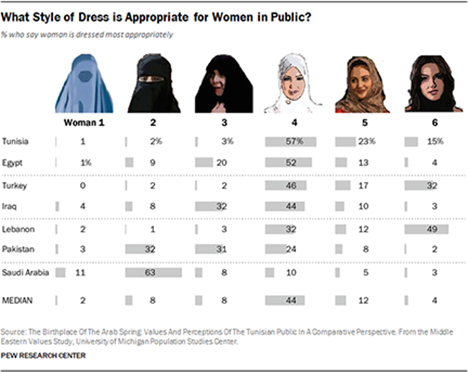
How people in Muslim countries prefer women to dress in public
By Jacob Poushter, Pew Research Center, January 8, 2014
An important issue in the Muslim world is how women should dress in public. A recent survey from the University of Michigan’s Institute for Social Research conducted in seven Muslim-majority countries (Tunisia, Egypt, Iraq, Lebanon, Pakistan, Saudi Arabia and Turkey), finds that most people prefer that a woman completely cover her hair, but not necessarily her face. Only in Turkey and Lebanon do more than one-in-four think it is appropriate for a woman to not cover her head at all in public.
The survey treated the question of women’s dress as a visual preference. Each respondent was given a card depicting six styles of women’s headdress and asked to choose the woman most appropriately outfitted for a public place. Although no labels were included on the card, the styles ranged from a fully-hooded burqa (woman #1) and niqab (#2) to the less conservative hijab (women #4 and #5). There was also the option of a woman wearing no head covering of any type. Continue reading Veiling Styles
Birthers, chew on this …
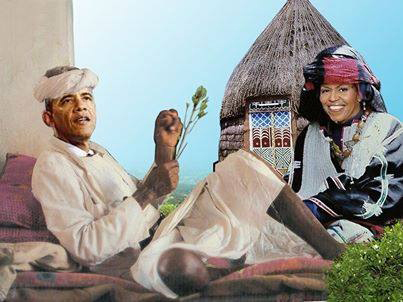
President Obama has been stalked by birthers ever since his first run for the White House. But forget about placing his birth in Kenya, even though Kenya is a country where qat (Catha edulis) is chewed. A friend in Yemen sent me this photograph which should confuse the birther issue even more. If Obama can chew like a Yemeni, who knows where he was really born. Just think, how much qat is there in Hawaii?
Tabsir Redux: An Archic Sonnet
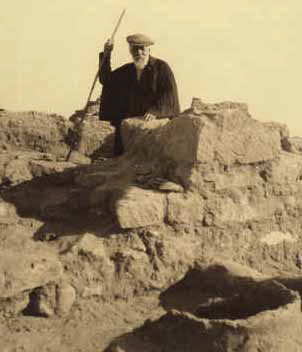
Sir Flinders Petrie, Egyptologist
An Archic Sonnet
To know what man was, ere he wrote his name,
Inscribed the laws and precepts on the rock,
And sacrificed the best lamb of the flock,
We dig the mound, and wander o’er the plain.
To learn the mysteries of the past, we fain
Would search for hidden slabs, and keep in stock
The Relics we so love. Oh, to unlock
The door, and gain an entrance to the same! Continue reading Tabsir Redux: An Archic Sonnet
Cafe Literati
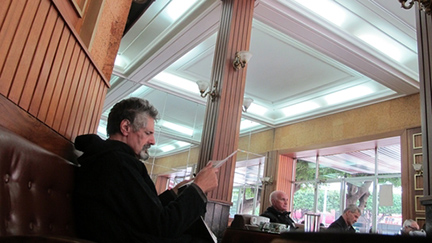
Cafe in Tangier; photography by Anouar Majid
by Anouar Majid, Tingitana, December 3, 2014
Say what you may about Tangier in Morocco, anyone who doesn’t know its cafe life and culture is missing out on the soul of the city. Cafes in Tangier are hard to describe; people gather in them, singly or in groups, talk about everything, and while away their days and nights to make room for the next cafe visit. Customers do read a lot of papers in them and, on occasion, as in these pictures I took around 10: 20 am on January 3, 2014 at the legendary Grand Cafe de Paris, even smoke cigars in the process.
Morocco is a nation of cafes. But the main reason Moroccans go to cafes is to talk and comment on everyday experiences; this is how communities are forged and cemented. Moroccans are different from Westerners in this sense—conversations to them are pure literature and theater. Who needs to write, read, or watch plays when one can experience literary euphoria orally?
الى اللاعبين السياسيين
الى اللاعبين السياسيين الذين يلعبون بالنار، النار ستØرق Ùلذات اكبادكم قبل ان تØرق الآخرين.
الى كل المناضلين الطيبين، التهرب من مواجهة الØقائق المريرة، والبØØ« عن شماعات يلقى عليها اللوم ÙÙŠ كل صغيرة وكبيرة، لا ÙŠØÙ„ المشاكل، بل يساعد على تÙاقمها.
الى الأغلبية السلبية من المتÙرجين، سلبيتكم هي الهشيم الذي تنتشر Ùيه نيران الÙوضى والهدم والقتل وتنتزع الابتسامة من وجوه أطÙالكم.
أبناء الجنوب وأبناء الشمال اخوة ÙÙŠ الدنيا والدين، والمخاطر والظلم والمعاناة واقعة على الجميع، والعابثين بأمن واستقرار الجنوب هم العابثين بأمن واستقرار الشمال.
وعلى من أمن بالله ورسوله ان يتذكر قوله تعالى: “وَاذْكÙرÙوا Ù†Ùعْمَةَ اللَّه٠عَلَيْكÙمْ ÙˆÙŽÙ…Ùيثَاقَه٠الَّذÙÙŠ وَاثَقَكÙمْ بÙه٠إÙذْ Ù‚ÙلْتÙمْ سَمÙعْنَا وَأَطَعْنَا Û– وَاتَّقÙوا اللَّهَ Ûš Ø¥Ùنَّ اللَّهَ عَلÙيمٌ بÙذَات٠الصّÙدÙورٔ. صدق الله العلي العظيم
Ù…Øمد اØمد جرهوم
صنعاء اليمن
New CyberOrient issue is out
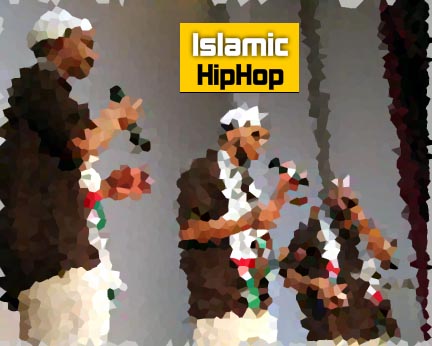
The latest issue of CyberOrient (Vol. 7, Iss. 2, 2013) is now available online as open access. Here are the contents:
Editorial
Orchestrating Hip-hop Culture Online: Within and Beyond the Middle East
Anders Ackfeldt
Articles
Muslimhiphop.com: Constructing Muslim Hip Hop Identities on the Internet
Inka Rantakallio
Hanouneh style resistance. Becoming hip-hop authentic by balancing
skills and painful lived experiences
Andrea Dankic
“I Am Malcolm X†– Islamic Themes in Hip-hop Video Clips Online
Anders Ackfeldt Continue reading New CyberOrient issue is out