Category Archives: Countries

40 Maps that Explain the Middle East

There is a very interesting set of 40 maps that Max Fisher has put together on one website to explain the history of the Middle East. Check it out here.

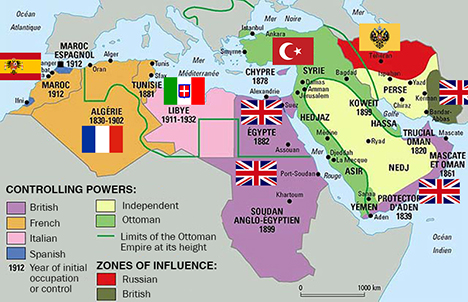
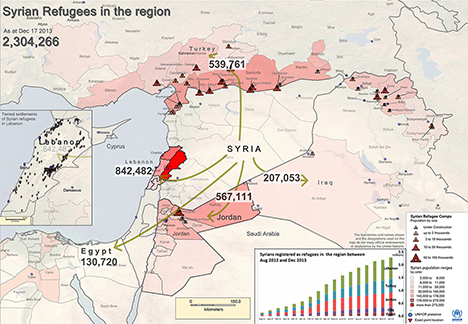
Below are Map #7 and Map #23

What the Middle East looked like in 1914

This is a pivotal year, during the Middle East’s gradual transfer from 500 years of Ottoman rule to 50 to 100 years of European rule. Western Europe was getting richer and more powerful as it carved up Africa, including the Arab states of North Africa, into colonial possessions. Virtually the entire region was ruled outright by Europeans or Ottomans, save some parts of Iran and the Arabian peninsula divided into European “zones of influence.” When World War I ended a few years later, the rest of the defeated Ottoman Empire would be carved up among the Europeans. The lines between French, Italian, Spanish, and British rule are crucial for understanding the region today – not just because they ruled differently and imposed different policies, but because the boundaries between European empires later became the official borders of independence, whether they made sense or not.

Syria’s refugee crisis

Syria’s civil war hasn’t just been a national catastrophe for Syria, but for neighboring countries as well. The war has displaced millions of Syrians into the rest of the Middle East and into parts of Europe, where they live in vast refugee camps that are major drains on already-scarce national resources. This map shows the refugees; it does not show the additional 6.5 million Syrians displaced within Syria. Their impact is especially felt in Jordan and Lebanon, which already have large Palestinian refugee populations; as many as one in five people in those countries is a refugee. While the US and other countries have committed some aid for refugees, the United Nations says it’s not nearly enough to provide them with basic essentials.

With Latefa Ahrrare in Rabat

by Anouar Majid, Tingiata, April 15, 2014

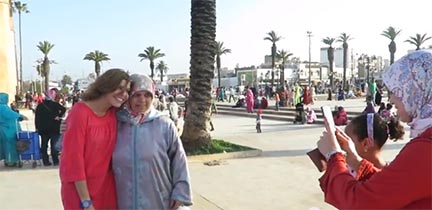
The most controversial actress in Morocco and the Arab world gave me a tour of Rabat, the capital of Morocco. To say that it was a unique experience would, quite frankly, be a huge understatement. Parking attendants, men in uniform, women with hijabs and jellabas, food sellers and everyone—literally—who saw Latefa greeted her with smiles and affection. People took photographs with her and asked for new performances. She is truly a people’s artist, one who uses a container (labelled “cont’n’art”), among other tools, to foster awareness about health and difficult social issues.

The car ride, as you could see in the video, was, in itself, a fascinating spectacle. The free-spirited Latefa sang throughout most of trip, ending, most appropriately, with the theme of Carmen, reminding us that women are born to be free, not objects to be hidden away.

The Haram of Boko Haram

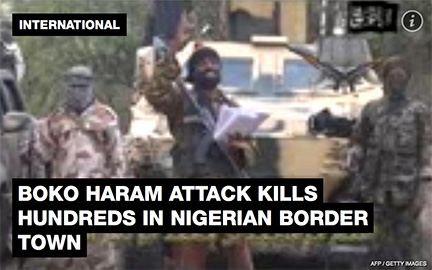
Here is a snap question: which does more harm to the image of Muslims, especially in the Western media: the political maneuvering of Egypt’s now outlawed “Muslim Brotherhood” or the savage acts committed by the self-styled Boko Haram in Nigeria? Boko Haram is well named, if you remove the Boko. I would have a hard time thinking of a more bloodthirsty and irrational group calling themselves Muslims, and there are far too many examples to choose from historically. Their kidnapping of some 276 Nigerian girls from a school to essentially enslave them is bad enough, but reports now surface of an indiscriminate killing spree in a crowded Nigerian market with over 300 said to be dead. The death toll from this group is measured in the thousands, both Christians and fellow Muslims becoming victims. Boko Haram espouses such a distorted view of Islam, that it is more accurate to label them a political terrorist group using the umbrella of Islam to carry out their barbaric acts.

Boko Haram is not alone. It is this kind of volatile mix of politics and religion that has plagued human history, probably from the start of recorded history. If one steps out of the Western preoccupation with the biblical tradition, the idea that any kind of just God would tell his ragged followers to kill every man, woman, child, ox, sheep and ass in a Canaanite city is a clear attempt to justify what most of us would rightly see today as a violation of human rights. The crusades and the bloody wars in Europe between Protestants and Catholics turned religion into yet another excuse to justify killing others. Hindus and Buddhists also have their blood-soaked moments, as do most known religions. The point is that “religion” is never separate from the real world except in some imaginary. It is myth that drives belief, whether from a sacred text written in a shroud of mystery or the quotidian alibi of personal experience. Those who take on the mantle of “God” show how little faith they really have. Continue reading The Haram of Boko Haram

They died with their sandals on

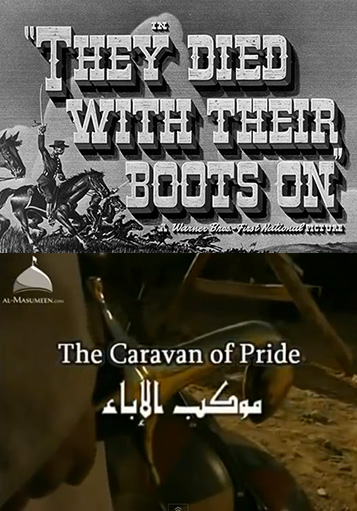
When I was young and impressionable, one of my favorite movies was They Died with their Boots On, the Errol Flynn movie about Custer’s last stand. There was Flynn/Custer with his sword raised out in front of his troops heading for the savage Indians. Had it been a fair fight, of course he would have won, but he stood his ground and was the last man standing. Watching this film recently, apart from the totally ahistorical plot of the made-for-Hollywood battle scene, I wonder how many horses were maimed from the trip wires. In a sense Flynn represented a hero against impossible odds, but in another it perpetuated the notion of the white man’s manifest destiny at the expense of the savage “red man.” I doubt it inspired any sarsparilla party types to go out and shoot any Indians, but it certainly reinforced a cultural bias that remains to this day.

I recently came across a film about the death of Husayn, the Prophet Muhammad’s grandson, at Karbala. This comes in Arabic and Urdu versions and is entitled “The Caravan of Pride” (موكب الاباء). Like the Flynn film, the bias in the film is evident from the start. This is a film highlighting the conservative Shi’a view of an evil and crazed Yazid. Watching the film creates sympathy for the tragic death of Husayn and his followers at the same time that it denigrates the incoming Umayyad caliphs as heretics. It is easy to forget that the event taking place happened in 61 AH/680 CE, before there were any of the Sunni law schools and five years before Abd al-Malik became caliph and authorized a new edition of the Qur’an. Continue reading They died with their sandals on

Nose kiss, anyone? How the Gulf Arab greeting has evolved

By Abdullah Hamidaddin | Special to Al Arabiya News
Sunday, 4 May 2014

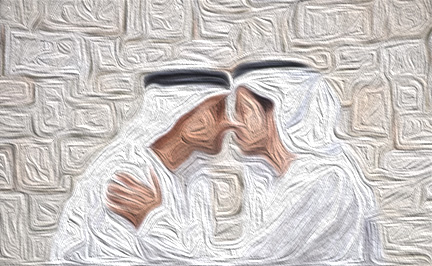
Last March, the “First Kiss” video was released on YouTube attracting more than 80 Million views so far. Not many people in this region were excited about it. For many here it symbolized the decadence and corruption of the West. Yet there were those who considered it interesting enough to inspire them into making a parody of it: “First Nose”. In it you have a set of guys ready to give each other a ‘first nose’.

In the “First Kiss” video the participants are embarrassed and nervous; it’s an awkward moment particularly because of the intrusive effect of the camera. And the same feelings were acted in the “First Nose” video.

There is a difference of course between a “first kiss” and a “first nose.” A kiss is an intimate act and so to kiss an absolute stranger in the presence of a camera can be quite awkward. But a “nose” is merely – or mainly – a handshake using other means. There’s no intimacy at all there. It would be hard to imagine anyone feeling awkward because he/she had to shake hands with complete stranger; camera or not. Even though the video is a parody it led to some misunderstanding. Continue reading Nose kiss, anyone? How the Gulf Arab greeting has evolved

Noah and the Muslim Brotherhood

What do a new film about the biblical Noah, who built the ark, and the Muslim Brotherhood have in common? Both have been banned in Egypt. Muhammad Morsi, the stealth brother who was elected president of Egypt, was removed from office last July (one day before we in America celebrated our revolution). On December 25 (the consummate day for thinking about peace one earth), Egypt declared the Muslim Brotherhood a terrorist organization. Now along comes Noah, at least the latest Hollywood version, with Russell Crowe donning the mantle (at least the biblical robe variety) of Charlton Heston and providing a robust challenge to John Huston’s whimsical Noah in The Bible. The major Egyptian Islamic institution, al-Azhar, has issued a fatwa condemning the film for depicting the Prophet Noah (who has an entire chapter devoted to him in the Quran). Qatar, Bahrain and the United Arab Emirates have already officially banned the film and Egypt is likely to follow suit, given the fatwa. Continue reading Noah and the Muslim Brotherhood