
The online collection of the Bibliothèque Nationale du Royaume du Maroc is well worth checking out.
The online collection of the Bibliothèque Nationale du Royaume du Maroc is well worth checking out.
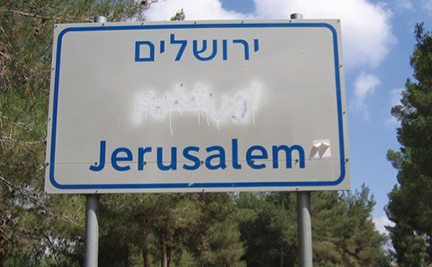
The Irony of Erasing Arabic
Making Hebrew Israel’s Only Language Ignores History
By Liora R. Halperin, Forward, October 06, 2014
In late August, a group of Knesset members from the right flank of the Likud party, Yisrael Beiteinu and the Jewish Home party proposed a bill that would make Hebrew the only official language of Israel, annulling a requirement in existence since the British Mandate period that all official documents be published in Arabic as well as in Hebrew. Similar bills to eliminate or demote the official status of Arabic were proposed in 2011 and 2008. Critics have pointed out that this bill is part of a broader effort to affirm the “Jewish†character of the state (as opposed to its democratic character) by enshrining Jewishness into Israel’s basic laws. Israeli President Reuven Rivlin, for one, has spoken out against it.
A historical perspective is worth adding to the discussion, one that highlights a contradictory Zionist view of language that has existed since the British ruled Palestine: As Zionists advocated forcefully for the very principle of national language rights, they fantasized about a society in which there would be no national competitors to Hebrew. Israel still is navigating between these two positions. Continue reading Making Palestinian Arabs invisible
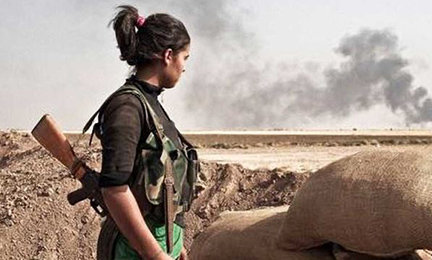
by Ibrahim Kalin, Daily Sabah, October 26, 2014
So it looks like Mosul, the second largest city in Iraq, is not as strategic as Kobani. Nor is Aleppo while the Bashar Assad regime kills hundreds of civilians there. It is not only Mosul or Aleppo though that are forsaken in this supposedly smart strategy. About one third of Iraq and Syria are under Islamic State of Iraq and al-Sham (ISIS) control and have been given up in the rush to liberate the now legendary town of Kobani – a town whose name until a few weeks ago no one had even heard of but has suddenly become the frontline in the fight against ISIS.
In the meantime, Aleppo in Syria, a city of more than 3 million, is about to fall to the Assad regime. While the world’s attention has been focused on Kobani, Mr. Assad is virtually carrying out a massacre with barrel bombs and artillery in Aleppo, Homs and other cities. Will arms be airdropped to Aleppo as well? And if not, why? One cannot help but ask: how is it that Kobani has suddenly gained such “strategic significance” with global attention when U.S. Secretary of State John Kerry said just two weeks ago that preventing Kobani from falling to ISIS is not a strategic priority for the U.S.? How has Kobani become the center stage in the fight against ISIS while the fact that one third of Iraq and Syria is under ISIS control is not even being discussed? Continue reading AFTER KOBANI
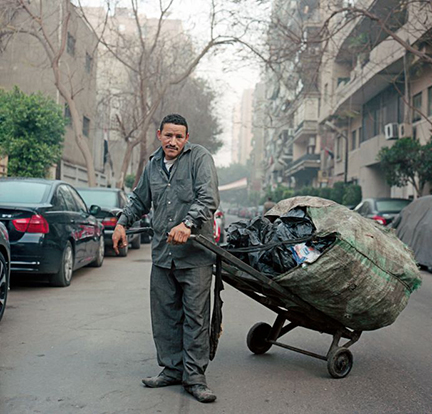
Waste collectors like Sayyid Ahmed, known as zabaleen, work in an informal economy, but they provide a remarkably efficient recycling service and become experts on their neighborhoods. Credit Photograph by Rena Effendi / Institute
The New Yorker has an excellent piece by Peter Hessler on Cairo as seen by the Zabaleen, the traditional garbage collectors.

A new Youtube music video on the nightmare in Syria…
لبلادي عمل من إعداد وإنتاج وتنÙيذ مجموعة شباب يقيمون ÙÙŠ السويد وهم من سوريا Ùˆ العراق Ùˆ لبنان Ùˆ Ùلسطين. على أمل السلام…
“To Our Countries” is a project produced by a group of youths who live in Sweden and are originally from Syria, Iraq, Lebanon and Palestine
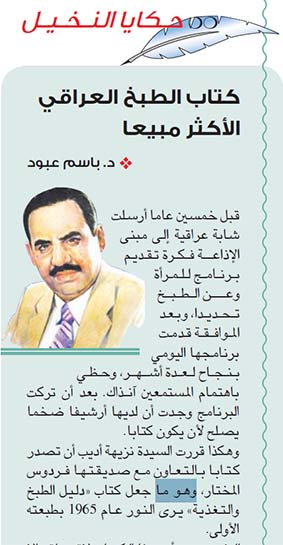
The following commentary is about the famous Arabic language cookbook of Naziha Adibe, published half a century ago in Baghdad and known throughout the Arab world.

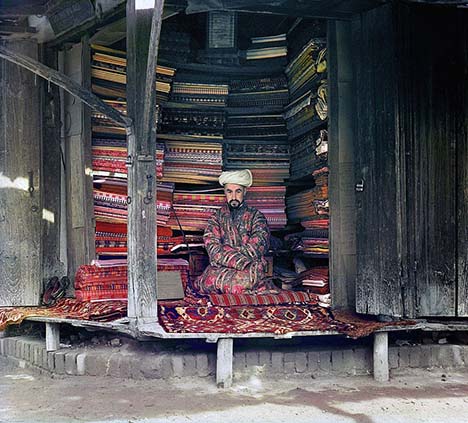
Samarqand merchant in 1911
There is a wonderful website with photographs of various places in Russia, including Islamic areas, from the early 20th century at Mashable.
By Timothy Daniels, Guest Contributor, New Mandala, October 6, 2014
There appears to be no end to the war between several western powers—leaders in the global capitalist world order—and Muslim militants. Both sides are spiralling into some form of mutually assured destruction. Fragile “modern†nation-states, formed under the influence of European colonial forces in the early twentieth century, are crumbling and revealing their inability to deliver the promised fruits of secular modernity. Millions of Muslims are being killed, thousands are fleeing for their lives, and centuries old sites of Islamic civilisations are being decimated, while war-stressed western economies are declining into the shadows of China’s great industrial leap forward.
In the face of the current phase of this violent confrontation ushered in by the emergence and establishment of a militant-led Islamic State (IS) in Syria and Iraq, many officials of western governments and Muslim leaders are making public statements that include the positive representation of Islam as a “religion of peace.†Linguistic anthropologists or any other social scientists seeking to provide a serious scholarly analysis of such discourse would examine the context and what the speakers are trying to do. Here, some of the social meanings of these statements may include efforts to reinforce the peace-loving posture of the majority of Muslims and to calm the fears of non-Muslims, many of whom have already begun to resort to acts of violence against fellow citizens perceived to be Muslims. However, this scholarly tack is not the approach Clive Kessler chose.
Clive Kessler, a Columbia University trained Emeritus Professor of Sociology and Anthropology at the University of New South Wales, chose to interrogate the truth value of discourse expressing the positive representation of Islam “as a religion of peace.†In the article, “The Islamic State and ‘Religion of Peace,’†published online in the Quadrant on September 26, 2014, Kessler tells us that he finds this description of Islam to be “bland, disingenuous, intellectually lazy, delusional, politically evasive, and altogether simplistic.†He wants us to have a clear idea of what we’re confronted with in order to devise an “effective response.â€
Continue reading Islam, a religion of peace