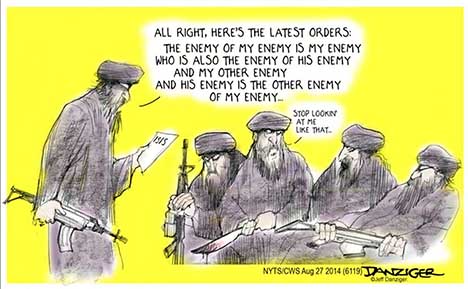
One political cartoon sums up the problem with both ISIS and the current crisis in Yemen…
One political cartoon sums up the problem with both ISIS and the current crisis in Yemen…
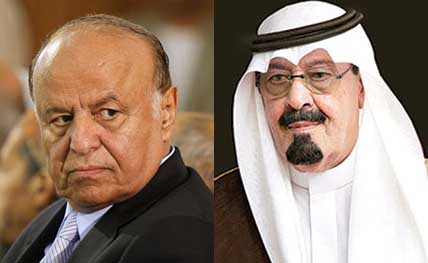
President Hadi of Yemen, left; King Abdullah of Saudi Arabia, right
In the space of 24 hours two countries on the Arabian Peninsula have seen a change, or at least anticipated change, in leadership. Yesterday President Hadi of Yemen, his Prime Minister Khaled Baha and the entire cabinet resigned after bowing to demands made by the Huthi leadership. The complicated political system ensures or at least suggests that he must remain in power for at least three months, although what power he actually has is severely limited. Not long after midnight King Abdullah of Saudi Arabia passed away at the estimated age of 90. The new Saudi monarch is Crown Prince Salman bin Abdulaziz Al Saud, who is 79, with Muqrin Bin Abdulaziz as the new crown prince. Given the fact that Sultan Qabus of Oman is in his mid 70s further change is possible as the years roll by. Qatar and the Emirates have relatively young rulers, so their stability does not appear to be in question.
Yemen is in free fall politically. The Huthis have taken control of most of the northern highlands and the capital city Sanaa, while they continue to battle local tribes in Marib and the Jawf. Hirak has, at least in spirit, seceded from the once-touted wahda. Al-Qaeda continues its attacks on Yemen’s military and the Huthis, while there are now reports that ISIS/ISIL is trying to muscle into Yemen as well. Hadramawt has also removed itself from any central authority. Only Socotra remains isolated from the potential for violence. This political quagmire is even murkier due to the behind-the-scenes (and at times quite overt) maneuvering of former President Ali Abdullah Salih, who remains a potent force and appears to have ambitions of regaining power. Yemen has no functioning government, the economy has ground to a halt, foreign aid from the Saudis has all but ceased and there are daily clashes that take the lives of ordinary Yemeni citizens. Yemen has not become another Iraq or Syria, but it is teetering on the brink. Continue reading Yet more change in Arabia
The Middle East-Asia Project (MAP) is an initiative undertaken by the Middle East Institute which is designed to serve two broad objectives:
1. To promote awareness and understanding of the multidimensional relations between the Middle East and Asia by providing information and analysis on cross-regional economic, political, security, and social/cultural interactions and their implications; and
2. To foster collaborative research and other activities regarding Middle East-Asia relations through establishing an online community of experts and forging institutional partnerships.
The Cyber Library contains publication details, abstracts and live links to full text versions of previously published works on Middle East-Asian affairs organized by country and by topic/issue.
The Experts Directory contains the profiles and contact details of a worldwide network of academics, business leaders, diplomats, journalists, researchers and other practitioners affiliated with the MAP.
The Infographics project element consists of periodically updated charts, tables and timelines depicting key trends and developments in trade, investment, migration, and other spheres of cross-regional activity.
The Publications element is organized as follows: Continue reading Middle East and Asia Project
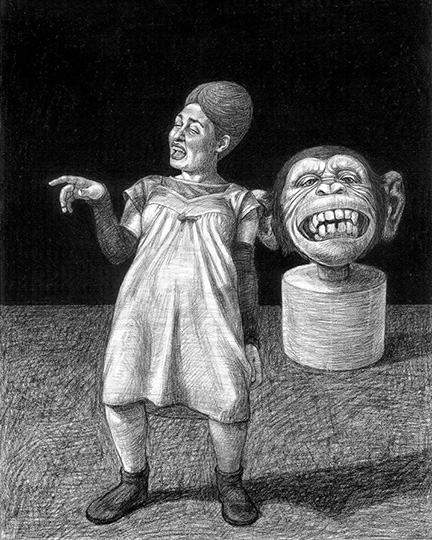
Check out the artwork of twenty-five year old Iranian artist, Maryam Sabbaghpour on Mouftah.
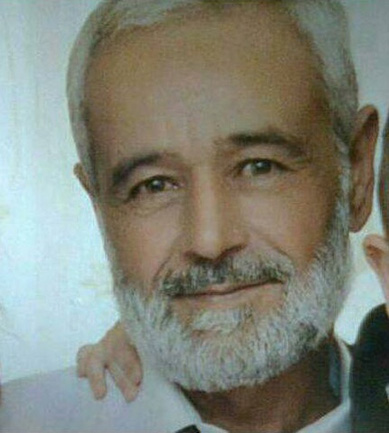
This is Ali Issa’s face. It deserves to become imprinted in our collective memory as a nation.
State of Mind, January 12, 2015
Two days ago, Tripoli got hit with death yet again as a terrorist attack took place in its Jabal Mohsen neighborhood.
The politics and intricacies of the attack are many, but there is one story of heroism springing out of the horror that took place on Saturday that no one is talking about. I figured I will, because this particular story about these kinds of people are the ones that make you see that faint silver lining in all the mayhem.
Many have wondered how come a café as crowded as the one attacked in Jabal Mohsen only amounted to less than 10 casualties. That’s because the suicide bombing attack didn’t go according to the two terrorists’ plans.
Among those was a brave, courageous, heroic man called Abou Ali Issa. He was a father of seven. When the first suicide bomber detonated himself, people started gathering at the site. Abou Ali Issa who wasn’t even at the café at the time rushed to the site to see what was happening. It was then that he saw the second suicide bomber approaching the premises to detonate himself and kill much more people than the first one did. The bomber shouted “Allahou Akbar.†Abou Ali Issa rushed at him and tackled him, preventing the bomber from reaching the café, killing the people inside. The bomber then detonated himself, killing them both.
He didn’t care about the sects of those in the cafe. He didn’t care if he was saving the lives of Sunnis, Shia, Alawites or Christians. Abou Ali Issa did not care about his own life as he was faced with a choice most of us would never face: save others or save yourself. He chose the former.
This man who saved hundreds of life will never become a viral sensation. His funeral was broadcast yesterday, along with that of the 7 other people that died with him, on a split-screen on Lebanese TVs, not even worthy of full screen treatment.
In a few days from now, no one will remember that there were two suicide bombers in Tripoli who targeted innocents, let alone the existence of a man who prevented those terrorists from doing so much more harm hadn’t he sacrificed his own life to save everyone else.
Today, there are hundreds of families in Tripoli and Jabal Mohsen who owe their wholeness to Abou Ali Issa. They owe him the presence of their fathers, mothers, brothers, and sisters. They owe him the sheer relief they felt when their loved ones came back home that day.
Abou Ali Issa’s family, his wife and seven children, did not get that same sense of relief and happiness. Their family will never be whole again, and justice for their father and husband will probably never come.
This is my attempt to make the memory of their father and husband that of a national hero, as it should be, as he is the kind of people who deserve to be paraded around as national symbols, as household names who should never be forgotten, because people like him are rare to come by and they should always be cherished and honored and respected.
May he rest in peace. There are fewer people deserving of such peace.
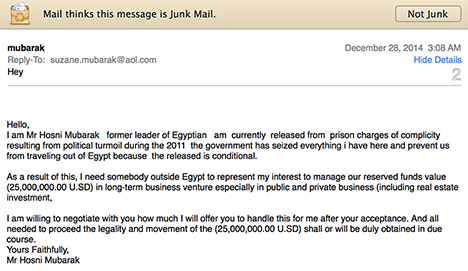
Dear Husni,
I had no idea you were so poor. Only 25 million stashed outside Egypt? What happened to all the millions you took in over the years? Was your wife like Imelda Marcos, buying way too many shoes? Of course I will be glad to help you get access to that money. After all, you stole it fair and square. And Sisi can siphon off as much as he wants, now that the Brothers are gone. I know how much you have suffered, so I will not charge you anything for helping you. Some of my best friends are Egyptian and I know they would help me if I ever needed someone to get 25 million out of the bank. By the way, your English has really improved. Did you take lessons in prison? Or did you use Google Translate? You did not mention which bank your funds are in. Someone told me it was in the same offshore bank as the savings of Mitt Romney, but I find that hard to believe. I am really honored that you chose me out of the millions of people getting spam emails to help you. I am sorry it has taken so long but your email went into my Junk folder. Can you imagine that. I am really glad I found it. Just send me you bank name, account number and password and I will sure do you justice.
Yours sincerely,
John Doe
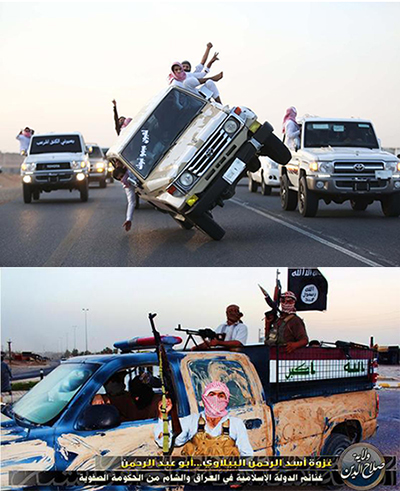
“It was the best of times, it was the worst of times, it was the age of wisdom, it was the age of foolishness, it was the epoch of belief, it was the epoch of incredulity, it was the season of Light, it was the season of Darkness, it was the spring of hope, it was the winter of despair, we had everything before us, we had nothing before us, we were all going direct to Heaven, we were all going direct the other way – in short, the period was so far like the present period, that some of its noisiest authorities insisted on its being received, for good or for evil, in the superlative degree of comparison only.”
So begins the classic Dickens novel, A Tale of Two Cities, written over a century and a half ago. The two cities in question were revolutionary Paris and Dickens’ own squalor-laden London. As fiction it was an unpacking of black-and-white, good and evil, wealth and poverty, kindness and cruelty. But as Dickens wryly noted from the start, such a period of stark contrast “was so far like the present” that it cried out for comparison. When I came across the two images juxtaposed above, the title of Dickens’ novel raced into my mind. What can one say about these two images, the iconic “American” image of the pick-up in the current political maelstrom that plagues the Middle East. What is this tale of two trucks?
So what do we see in both these images? Young men out for a thrill, one group actively seeking to kill. The top image reflects the top of the economic ladder, these young men of the UAE in a country that boasts a GDP (in 2012) of 383.80 billion dollars, representing .62% of the world’s economy. The rock-hard bottom is apparent in the bottom image of ISIS fighters. As for ISIS between Syria and Iraq, the GDP for Syria in 2012 was 73.67 billion dollars, while war-torn Iraq is elevated to 223 billion in 2013. God bless the hands that pump the oil. What would the region be without its black baraka? Continue reading A Tale of Two Trucks