Category Archives: Countries

Real Change from Interfaith Dialogue

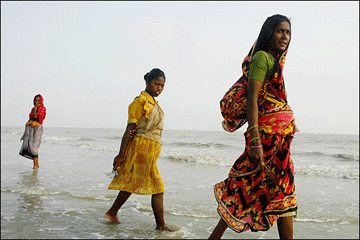
Muslim women search the beaches of Sagar Island for coins thrown into the waters of the Ganges by Hindu pilgrims. Heathcliff O’Malley/Telegraph Media Group © 2007

This morning’s news is predictable deja vu: another car bomb explodes in Iraq killing at least 20 people, the Taliban are poppying up again in Afghanistan, children are still starving in Darfur as their mothers get raped, Somalia is summarily consigned to old news since no new soldier bodies have been paraded in the streets. Page two… So much killing, so much religious faith spread around the ever warming globe, and seemingly so little dialogue for God’s children. But here’s a story from where the river bends, the Ganges of India that is, at the last bend it makes into the sea. Here is a river so holy to Hindus that it is viewed as alive, if not life itself, prompting both the devout and the just-following-the-nabob-mob to toss rupees into the polluted current. As Philip Reeves reports for NPR today, this all results in real change (if you dig hard enough in the sand) for a few of the poorest of India’s 150 million plus Muslims.
Continue reading Real Change from Interfaith Dialogue

Another Blow for the Horn of Africa

The news this morning after Christmas is more bad news, especially for the Horn of Africa. As if the Darfur debacle in Sudan is not bad enough, the civil war in Somalia has escalated beyond the borders. Yesterday Ethiopia dispatched a fighter plane to briefly strafe the international airport in Mogadishu. This was not exactly shock-and-awe, but then Mogadishu is not Baghdad and the self-styled “Islamists” in more-or-less control of the capital are not a trained and disciplined army.

Continue reading Another Blow for the Horn of Africa

Poetic Vengeance

The Critics
by Ceyhun Atuf Kansu (1919-78)

They know their English:
The Victorian Age,
Eliot schmeliot
Are complete on their shelves.

They know their French:
From its origins to the present
The grasshopper and the ant
From La Fontaine to our day.

I am not even mentioning
Those who know Italian or German
The erudite scholars
Those who did it the American way.

Continue reading Poetic Vengeance

Among the Earlier Ruins

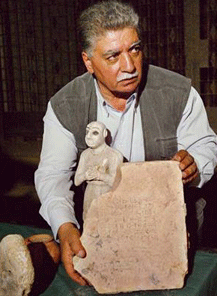
[Donny George at Iraqi exhibition of pre-Islamic antiquties.]

Muslims Need to be Sensitised to their Own Material Past
By Alastair Northedge, The Art Newspaper, November 2006

At the end of August, The Art Newspaper revealed the stunning news that Donny George, president of the State Board of Antiquities and Heritage in Iraq, had been forced to flee the country in fear of his life and take refuge in Damascus. In recent months, Dr George sealed up the treasures of the National Museum in Baghdad behind concrete walls, as it was too dangerous to leave them exposed. He was replaced by a relation of the Minister of Tourism, who comes from the party of Muqtada al-Sadr, the Shia cleric and leader of the resistance movement. Continue reading Among the Earlier Ruins

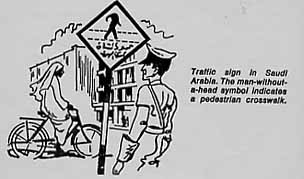
Headless in Saudi Arabia

[”Traffic sign in Saudi Arabia. The man-without-a-head symbol indicates a pedestrian sidewalk.”]

I recently came across a rather plebian junior high school level text on The Middle East: History, Culture, People (by Thomas G. Kavunedos and Harold E. Hammond, Bronxville, New York, Cambridge Book Company, Inc, 1968). The book is quite forgetable, but some of the illustrations bring you to a full stop. My favorite is the illustration above. If indeed this was once the sign for a crosswalk, no wonder everyone seems to drive Mercedes in the kingdom.

Daniel Martin Varisco

Alaa Al Aswany: Voice of Reason

This month’s National Geographic Magazine has an extended interview with the Egyptian author (and dentist) Alaa Al Aswany, whose recent Arabic novel, The Yacoubian Building, is a major bestseller.

“Just who is the Arab world listening to? Not only radical sheikhs and militant politicians. The man whose voice has captivated the Arab public is a Cairo dentist by day and a novelist by dawn. Alaa Al Aswany’s novel The Yacoubian Building is a phenomenon—the best-selling novel in the Middle East for two years and the inspiration for the biggest budget movie ever produced in Egypt. The novel paints a poignant and uncompromising picture of life in modern Cairo, as seen through the eyes of a carnival of characters—from the richest and most powerful to the poorest. An outspoken critic of the Mubarak regime and a friendly, self-effacing man, Dr. Al Aswany studied dentistry, and the American way of life, in the U.S. He has a humanist’s love of pondering what makes people do what they do.”

To read the interview online, click here.

Mel Brooks, Where are You?

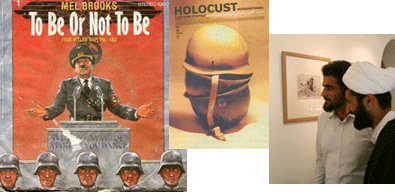
One of the top stories in today’s New York Times is called “Iran Exhibits Anti-Jewish Art.” This has all the media makings of another blown-out-of-proportion cartoonnami, especially since the exhibit was concocted by an Iranian newspaper (Hamshahri) in direct response to the Danish cartoons about Muhammad. Add to this the fact that more than 200 cartoons (of the 2000 plus submitted) are displayed in the Palestine Contemporary Art Museum in Tehran. So is this artistic tit for tat or just another op-ed tempest in a samovar? Continue reading Mel Brooks, Where are You?

Can’t Win for Losing


[”Cease Fire” by Samuel Bek]

Wars are never won until they can be relegated safely to the history books. The recent Israel/Hizballah flare up is no exception. The spin masters are at work with both the main proponents claiming victory. Since Israel for the time being maintains 30,000 soldiers in southern Lebanon, continues to dominate the sky and has not yet ceased its sea blockade of Lebanon, the winner should be obvious. With the deployment of UNIFIL and Lebanese troops to replace the IDF, the goal of stopping Hizballah military muscle would seem to be on target. But Israel’s latest reaction is the kind that the term “Pyrrhic victory” (closely following the Bush administration’s ill-conceived invasion of Iraq) seems destined to define. The Katusha rockets will no longer thud aimlessly into northern Israel, but then there were hardly any being shot before Israel invaded. Continue reading Can’t Win for Losing