Category Archives: Countries

A Taylor Made Bath in Damascus

The American man of letters Bayard Taylor (1825-1878) was one of many travelers to the Near East of his time. His tour in 1853 resulted in a travel account above the common lot of Holy Land roller overs. Of particular interest is his frank account of a Turkish bath in Damascus.

“The Bath is the ‘peculiar institution’ of the East. Coffee has become colonized in France and America; the Pipe is a cosmopolite, and his blue, joyous breath congeals under the Arctic Circle, or melts languidly into the soft airs of the Polynesian Isles; but the Bath, that sensuous elysium which cradled the dreams of Plato, and the visions of Zoroaster, and the solemn meditations of Mahomet, is only to be found under an Oriental sky. The naked natives of the Torrid Zone are amphibious; they do not bathe, they live in the water. The European and Anglo-American wash themselves and think they have bathed; they shudder under cold showers and perform laborious antics with coarse towels. As for the Hydropathist, the Genius of the Bath, whose dwelling is in Damascus, would be convulsed with scornful laughter, could he behold that aqueous Diogenes sitting in his tub, or stretched out in his wet wrappings, like a sodden mummy, in a catacomb of blankets and feather beds. As the rose in the East has a rarer perfume than in other lands, so does the Bath bestow a superior purification and impart a more profound enjoyment… Continue reading A Taylor Made Bath in Damascus
Faces of the Fallen

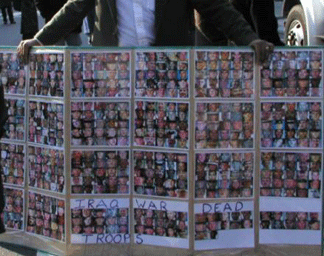
While Congress debates target dates for withdrawal and President Bush wields his veto bravado, the casualties from a no-longer-admired, quagmired war in Iraq continue to mount. For Operation Iraqi Freedom 3,345 American military personnel have lost their lives; for Operation Enduring Freedom in Afghanistan the number is a far more modest 381, yielding a total of 3,726 total fatalities overall. Then there are the Iraqi civilians and insurgents who have died, usually in bloody and terror-damned ways, reaching between 63,000 and 69,000 according to Iraq Body Count, but with estimates well above 100,000. Figures for Afghanistan are harder to come by. The initial bombing campaign four years ago took an estimated 3000-3400 civilian lives, with more every passing year. The sheer numbers, although not catastrophic when compared to big bloody wars of the past, are still numbing. But listing names is the easy way out; looking at the faces of the fallen takes more courage. Continue reading Faces of the Fallen

In and Out of Aden

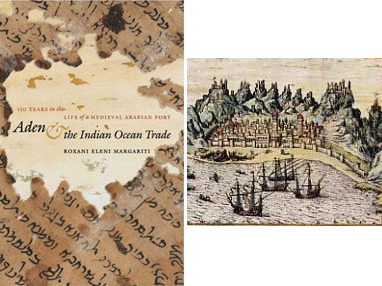
[The following is an excerpt from a recently published historical analysis of the Yemeni port of Aden in the 13th and 14th centuries by Roxani Margariti (Emory University), who reconstructs port life vividly through archival records in the Cairo Genizeh, relevant Arabic texts and archaeological research. This is a fascinating look at one of the most important medieval ports in the Red Sea/Indian Ocean trading network that ultimately linked Europe with the Far East before Portuguese galleons changed the complex equation of global trade.]

by Roxani Eleni Margariti

In the current era of giant container ships, GPS, and e-commerce, a single vessel can carry forty-eight hundred trailer-sized containers of merchandize from Bremen, Germany, to Elizabeth, New Jersey, in a single voyage. The exact position of a ship is knowable at the push of a button and the blink of any eye, and one can place an order one minute and have confirmation of its receipt in the next. It is therefore difficult to grasp the medieval dimensions of dimensions and time. A respectably sized medieval Arab ship held the equivalent of about two trailer-sized containers. Continue reading In and Out of Aden

An Iraqi Rhapsody

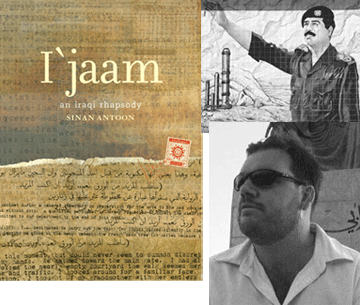
[The following is an excerpt from Sinan Antoon’s recently published translation of his earlier Arabic novel about life in Saddam’s Iraq.]

Two clouds kissed silently in the Baghdad sky. I watched them flee westward, perhaps out of shyness, leaving me alone on the bench beneath the French palm tree (so called because it stood in the courtyard in front of the French department) to wait for Areej. I looked for something worth reading in that morning’s al-Jumhuriyya, and found a good translation of a Neruda poem in the culture section, besieged [beside?] on all sides by doggerel barking praises of the Party and the Revolution. The breeze nudged the palm fronds above my head to applaud. It was April, “the month of fecundity, the birth of the Ba’th and the Leader,” as one of the posters on the college walls announced. Continue reading An Iraqi Rhapsody

Delta Farce: Jihad in Somalia?


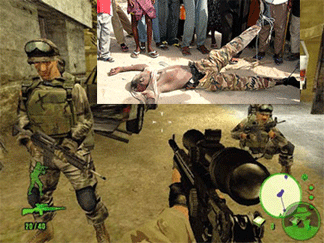
[Illustration: Delta Force video game; insert, Somali soldier killed in heavy fighting in Mogadishu is dragged through the city’s streets in late March. Photograph: Mustafa Abdi/AFP/Getty]

The impoverished East African country of Somalia is continually in the news. Minority Rights Group (MRG) International announced a month ago that Somalia is now the least safe country in the world for minorities, edging out Iraq and Sudan for this dubious distinction. Nor can it be said that Somalia is safe for majorities, given its recent, bloody history. In the past month more than 1,000 people have died, rivaling the surging toll in Iraq.

In 1993, a decade before Saddam Hussein’s Iraq was shocked and awed into anarchic free fall, a team of U.S. commandos parachuted into Mogadishu, the capital of this strife-torn East African country. Two Blackhawk helicopters were downed and the warlord escaped. Hollywood’s cinematic version hit the screen eight years later with the same bad ending. Then came the video game, Delta Force Black Hawk Down. Now a savvy teenager, armed with cheats, could rewrite history and let the good guys win. But in Somalia today it is hard to figure out just who the good guys are. Continue reading Delta Farce: Jihad in Somalia?

The Book Of Death #28


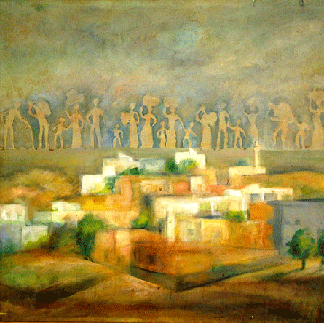
[Illustration: “Refugees” by Palestinian artisit Ibrahim Hijazy, 1996.]

by George El-Hage

Today, the seventh day of the month of Death, I decided to end our relationship. I decided to pack my suitcase and leave. Everything in our spring-like room I left for you: the velvet drapes, old books, notebooks of memories and red roses. All the silk pillows, and the ivory chairs, and the chandelier of carnations, the big bed in the other corner of the room remain for you. I took with me one bleeding suitcase which is my heart. It was so filled with surprise and sorrow that I did not have room for one little pencil. I left empty-handed except for an armful of ashes. I held dejection to my breast, the harvest of a full year of love. I embraced it with anguish and washed its forehead with dew from my eyes. Continue reading The Book Of Death #28

“when I asked him what a Moslem was”

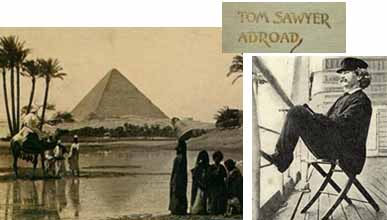
According to all three major monotheisms even God needed time to take a rest and so the sabbath was created. With the spate of mosque bombings, torture of prisoners and outright mayhem dominating the news about the Middle East these days, it might help to sit back and read what the American humorist Mark Twain wrote about his Missouri-born creation Tom Sawyer set loose in the Holy Land more than a century ago. Continue reading “when I asked him what a Moslem was”