Category Archives: Countries

Fat Chance Fatwas

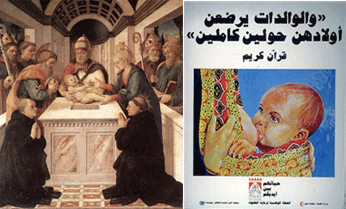
Breastmilk and urine: two unlikely bodily fluids to be news fit to print in the New York Times. But an article by Michael Slackman in Tuesday’s edition pours it on, the kind of hook that tabloids feed on, and then it gets milked for less than it is worth. Here is the hook at the front:

First came the breast-feeding fatwa. It declared that the Islamic restriction on unmarried men and women being together could be lifted at work if the woman breast-fed her male colleagues five times, to establish family ties. Then came the urine fatwa. It said that drinking the urine of the Prophet Muhammad was deemed a blessing.

For the past few weeks, the breast-feeding and urine fatwas have proved a source of national embarrassment in Egypt, not least because they were issued by representatives of the highest religious authorities in the land.

Continue reading Fat Chance Fatwas

The Butler Did it in Hebron

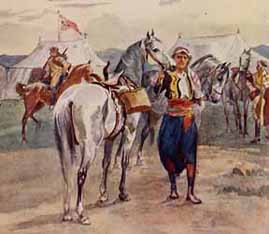
In the late 1890s a certain Elizabeth Butler, accompanying her British military husband, made one of those Protestant-style visits to Anglican nirvana, the Holy Land made somewhat less holy for her at the time by Ottoman Turkish troops. “The time of year chosen by my husband for our visit was one in which no religious festivals were being celebrated, so that we should be spared the sight of that distressing warring of creeds that one regrets at Jerusalem more than anywhere else,” she notes in the preface to her Letters from the Holy Land. Better to go in the off season, it seems, than face the reality of the individual Palestinian Arabs and Jews cluttering the biblical landscape. Her letters, written to her mother “lay no claim to literary worth,” as she humbly and astutely admits. The chief value of the work is, in her own ranking, her 16 color sketches, mostly pastoral pastiche, with the exception of an anonymous Arab attendant, shown here. Continue reading The Butler Did it in Hebron

Always a Kurd

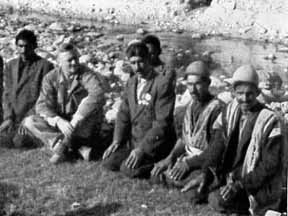
In his post-World War II visit to the Kurdish highlands of Iran, Justice William O. Douglas was clearly thrilled by the resilience of his hosts in the face of threatened Soviet dominance. His comments on the Kurds here are worth remembering more than half a century of political change later:

I learned three things from my visit among the Kurds. ‘First’: Kurdish nationalism is in the marrow of these tribesmen – deeper than any creed or dogma. They want a state of their own, one in which they have a degree of self-government. But their basic loyalty is to Persia. There it will remain. They have pride in the tradition that they are Medes. They have pride in their historic role – border patrol. Neither their misery and poverty nor Communist propaganda have altered those articles of their faith. Continue reading Always a Kurd

Wavell in Arabia: Face to Face with a Pasha


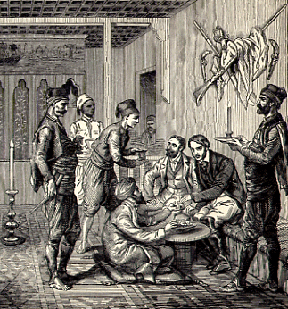
[Illustration, Guests in Turkey, from John Clark Ridpath, Ridpath’s History of the World (Cincinnati: The Jones Brothers Publishing Company, 1899), vol IV.]

[Note: Arthur John Byng Wavell (1882-1916) was a British soldier and adventurer who traveled in disguise to Mecca in 1908 and went on to Yemen in 1911 to witness fighting between the Zaydi imam’s troops and the Ottoman Turks. This account was originally published in 1912.]

The hour was late and the smoking room almost deserted when the conversation about to be reported took place. My companion the Pasha was a tall, heavy man, on whose sunburned and lined countenance a long life in the open air and many hard-fought campaigns in tropical countries had left their traces. He had been a field marshal once, but that was in the days of Abdul Hamid, when as some one said after the American civil war, “you could not spit out the window without hitting a major-general.” It was to this latter rank that the reshuffle which followed hard on the constitution had reduced him… Continue reading Wavell in Arabia: Face to Face with a Pasha

A Dialogue With Allah


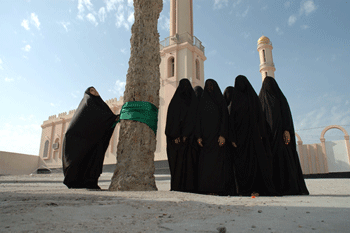
Figure 1: Mosque, women and palm tree.

By el-Sayed el-Aswad

Folk culture provides members of the society with living models in the form of iconic images, key symbols, and root metaphors that enable them to express themselves, and the other as well. Sanctity or religious meaning is bestowed on an object or place for the reason that a religiously significant event (a miracle, wonder or blessing) is associated with it.

At an art exhibition at the College of Art, Bahrain University last year, 2006, I was surprised to see very beautiful and stunning pictures in which a group of women were climbing palm trees (figure 2-5). Recognizing the cultural significance of the palm tree in Arab societies, I decided to interview Waheeda Malullah (figure 6), the artist whose photos show that the climbing of palm trees is not just aimed at the collection of dates commonly consumed in the Arab Gulf countries, but rather at the engagement in spiritual communication with invisible spheres of the cosmos and the achievement of blessing or grace (baraka), among other objectives. Continue reading A Dialogue With Allah

Six Biblical Days of War

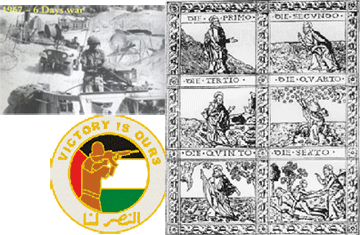
Quick, here’s a trivia question. How long did it take God to create the world, according to the book of Genesis? Six days, of course. If you miss this one, you may have been brought up in the backwaters of the Amazon, although it would not be the fault of Christian missionary translators who have tried to undo God’s rash Babeling of tongues to get the Bible into every known tongue. But what’s a day? Before the scientific revolution sealed by Darwin, the ordinary 24-hour variety day posed few problems for the devout. Once it seemed that the world must be older than Bishop Ussher’s supposed official date of 9 AM on October 23, 4004 BC, seeds of doubt grew into Enlightenment-nurtured forests. But is nothing sacred? it turns out that poor Bishop Ussher never ordained that God slept in late on Day One; the distinction of 9 AM goes to a certain Dr. John Lightfoot. But there’s still the problem of how to define a day, especially in a creation scenario in which the creation of light precedes the sun, moon and stars. Theologians in retreat (as distinguished from those who remained, and still do so, in denial) resorted to a semantic salvation of the scriptural record, arguing that with God a day is the same as a thousand years.

Tomorrow, June 5, is the 40th anniversary of a modern event on Holy Land soil of biblical proportions: the Six-Day War of 1967 in which Israel expanded its borders, took total control of Jerusalem and embroiled the region in the plight of the Palestinians. It only took six days for the overmatched armies of Egypt, Jordan and Syria to be effectively eliminated and since that war there has been little doubt that Israel as Zionist-revived David to a disorganized Arab Goliath lies only in myth. Only six days, but how long is a day? Continue reading Six Biblical Days of War

The Forbidden Fruit of the Iraq War

War is mainly a man’s game. Men like Osama Bin Laden send men like Muhammad Atta to bomb a New York building. Men like George Bush and Tony Blair react like, well like men, and take it out on men like Mullah Omar and Saddam Hussein by sending young men to dodge bullets and iuds in a real video-game scenario. Men like Nouri al-Maliki are purple-fingered into a Green Zone political club so that mostly men can wear uniforms or hide bombs in order to kill other men, as well as women and children. Even a pacifist like Jesus predicted no end to war and rumors of war.

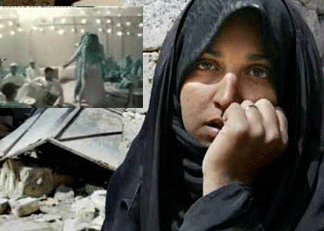
Everyone, not just men, suffers in the manly game of war. But while some men think it honorable to kill others, the burden of war probably hits women harder than anyone else. Suicide bombs are as likely to tear apart female bodies as male bodies, as able to cut short the life of a child as trump the survival of the elderly. In Iraq we see the blood smears that mark death and hear the mourning that haunts the grieving of the left behind. But beyond the battlefield and the car-blown open markets the exercise of war bears more fruit, one that harks back to the forbidden fruit in the innocence of Eden. Continue reading The Forbidden Fruit of the Iraq War

A Quiet Revolution in Algeria?


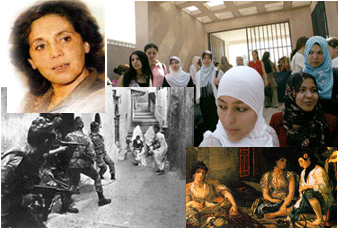
[left to right: Djamila Bourhiredf; Women waiting for bus at University of Algiers, photo by Shawn Baldwin for The New York Times; scene from “The Battle of Algiers”; “Algerian Women in Their Apartments” by Eugene Delacroix, 1834

One of the lead articles in yesterday’s New York Times was titled “A Quiet Revolution in Algeria: Gains by Women” by Michael Slackman. Revolutions, no matter where they erupt, tend to be noisy, even when they are not successful. The French stormed the Bastille; America had its Boston Tea Party; the Russians knocked off the Czar and his family. The Algerian Revolution, which took eight years from 1954-1962, claimed an estimated one to one-and-a-half million lives, not to mention the French military casualties of some 18,000. In the past decade or so more than 100,000 Algerians have died as a direct result of partisan extremist religious fighting. So if Algeria is now having a quiet revolution, where did all the noise go? Continue reading A Quiet Revolution in Algeria?