Category Archives: Countries

The Land and the Book #2: Smoke on the Water


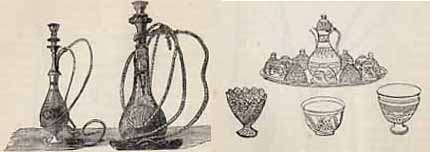
Water Pipes, left; coffee set, right; from Thomson’s “The Land and the Book”

The rustic American style pilgrim’s progress of Rev. William M. Thomson in the 1830s through the 1850s in Palestine was not just about places where the locals swore that Abraham bought a cave or Jesus preached. There were real people along the way and Thomson takes the reader inside a diwan from time to time. In one of his accounts he would be in good company with legislators who ban smoking in public places. Although cigarettes were just taking off in popularity, the traditional approach to tobacco in Syria and Palestine was smoke on the water to be followed by Turkish coffee. Let’s return a century and a half to this precursor of the modern sheesha bar. Continue reading The Land and the Book #2: Smoke on the Water

The Problem with ‘My Problem with Jimmy Carter’s Book’

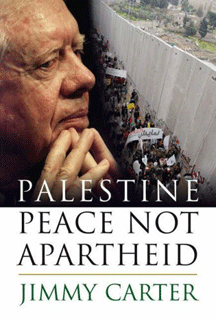
Middle East Quarterly, published by Daniel Pipes’ organization Middle East Forum, contains an article titled “My Problem with Jimmy Carter’s Book”, by Kenneth Stein, the first executive director of the Carter Center in Atlanta from 1983 to 1986, and currently a professor of Contemporary Middle Eastern History at Emory University. Stein, it will be remembered, resigned from his affiliation with the Carter Center, where he was a Middle East Fellow for over two decades, in protest over former President Jimmy Carter’s book, Palestine: Peace Not Apartheid. Touring the country explaining his objections to his former boss’s perspective on the Israeli Palestinian conflict, Stein has refrained from tarring Carter with the label “Jew-hater” (this from the ever-subtle David Horowitz), or claiming that Carter’s criticisms of Israeli policy stem from Carter having “enriched[ed] himself with dirty money”–dirty Arab oil money, specifically–from Shaykh Zayed bin Sultan al-Nahyan of the United Arab Emirates, “an unredeemable anti-Semite and all-around bigot” (this from the extraordinary Alan Dershowitz in an article) It should be noted, since Dershowitz does not, that much of the alleged dirty money that flowed through the Carter Center would have supported—and in the early years, been managed and disbursed by–Professor Stein. Continue reading The Problem with ‘My Problem with Jimmy Carter’s Book’

The Land and the Book #1: Looking for an Omnibus?


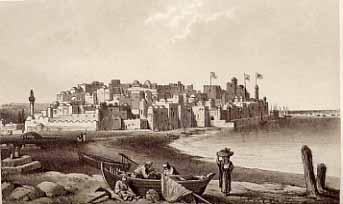
Jaffa from Thomson’s “The Land and the Book”

Almost 150 years ago one of the most popular travel accounts of the Holy Land was penned by an American missionary named William M. Thomson. Born in Ohio, my own home state, the 28-year old Thomson and his young bride arrived in Lebanon in 1834 as Protestant missionaries. This was a mere 15 or so years after the first American missionaries had made the Holy Land a mission field. At once an entertaining travel account and Sunday School commentary on the places and people of the Bible, this may have been one the most widely read books ever written by a Protestant missionary.

Reading Thomson is like reading one of the early English novels. The language is less familiar, although still thoroughly Yankee and the devotional tone has long since disappeared for a readership buying out The Da Vinci Code as soon as it hit the bookstores. The biblical exegesis, literalist yet frankly pragmatic at times, is intertwined with astute and at times humorous accounts of the people Thomson met along the way. But the style is not at all dry or discouragingly didactic. From the start Thomson engages in a dialogue with the reader, making the text (which stretches over 700 pages in the 1901 version) a rhetorical trip in itself.

Here is one of the forgotten books of a couple generations back. Easily dismissed as an Orientalist book, in the sense propounded and confounded by Edward Said, it is nevertheless a very good read. With this post I begin a series to sample the anecdotes and local color presented by Rev. Thomson. The times have indeed changed, but such textual forays into the night reading of a previous generation of Americans are well worth the effort. Let’s begin with the author’s own invitation. Continue reading The Land and the Book #1: Looking for an Omnibus?

Letter to a Country with No Frontier

by George El-Hage

[Note: This is a translation from the Arabic, which is available in pdf by clicking here.]

Stand up! Get up!

Carry your bed and follow me.

Let’s leave this ungrateful land

This land…

That savors the decaying cadavers of its sons

A land satiated by the blood of its children.

Let’s leave these poor people

Defeated, fragmented

Knowing nothing but selfishness,

Servicing foreigners,

And worshipping the hollow love of prestige. Continue reading Letter to a Country with No Frontier

Mahdi as Hell: Look out Darwin

Has your atlas arrived yet? The New York Times reported yesterday that prominent American scientists and politicians are receiving what purports to be an “Atlas of Creation” from a Turkish media guru self-named Harun Yahya. No, it is not revenge for the “War on Terror.” Nor is a glossy book of patent nonsense, no matter how intelligently designed and styled as “probably the largest and most beautiful creationist challenge yet to Darwin’s theory” much of a challenge. Scientists will recognize it for a “load of crap,” as Kevin Padian, an evolutionary biologist at the University of California, Berkeley, impolitely phrased it.

The “War on Terror” has manufactured a whole host of new enemies. But what a strange bedfellow is Charles Darwin, who liberated science from the dogmatic demands of religious apologists like Mahdi Yahya a century and a half ago. Darwin’s approach now summarizes all of modern science, a steady advance in knowledge because no specific idea is ever held sacred. This does not mean that scientists must abandon religion and faith, but it does offer a view of the world in which human reason is not abandoned under the cloak and rhetorical dagger of a supposedly spiritual quest for moral behavior. Continue reading Mahdi as Hell: Look out Darwin

Water rather than Whining


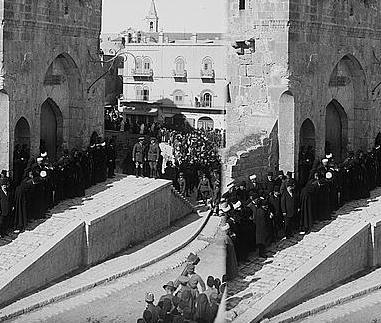
[“…I entered the city officially at noon, “December 11th”, with a few of my staff, the commanders of the French and Italian detachments, the heads of the political missions, and the Military Attaches of France, Italy, and America. The procession was all afoot, and at Jaffa gate I was received by the guards representing England, Scotland, Ireland, Wales, Australia, New Zealand, India, France, and Italy. The population received me well…” (General Allenby in Source Records of the Great War, Vol. V, ed. Charles F. Horne, National Alumni 1923)]

[Note: Almost 90 years ago, on December 9, 1917, General Allenby marched into Jerusalem to accept the surrender of the city by Ottoman Turkish officials. But unlike the current debacle in Iraq, where liberation has not been followed up by tangible development, it was the ability of British engineers to provide clean drinking water that helped smooth the transition from Ottoman rule to a mandate, ultimately as unclean and messy as it would become. It is worth reading the following excerpt by W. T. Massey, not only for strategic advice on how to win over a conquered populace, but also for a prime example of the journalistic ethnocentrism in which the West provides a “civilising hand” to the poor Oriental.]

THE TOUCH OF THE CIVILISING HAND
by W. T. Massey (1919)

It is doubtful whether the population of any city within the zones of
war profited so much at the hands of the conqueror as Jerusalem. In
a little more than half a year a wondrous change was effected in the
condition of the people, and if it had been possible to search the
Oriental mind and to get a free and frank expression of opinion,
one would probably have found a universal thankfulness for General
Allenby’s deliverance of the Holy City from the hands of the Turks.
And with good reason. The scourge of war so far as the British Army
was concerned left Jerusalem the Golden untouched. For the 50,000
people in the City the skilfully applied military pressure which
put an end to Turkish misgovernment was the beginning of an era
of happiness and contentment of which they had hitherto had no
conception. Justice was administered in accordance with British
ideals, every man enjoyed the profits of his industry, traders no
longer ran the gauntlet of extortionate officials, the old time corruption was a thing of the past, public health was organised as far as it could be on Western lines, and though in matters of sanitation and personal cleanliness the inhabitants still had much to learn, the appearance of the Holy City and its population vastly improved under
the touch of a civilising hand. Sights that offended more than one of
the senses on the day when General Allenby made his official entry had
disappeared, and peace and order reigned where previously had been but misery, poverty, disease, and squalor. Continue reading Water rather than Whining

Traveling Light in Arabia

[Note: the following list of items for light camping in Arabia is provided by G. Wyman Bury for the early part of the 20th century.]

CAMP EQUIPMENT
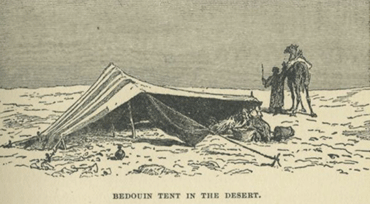
Try to do without a tent. Arabs hate pitching tents after a long day’s march, and seldom pitch them well. They draw fire and afford no protection, while preventing your own observation; they also betray the site of your camp to bad characters and casual callers on the look out for supper.

BEDDING
Avoid Wolseley valises or anything with pleats and folds, which become the permanent abiding places of parasitic insects.
‘Blankets.’ One each for the men. A few extra for convalescents or invalided men. Two for yourself.
‘Pillows.’ Carry your spare clothes in a green canvas sack. Continue reading Traveling Light in Arabia

The Wind and the Whirlwind


Wilfrid Scawen Blunt on Pharaoh, drawn by Lady Anne Blunt

[Note: The following poem was written by Blunt in response to the British occupation of Egypt in the late 19th century, but its words are apt for the present occupation of Iraq and Afghanistan today.]

by Wilfrid Scawen Blunt

I have a thing to say. But how to say it?
I have a cause to plead. But to what ears?
How shall I move a world by lamentation,
A world which heeded not a Nation’s tears?

How shall I speak of justice to the aggressors,
Of right to Kings whose rights include all wrong,
Of truth to Statecraft, true but in deceiving,
Of peace to Prelates, pity to the Strong?

Where shall I find a hearing? In high places?
The voice of havock drowns the voice of good.
On the throne’s steps? The elders of the nation
Rise in their ranks and call aloud for blood. Continue reading The Wind and the Whirlwind