Category Archives: Countries

Image Wars and Westernization

[On the sixth anniversary of the September 11 tragedy, it is worthwhile revisiting comments made soon after the event. The following is an excerpt from a commentary by Michael Sells, reflecting on events before Afghanistan was invaded and Iraq was occupied. His full reflections are available by clicking here.]

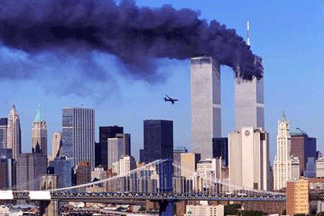
I’m been giving talks on the various components behind the current situation. Today’s rumination is sparked by an 8th grader question at a forum I was giving: “why can’t we find Bin Laden if he’s always on TV.” The question knocked me out. The 8th grader had hit upon a core problem.

Bin Laden is a guy living with the Taliban who have banned all images (except for identity card photos), blown up ancient Buddha’s, but who invite Western camera crews in to make videos of them themselves smashing TV’s, tearing up video and audio cassette film, and stomping on photographs. At the same time they encourage Bin Laden to make regular videos of himself to be shown throughout the world on a regular basis. And they invite Western media in to photography and image both Bin Laden and their ritual destruction of images and media. Continue reading Image Wars and Westernization
The Letters of Badr Shakir al-Sayyab: #3


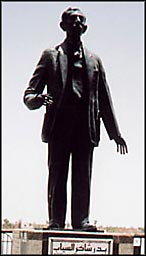
[Statue of Badr Shakir al-Sayyab in Basra, Iraq.]

[Note: This is the third in a series of translations of selected letters of the noted Iraqi poet Badr Shakir al-Sayyab. Click here for #1 and click here for #2.]

Letter #3 (5/7/1947)

My Dear Brother, Saleh, (Jawad al-Tu’mah)

As I write to you, I am suffering from the most difficult and severe physical condition, but I feel that loneliness weighs more heavily on me than illness itself. I have waited a very long time for the arrival of a letter from you. You said that you would begin writing… but I forgive you because I can surmise why you have forgotten or have become oblivious to the fact that there is a lonely person out there whose sorrows would be alleviated by your letter. It is spring, and not only flowers blossom in spring, but hearts and souls as well. Perhaps the decadent spring has stretched its tender fingers to your heart, tickling it and awakening it to love or perhaps the approach of final examinations has distracted you from everything except studying and being diligent. Continue reading The Letters of Badr Shakir al-Sayyab: #3

The Land and the Book #3: Under the Cedars of Lebanon

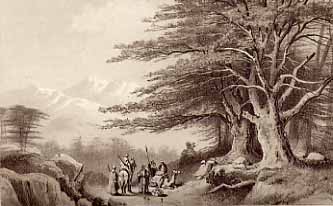
The Land and the Book by William Thomson revels in the open countryside, where the author would have the pilgrim join in under the stars, especially when the bed is stretched out in a grove of cedars on Mt. Lebanon. Here is the missionary’s description of the magic of the cedars over 150 years ago.

Have you ever visited these cedars?

Many times. They are situated high up on the western slope of Lebanon, ten hours south-east from Tripoli. Besherrah is directly west, in the romantic gorge of the Khadusha, two thousand feet below them, and Ehden is three hours distant on the road to Tripoli. In no other part of Syria are the mountains so Alpine, the proportions so gigantic, the ravines so profound and awful. You must not leave the country without visiting the cedars. Continue reading The Land and the Book #3: Under the Cedars of Lebanon

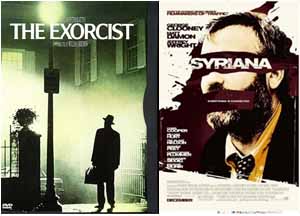
Pazuzu, Inc.: On the Movie Syriana

By Gregory Starrett
UNC Charlotte

“Now, the characteristic feature of mythical thought. . .is that it builds up structured sets. . .by using the remains and debris of events. . . .Mythical thought for its part is imprisoned in the events and experiences which it never tires of ordering and re-ordering in its search to find them a meaning.”
Claude Levi-Strauss, The Savage Mind

In a previous post, Desiree Marshall faulted director Thomas Gaghan’s recent movie Syriana, implying that a combination of bias and ignorance spoiled what might otherwise have been a useful exploration of identity and politics in the Middle East. While her misgivings are likely shared by others, she and most of the film’s other reviewers have missed its point entirely. Syriana is not at all “about” the Middle East except in the sense that it uses the debris of current events to reveal larger truths and tell much older stories. In fact, Syriana is what French anthropologist Claude Levi-Strauss would recognize as a structural transformation of another tale: director William Friedkin’s 1973 screen version of novelist William Peter Blatty’s The Exorcist. The two films are variants of the same myth. Continue reading Pazuzu, Inc.: On the Movie Syriana

This Should Make You Quake


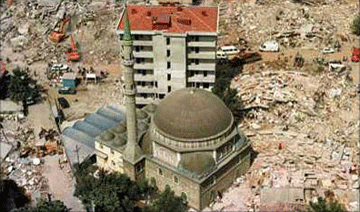
[A mosque still stands amidst the rubble of collapsed buildings in this aerial view of a neighborhood in the western Turkish town of Golcuk, 60 miles east of Istanbul, August 19, 1999.]

The recent earthquake in Peru, although not resulting in massive deaths, still has fallout which is more than nuclear. Turkey, Iran and Pakistan routinely have severe earthquakes, often resulting in the deaths of thousands. By an accident of sacred history, most of these victims are Muslim. In a number of ways these tragic events could be could be styled “an act of God.” To an insurance agent this would merely mean that it was one of those natural events which happen from time to time and are not covered in a standard policy. To Evangelical Christians, at least those who read KJV biblical prophecy as a Fox News documentary, it can easily become a special kind of act of God, not unlike the fire and brimstone that destroyed the wicked lot of Sodom and Gomorrah. But apocalyptic rhetor can boomerang, especially when the walls do not come tumbling down at the blasting away of the self-righteous. Continue reading This Should Make You Quake

Egyptian Cosmology and the Grand Canyon


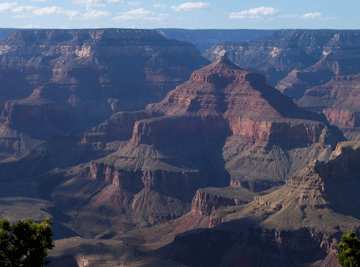
[Isis Temple of the Grand Canyon]

In mid August, this year, I traveled to the Grand Canyon in Arizona. I was stunned by the views of spectacular buttes and rises, some of which are named after Egyptian gods, goddesses and kings such as “Isis,” “Osiris,” “Horus,” “Set” and “Cheops” (the Pharaoh who built the Great Pyramid of Egypt). This exposure triggered substantial questions concerning the relationship between ancient Egyptian culture and Native Americans inhabiting the Grand Canyon recognizing that anthropological and historical studies of archaic cosmologies of ancient societies are still open for further development. I found a very interesting article on the subject of “Ancient Egyptian Treasures in the Grand Canyon: Suppressed Archeological Information and Metaphysical Paradox?” written by Barry McEwen in which he refers to an article written by David Hatcher Childress who reveals deep concern about the Smithsonian Institution cover up of important findings of G.E. Kinkaid and Professor S.A. Jordan. To quote Childress, “Perhaps the most amazing suppression of all is the excavation of an Egyptian tomb by the Smithsonian itself in Arizona. A lengthy front page story of the PHOENIX GAZETTE on 5 April 1909… gave a highly detailed report of the discovery and excavation of a rock-cut vault by an expedition led by a Professor S. A. Jordan of the Smithsonian. The Smithsonian, however, claims to have absolutely no knowledge of the discovery or its discoverers.” Continue reading Egyptian Cosmology and the Grand Canyon

A New Old Damascus

by Christa Salamandra
Lehman College, CUNY

If you enter the Old City of Damascus at Bab Sharqi (the Eastern Gate), walk a few yards along a Street Called Straight, and turn down the first narrow alley on your right, you will find, jutting out from among the inward-looking Arab-style houses of this quiet residential quarter, a sign advertising “Le Piano Bar.” Enter through the carved wooden door, walk along the tile-covered foyer, under the songbird’s cage, past a display case strung with chunky silver necklaces, and step up a stone platform to the raised dining room. Here well-heeled Syrians sit at closely spaced tables, drinking arak and Black Label whiskey, and eating grilled chicken or spaghetti. The walls around are decorated, each in a different style. One features a collection of Dutch porcelain plates set into plaster. In another, strips of colored marble hold a series of mosaic-lined, glass-covered displays of wind instruments. A third wall features two floral wrought-iron gated windows draped in a locally produced striped fabric. Wrought-iron musical notes dance on the last. At the from of the long, arch-divided room is a huge mother-of-pearl-framed mirror. Set into the top of the mirror is a digital billboard across which Le Piano Bar’s menu and opening hours float repeatedly. Patrons listen politely as the proprieter sings “My Way” and other Frank Sinatra favorites to a karaoke backing tape. When he finishes, video screens tucked into corners feature Elton John song sing-alongs. Some nights a pianist and clarinetist play Russian songs as patrons clack wooden catanets. Continue reading A New Old Damascus

Revenue Sharing, but not Drug-free


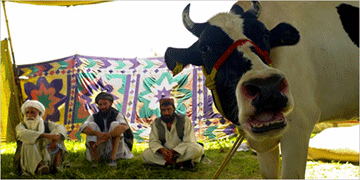
[The American plan to convince Afghan farmers not to grow poppies: some good old cow dung smothered in politically expedient B.S. Photo from the New York Times.]

In the old days (before 9/11, the posters for Osama dead or alive, the seeming fall of the Taliban, Operation Shock and Awe, etc.) before terrorism merited an all-out war, there were more socially-minded wars on the American political scene. An earlier Texan (so early he was Democratic) named Lyndon Johnson started a War on Poverty. The wealth of Bill Gates shows how well that succeeded. Then Betty Ford helped launch a War on Drugs. Casualty figures for this have been withheld by the government for insecurity reasons. Indeed, today’s New York Times has an article that suggests the War on Drugs has fused with the War on Terrorism and we are losing on both fronts. “Afghanistan produced record levels of opium in 2007 for the second straight year, led by a staggering 45 percent increase in the Taliban stronghold of Helmand Province, according to a new United Nations survey to be released Monday.” writes David Rohde in his article “Taliban Raise Poppy Production to a Record Again.” He adds, “Here in Helmand, the breadth of the poppy trade is staggering. A sparsely populated desert province twice the size of Maryland, Helmand produces more narcotics than any country on earth, including Myanmar, Morocco and Colombia. Rampant poverty, corruption among local officials, a Taliban resurgence and spreading lawlessness have turned the province into a narcotics juggernaut.” Continue reading Revenue Sharing, but not Drug-free