Category Archives: Countries

Blackwater vs. Backwater

“All the News That’s fit to Print.” This is the masthead mantra of The New York Times, one of America’s most important and best funded newspapers. For college professors like myself, it is the paper of choice, if it must be a paper. Long Island’s Newsday is local and closer to Little League than Big League for this Yankees fan; as a periodical Newsday is a great source for buying used cars and finding the nearest cinema. I avoid The Post, except to fill in the chortle gap now left by the demise of once super-marketed Weekly Wierdo News (or whatever…). I also listen to PBS, which all things considered actually tries to grapple with issues rather than just sensationalize how far a baby can fall from a window and still survive. But, my comments today are not really about a particular news outlet. Liberal or conservative is not the issue; a gut reading reaction is. I start with the premise that news media are all in the same boat, sinking in cyberspace apart from the Times Elite crowd and its pay-for-view ilk, which is steaming over an ocean of ignorance on one fuel: profit. It may still be possible to try to limit news items to what is “fit to print”, but most of us have a fit with a lot of what does get printed across the spectrum of right, left, up and down.

It is the choice of fit in today’s NYT that I noticed. Continue reading Blackwater vs. Backwater
The Courage of Professor Bollinger

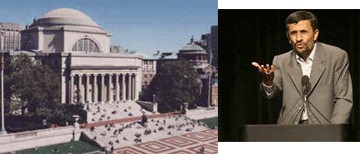
“I am only a professor, who is also a university president, and today I feel all the weight of the modern civilized world yearning to express the revulsion at what you stand for. I only wish I could do better.” Columbia University President Lee Bollinger to Iranian President Mahmoud Ahmadinejad, 24 September 2007

Back in the dark days of the American “culture wars” of the 1990s, I read a surprising newspaper column on higher education by a well-known conservative writer–I can’t remember whether it was George Will or Joseph Sobran. Since both of them usually made me shudder, I was surprised to agree quite wholeheartedly with an argument he was making about the nature and content of college education. Colleges, he wrote, should not offer students courses on popular culture. Not because popular culture is necessarily evil or degenerate, but because this (the content, if not the analytical position) was something they could get from the market. Works by and talk about Madonna, the Ramones, and, even then, the Simpsons, are things students receive daily in their cars and their apartments and from their friends. What a university education should offer students is precisely what is not normally available in the broader world, what they cannot get on the open market: Shakespeare, Moliere, general relativity, the history of Polish nobility in the 16th century. None of these topics can be researched or taught or sustained as bodies of knowledge without subsidy. The market can provide us with the lovely Gwyneth Paltrow in Shakespeare in Love, but not with Shakespeare himself (the exceptions–Kenneth Branagh’s Henry V, Baz Luhrmann directing the extraordinary Claire Danes in Romeo and Juliet, and a few others–prove the rule. They were successes precisely because they were so rare and so surprising). All of what we think of as high culture, from symphony concerts to sculpture, depends on financial support from foundations and governments and wealthy individuals to support its performance and availability (the fact that we can still buy Shakespeare’s plays in bookstores is due entirely to the fact that the market for his work is supported by his forced consumption in high school and college classes). Continue reading The Courage of Professor Bollinger

Creative Reckoning Today

[Note: If you are in the New York Metropolitan area, you may be interested in a lecture by Jessica Winegar at Alwan for the Arts this evening.]

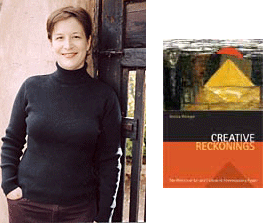
Creative Reckoning: The Politics of Art and Culture in Contemporary Egypt Creative Reckoning

Book Reading by Jessica Winegar

Tuesday, September 25, 2007 7 PM

Free and open to the public

Refreshments will be served

Creative Reckonings: The Politics of Art and Culture in Contemporary Egypt (Stanford University Press, 2006) is an ethnographic study of the intense debates over cultural authenticity and artistic value that occur in a postcolonial society undergoing market liberalization. Based on 33 months of fieldwork in Egypt, the book examines the creation, circulation, and commodification of art in the context of a globalizing cultural economy. Continue reading Creative Reckoning Today

Yemeni Tribes as Social Entities

Tribes should be social entities not political participants, says al-Dhaheri

Reported by Zaid al-Alaya’a, Yemen Observer, Sept. 22, 2007

Dr. Mohammed Mohsen al-Dhaheri, chairman of the Political Sciences Department at Sana’a University, spoke with the Yemen Observer about the contemporary role of tribes in the governance of Yemen and the conflict between the traditional and modern authorities. He is the author of two books about the socio-political relationship between the tribes and the state in Yemen.

Yemen Observer: What do you think of the newly established National Solidarity Council, and what do you think prompted its establishment?

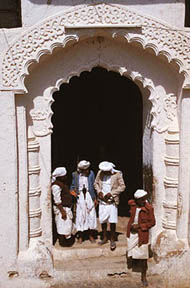
Dr. Mohammed al-Dhaheri: First, I would like to say that this is what we can call political meddling. Tribes in Yemen have certain mechanisms to demand their rights. For example, some tribes will block highways or kidnap foreigners to add urgency to their demands. I can not put this council in the frame of a tribal bloc. It is can not what I would call a tribal council nor is it a partisan council. You can see that politicians meet with the sheikhs and with the academics. The council represents a period in tribal meetings that Yemen has not witnessed before. You can not call it an opposition entity as it has many members from the GPC, and academics etc. As you see there is a sort of dichotomy that starts to prevail in Yemen. This council has encountered other gatherings from tribes led by Sheikh al-Shaif. Continue reading Yemeni Tribes as Social Entities

The Mess in Mesopotamia


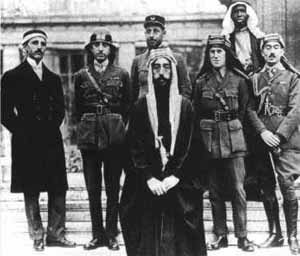
King Feisal, center, with Colonel Lawrence next to him to the right


[Given the surge in bad news from Iraq these days, it may be useful to reflect on the assessment of the British involvement in Iraq as a mandate almost nine decades ago. The words of T. E. Lawrence resonate with the situation today.]

22 August, 1920
A Report on Mesopotamia by T.E. Lawrence
Ex.-Lieut.-Col. T.E. Lawrence,
The Sunday Times, 22 August 1920

[Mr. Lawrence, whose organization and direction of the Hedjaz against the Turks was one of the outstanding romances of the war, has written this article at our request in order that the public may be fully informed of our Mesopotamian commitments.]

The people of England have been led in Mesopotamia into a trap from which it will be hard to escape with dignity and honour. They have been tricked into it by a steady withholding of information. The Baghdad communiques are belated, insincere, incomplete. Things have been far worse than we have been told, our administration more bloody and inefficient than the public knows. It is a disgrace to our imperial record, and may soon be too inflamed for any ordinary cure. We are to-day not far from a disaster. Continue reading The Mess in Mesopotamia

Lebanon is Laid Waste

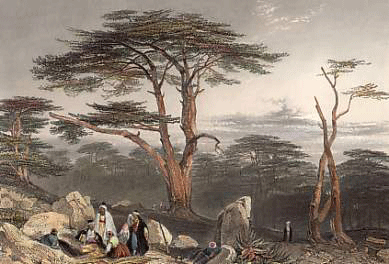
[The Cedars of Lebanon, steel engraving by J. D. Harding after C. Barry, 1835]

Lebanon is laid waste.
I need no bible-toting prophet to remind me
that someone’s long silent God gave the order
to saw through the last cedars.

The litany of woes crosses the Litani
but no bridge is left behind to burn,
just the kindling of ersatz-born leaflets that first say “Flee”
then demand “Stop,”
but really mean “Do not breathe, we own the air.” Continue reading Lebanon is Laid Waste

The Letters of Badr Shakir al-Sayyab: #4

[Note: This is the fourth in a series of translations of selected letters of the noted Iraqi poet Badr Shakir al-Sayyab.]

Letter #4 (3/25/1954)
The Directorate of Imported Funds, Baghdad, Iraq

My Kind and Respected Brother, Dr. (Suheil) Idres,

Sweet greetings to you.

The kind letter that you sent me has had a deep effect on my soul. It bears witness anew to the nobility of your spirit, the vastness of your heart, and the sincerity of the pledge that you have assumed in the service of the Arab community and its literature which is advancing towards the light. I have made an elite group of friends, writers, and lovers of literature aware of your letter so they are informed of the biased uproar that a group of “preachers” have attempted to create.

It appears that Divine Justice has wished numerous, simultaneous events to occur so that the truth could become evident. Your letter to me and to our brother, Kathim (Jawad), arrived at the same time that the magazine, al-Adeeb, came out displaying a photograph of the “Preacher of Modern Poetry.” “The preacher” had dedicated the photograph to “the great poet, Albert Adeeb!!” This appeared along with a discussion on the great international poets such as Nathem Hikmat, Pablo Neruda and Aragone!! Is there more falsehood than this? Continue reading The Letters of Badr Shakir al-Sayyab: #4

Keane on Mecca


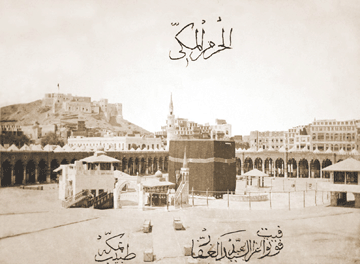
[Illustration: The ka‘ba in Mecca during the period of Ottoman Sultan Abdulhamit II.]

[Editor’s Note: As the holiest location in the Muslim World, the Arabian city of Mecca is prohibited territory for any non-Muslim. Over the years a number of travelers disguised themselves and visited the sacred enclosure of the ka’ba, most notably Johann Ludwig Burckhardt (1784-1817), who made his overture in 1812, and Richard Burton in 1853. In 1877 an Englishman named John Keane entered Mecca. His travel account is available online. Here is the story of that surreptitious visit, as told by Robin Bidwell.]

John Fryer Keane was the son of a clergyman and had run away to sea at the age of twelve. He spent most of the next nine years among Muslims, mainly as an officer on ships with Indian crews. He arrived at Jedda, attached himself to the suite of an Indian prince and after six weeks in Mecca felt as completely at home as if he had been there all his life. No one commented upon his fair skin for, as he said, the visitors were so varied that it looked like Madame Tussaud’s out for a walk and the spectacle of the Archbishop of Canterbury in a mitre would really have caused no comment. He wandered around happily, peering in through a school window to see the boys having the soles of their feet beaten in batches of five and chattering with a Muslim lady who, as Miss McIntosh, had been taken prisoner during the Indian Mutiny.

He was deeply impressed by the religious sincerity of the pilgrims and the deep spirituality that it engendered, but he cared much less for the resident population. Continue reading Keane on Mecca